.svg)
%2Bcopy.jpeg)

%203%20(1).jpg)
.svg)

.png)

E-bikes occupy an odd place in the United States, a sort of Schrödinger's two-wheeler if you will. On one hand, they’re hugely successful, shifting millions of units. But, on the other, their penetration is slightly disappointing in the context of the size of the country.
Both these things are true — so let’s have a quick look at what’s going on, and how this question may be solved once and for all.
What’s going on with e-bikes in the United States
As noted, the rise of e-bikes in the U.S. has been miraculous in its own way. In 2012, there were only 70,000 of them sold in the country, but ten years later, one million e-bikes were shipped out. It’s hard to argue that this isn’t a success story.
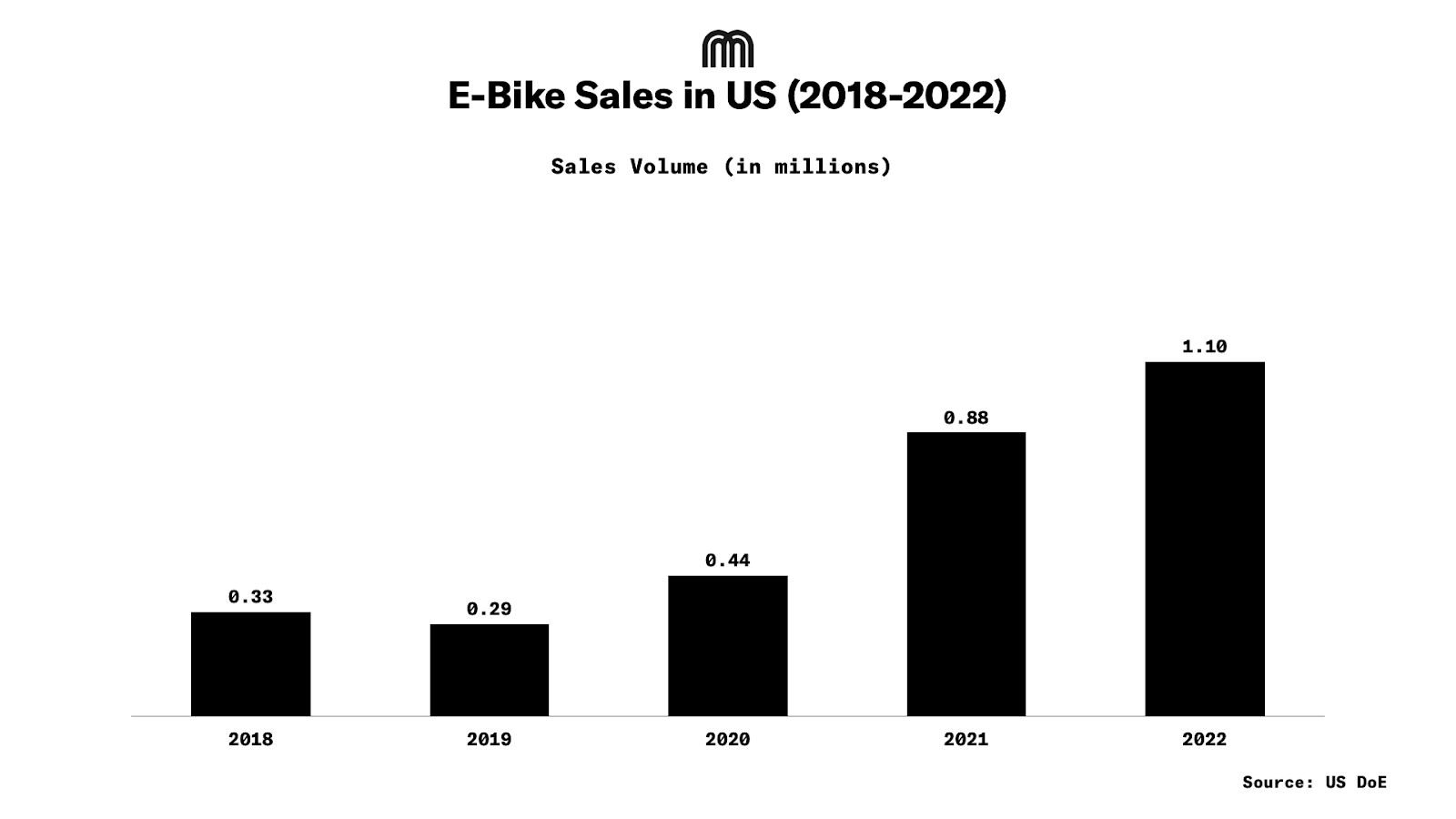
The period also saw e-bikes becoming an increasingly key part of the U.S. bike market as a whole, accounting for about 30% of total bicycle revenue in 2024. Financially, this represented $1.63 billion out of a total $5.1 billion. Direct-to-consumer (DTC) channels dominated e-bike growth, with roughly 450,000 units sold through these channels.
So far, so good. By all metrics, these are positive signs. The problem, though, is when you start to compare this to other parts of the world.
Although it’s tough to find ultra-specific numbers, it’s been estimated that around 1.7 million e-bikes were sold in the United States in 2024. This might not be entirely accurate, as the researchers themselves said it was an optimistic look at the data, based more on the number of imported vehicles, rather than sales figures.
Other sources place the figure lower, with the PeopleForBikes impact report estimating around 920,000 e-bikes shifted in the country in 2024. Whichever of these figures we take, it’s pretty clear that the US is substantially lagging behind Europe.
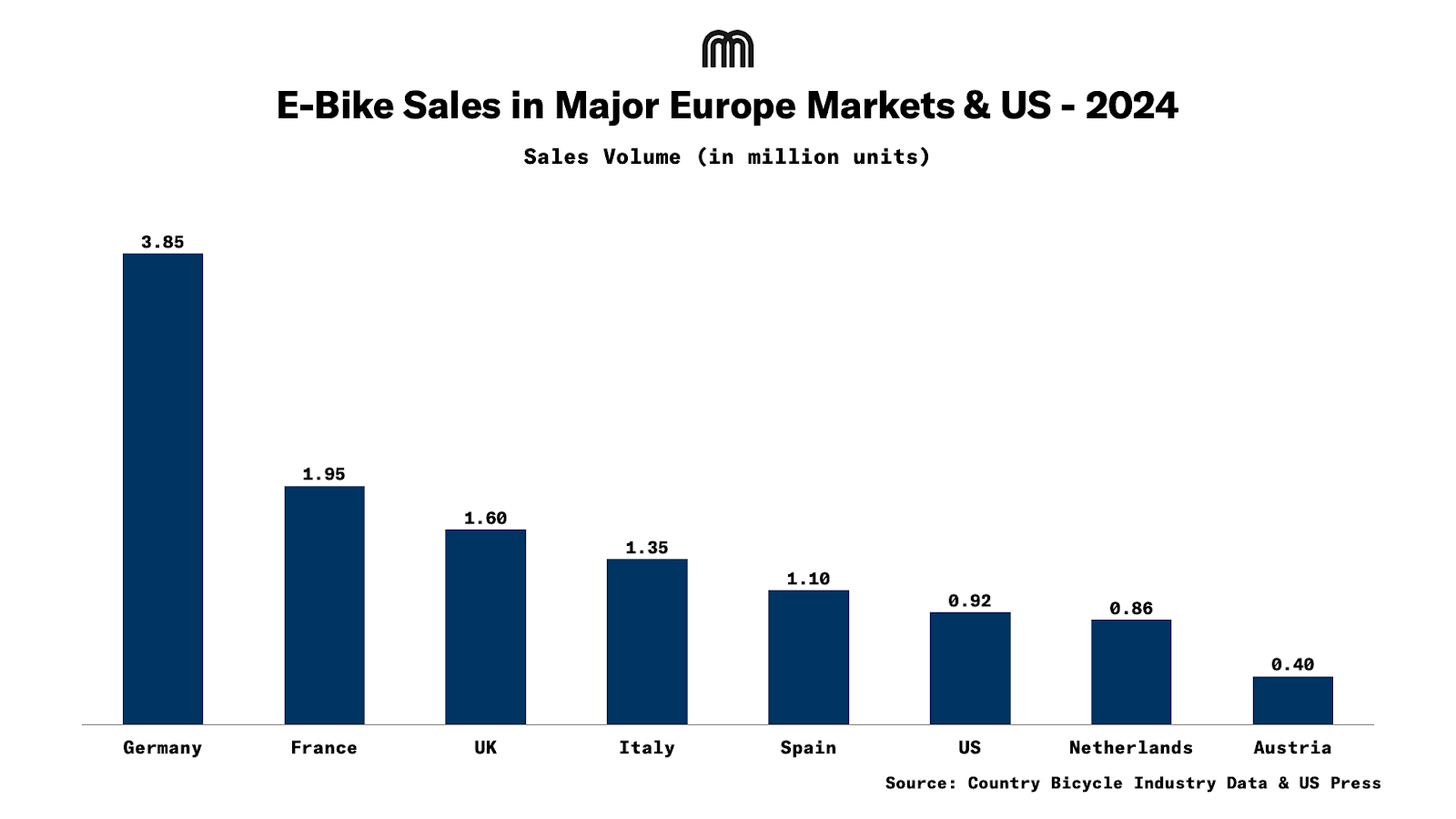
Even if we took the higher estimate of 1.7 million, this is about the same as the UK, a country with roughly one-fifth of its population. Germany and France — countries also with much lower populations — far outstrip the United States.
The e-bike market is successful, but not that successful. So what’s happening?
The cultural question
The first thing that may spring to mind is the geography and culture of the United States. Which, while important, doesn’t tell the full story.
It almost goes without saying that the U.S. is huge. Although it’s roughly the same size as Europe, it has a much lower population density. Important, sure, but despite the huge swathes of rural land, U.S. cities are directly comparable to European ones when it comes to density. Around 80% of Americans (roughly 265 million) live in urban areas, so there’s undeniably a large market that could be targeted by e-bikes.
This is where culture comes into play. The United States is the birthplace of the modern car and, as such, still retains a car-first approach to much of its city design — and this means fewer bike lanes.
Although it’s tough to get exact figures on the length of bike lanes, the United States Bicycle Route System (a collection of long-distance cycle lanes) stretches 30,502 km across the country. In comparison to this, the Netherlands alone has 37,000 km of cycle lanes.
We’ve written before about the importance of bike lanes in making people feel safe when cycling which, in turn, increases how regularly people use this form of transportation. And the U.S. is lagging behind.
While all this plays a role in e-bike adoption, there’s another vital cog in this puzzle: regulation.
Regulatory landscape
To put it bluntly, the setup of e-bikes in the US is a mess. There isn’t a huge amount of crossover between states, although the three-class system has been adopted by 43 states, which categorises the vehicles as such:
- Class 1 (Pedal-Assist): The motor only kicks in when you pedal and stops helping when you reach 20 mph. These are generally allowed anywhere traditional bicycles are allowed.
- Class 2 (Throttle-Assist): These feature a throttle, meaning the motor can power the bike even if you aren't pedaling. The motor cuts off at 20 mph.
- Class 3 (Speed Pedal-Assist): You still have to pedal to get a boost, but the motor continues helping until you reach 28 mph. Because they are faster, states often ban them from standard multi-use trails and require riders to be at least 16 years old and wear a helmet.
Despite this, there is still enough variance between where you can ride e-bikes, age limits, helmet requirements, and registration rules that resources like this exist. Even in unified states, it’s not that unified.
The fragmentation gets even deeper. For example, Alaska and Hawaii impose motor vehicle-style rules on e-bike riders, requiring operator's licenses, and vehicle registration. What this means is that owning an e-bike becomes an administrative issue, especially if you move between areas.
Finding a new lane
The goal of the United States should be in simplification. There has already been some work done to make e-bike law easier to parse, and it’s no surprise that this coincided with the vehicles becoming more popular.
What marks it out is how much simpler owning a car is in America. Although there are differences in driving laws across the country, it’s a far more joined up approach. When you buy a car in one state, the likelihood is that you can use it in much the same way in another.
For the United States to take e-bikes to the next level, it must join up the disparate dots. Not just on the state level with cycle lanes, but also on a federal level with regulations.
The country doesn’t need to be a Schrödinger's two-wheeler market, it can simply be a thriving e-bike one instead.
Image credits: Aventon