.svg)
%2Bcopy.avif)

.svg)

.jpg)


.jpg)
%20(1).jpeg)
.jpg)
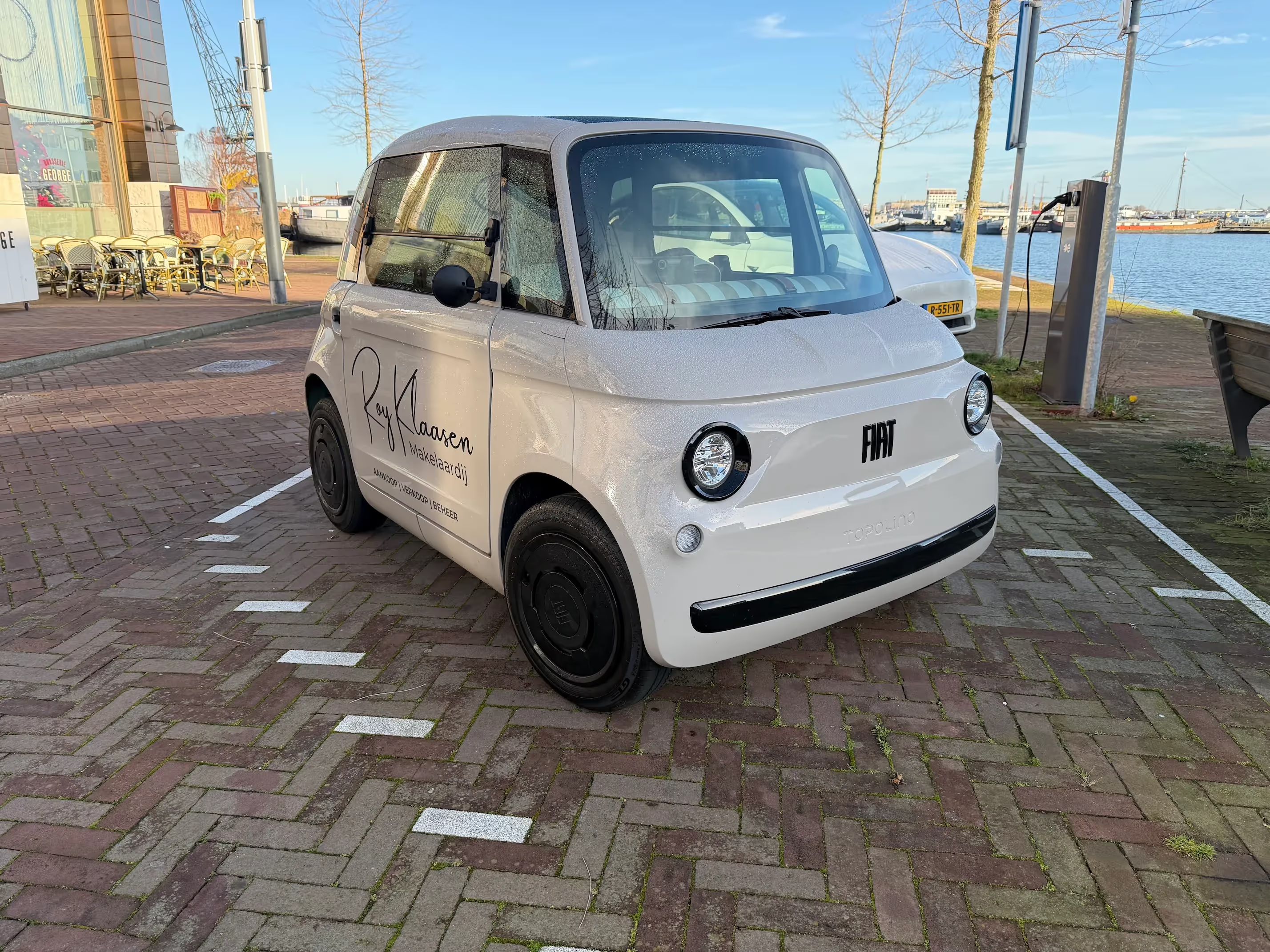
Microcars are a favourite topic of mine. There are a few reasons why: it’s their futuristic and retro aesthetic; it’s the fact I live in the Netherlands and they’re everywhere; and it’s also because I believe they’re a vehicle that could be perfect for huge swathes of the population.
Basically, to quote Marge Simpson, I just think they’re neat.
The thing is, though, actually defining a microcar is easier said than done. Of course, there’s the Justice Potter Stewart test (“I know it when I see it”), but the reality is murkier.
Just take the Netherlands for example. When microcars took off in the country, they weren’t officially classified as any sort of car. Instead, they qualified as mobility aids. What this meant is that they followed roughly the same rules as bicycles, giving them access to bike lanes and the ability to park pretty much anywhere.
Eventually, when they became too popular and began to be a nuisance in this environment, the Dutch government changed the classification of certain popular microcars (like the Birò) from being mobility aids to mopeds. And that, in a sense, sums up microcars. We might think that they’re just small cars, but the technical and regulatory reality is different.
In this piece, then, we’re going to have a little look at how microcars are defined and regulated across the globe, to try and answer a simple question: what actually is a microcar?
European quadricycles
As we were discussing the Netherlands, it makes sense to begin in Europe. Effectively, the EU classifies microcars as quadricycles.
What this means in practice is that they don’t have to fulfill the same safety standards as regular cars, meaning they don’t have to adhere to crash test regulations in the same way as their bigger cousins. In the EU, quadricycles are split into two categories:
- Light Quadricycles (L6e): These have a top speed of 45 km/h (28 mph), a maximum weight of 425 kg (937 lbs) excluding batteries, and a maximum power output of 6 kW (8 hp). In many European countries, these can be driven by teenagers (often starting at age 14 or 16) without a full driver's license. The Citroën Ami is a well-known example.
- Heavy Quadricycles (L7e): These can weigh up to 450 kg (992 lbs), and have a maximum power output of 15 kW (20 hp). The big difference is that a full driving license is normally needed to operate them.
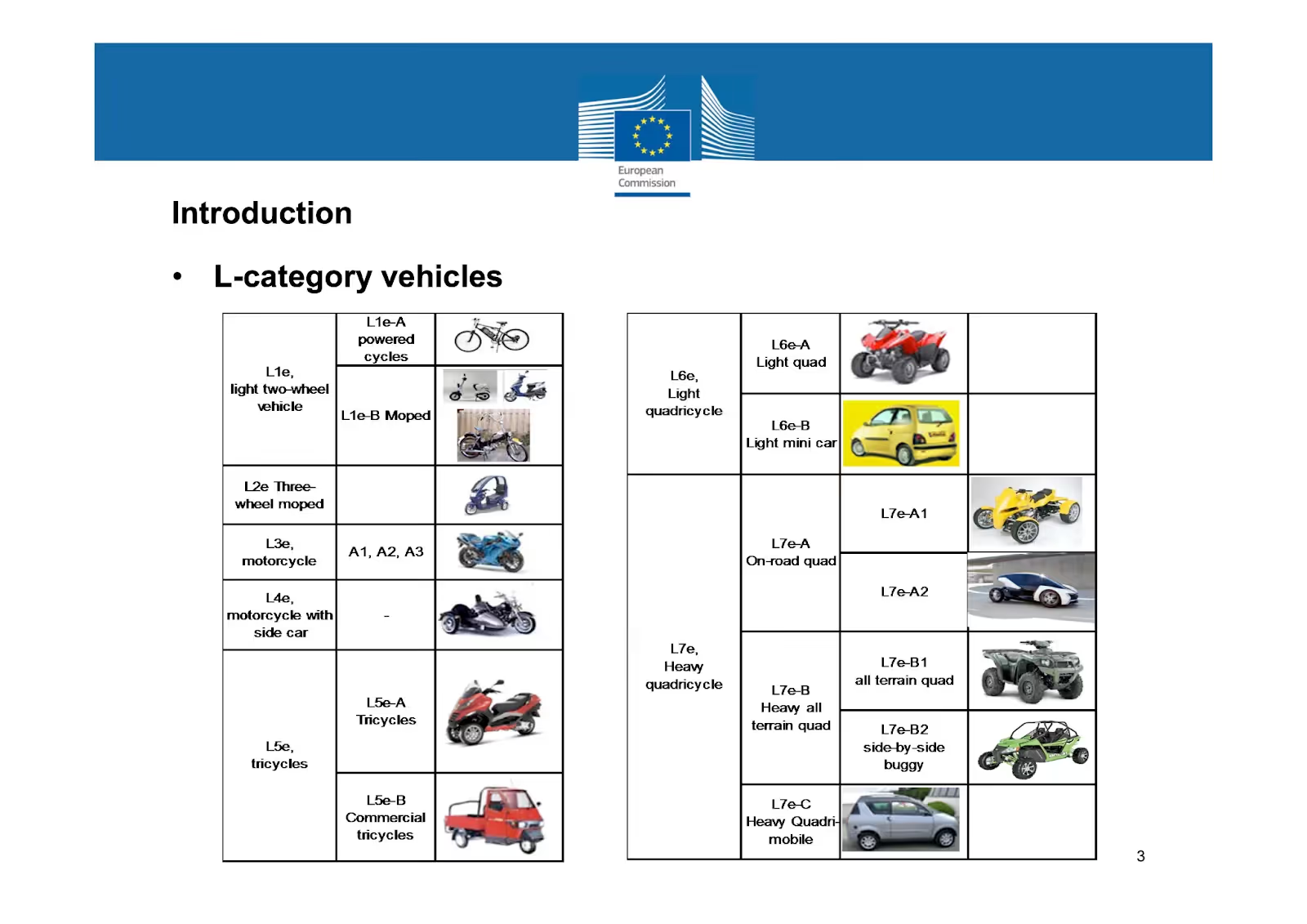
Although there is of course a Europe-wide consensus on the categorisation of the vehicles, what is different is how countries handle who can actually drive them. For example, in France it’s possible to drive one when you’re 14 and, if you’re born before 1988, you don’t need a driver’s license to operate a microcar. Meanwhile, in Finland, the lowest age limit is 15.
Japan and “Kei cars”

Japan is another fascinating market when it comes to microcars. In the country these are known as “Kei cars,” or Keijidōsha. These are a specific class of small vehicles, and to be considered one they must meet these maximum dimensions:
- Engine: No larger than 660cc
- Length: Maximum of 3.4 meters (11.2 ft).
- Width: Maximum of 1.48 meters (4.9 ft).
- Power: 63 horsepower.
Cars that meet these definitions are given a specific number plate that’s yellow with black text.
They were originally designed to help citizens afford cars after the Second World War, and are supported heavily by the government. This means owners pay less tax and insurance on the vehicles.
And they’re popular. Incredibly so. Kei cars made up 38% of the Japanese market in 2024.
Honestly? If the rest of the world wanted to embrace smaller vehicles, they could do much worse than looking at how Japan managed it.
Still, when you look at the comparison between quadricycles in Europe and Kei cars in Japan, there’s not a huge amount of statistical crossover.
The US and Canada’s "Neighborhood Electric Vehicles"

Once again, what’s interesting is that microcars don’t really exist in the US and Canada. Well, of course, they do, but they’re not technically called that. Instead, the legal classes of microcars are either as a Low-Speed Vehicle (LSV) or a Neighborhood Electric Vehicle (NEV).
To be legally driven on public roads, an LSV must meet Federal Motor Vehicle Safety Standard (FMVSS) 500, which mandates:
- The vehicle is physically capped at a top speed of 20 to 25 mph (up to 40 km/h)
- LSVs can only operate on public roads with posted speed limits of 35 mph or less.
- Although they don’t need airbags or to pass structural crash tests, they must have three-point seatbelts, windshields, headlights, taillights, turn signals, mirrors, and a 17-digit Vehicle Identification Number (VIN)
In comparison, an NEV is a type of LSV powered by electricity
Again, these are microcars, but subtly different from the regulations found in Europe and Japan. Interestingly though, there’s a loophole that some North Americans take advantage of when it comes to these vehicles.
Under US federal law, any vehicle older than 25 years is classified as a "classic" and is exempt from standard safety and emissions testing. This means you can legally import, say, a 1990s Japanese Kei car through US Customs and drive it normally. Of course, just because the federal government allows this, doesn’t mean the state does — and some have actually banned the vehicles.
So… what is a microcar?
There are probably two answers to this. The first, and slightly glib one, is that it’s a small car. The second response to what a microcar is: it depends on where you are.
Maybe it’s the power of the passenger car market, maybe it’s because microcars are in an awkward middle ground, but looking at how different countries regulate the vehicles it’s clear that there should be some effort to standardise the machines globally.
Microcars are perfect for short journeys, especially in urban environments, with one of the few negatives being their expense compared to, say, e-bikes. But if the world is able to regulate them uniformly, then prices should come down.
Until then… what actually is a microcar? At the moment, it’s a lot of different things.