After 23 Years of Growth, Brompton's Revenue Slides Again!

Team M
News
February 26, 2026

Subscribe

Welcome to Micromobility Pro, a bi-weekly publication which is part of The Micromobility Newsletter, where we deep-dive into the financials of micromobility companies and share exclusive insights tailored for professionals and members.

Hurry! Early Bird Sale Ends in 2 days!

If you’re reading this… it’s a sign.
(And sure, technically you subscribed - but let’s go with destiny 😉)

Berlin is calling! Micromobility Europe 2026 is planned for June 2-3, where the passionate folks shaping the future of urban mobility actually meet. Two days of talks, hands-on demos, and conversations that could spark your next big idea and make all vision to reality!

Last chance to get your Early Bird tickets at €375 and it expires on 28 February. Grab your spot and join the movement. Will you be there?

Get Your Ticket

Join McKinsey, Rivian’s ALSO, Lyft, Dott, NextBike, POLIS, Urban Sharing, Navee, CityFi, Valeo, XYTE, Vmax and many others!

[Sponsor/Exhibit] | [Speak at the Event] | [Exhibit as a Startup] | [Get A Free Pass]

And to find all about Micromobility America | Nov 11-12 | Palace of Fine Arts, SFO - HERE! (Limited Launch Tickets are on sale at $199)

Contents

  • About Brompton
  • History
  • Operations
  • Electric Bike Expansion & Smart e-Motiq System
  • Market Shifts
  • Ownership Structure
  • 2025 Financial Performance
  • Chart: Revenue & Net Loss (2020-2024)
  • Bike Sales and Product Mix
  • Chart: Yearly Bike Sales
  • Chart: Average Revenue Per Bike
  • Revenue Breakdown by Region
  • Chart: Revenue Split by Region
  • Cost Structure, Margins and Investment
  • Table: P&L Snapshot
  • Cash Position and Financing
  • Table: Balance Sheet Snapshot
  • Conclusion

About Brompton

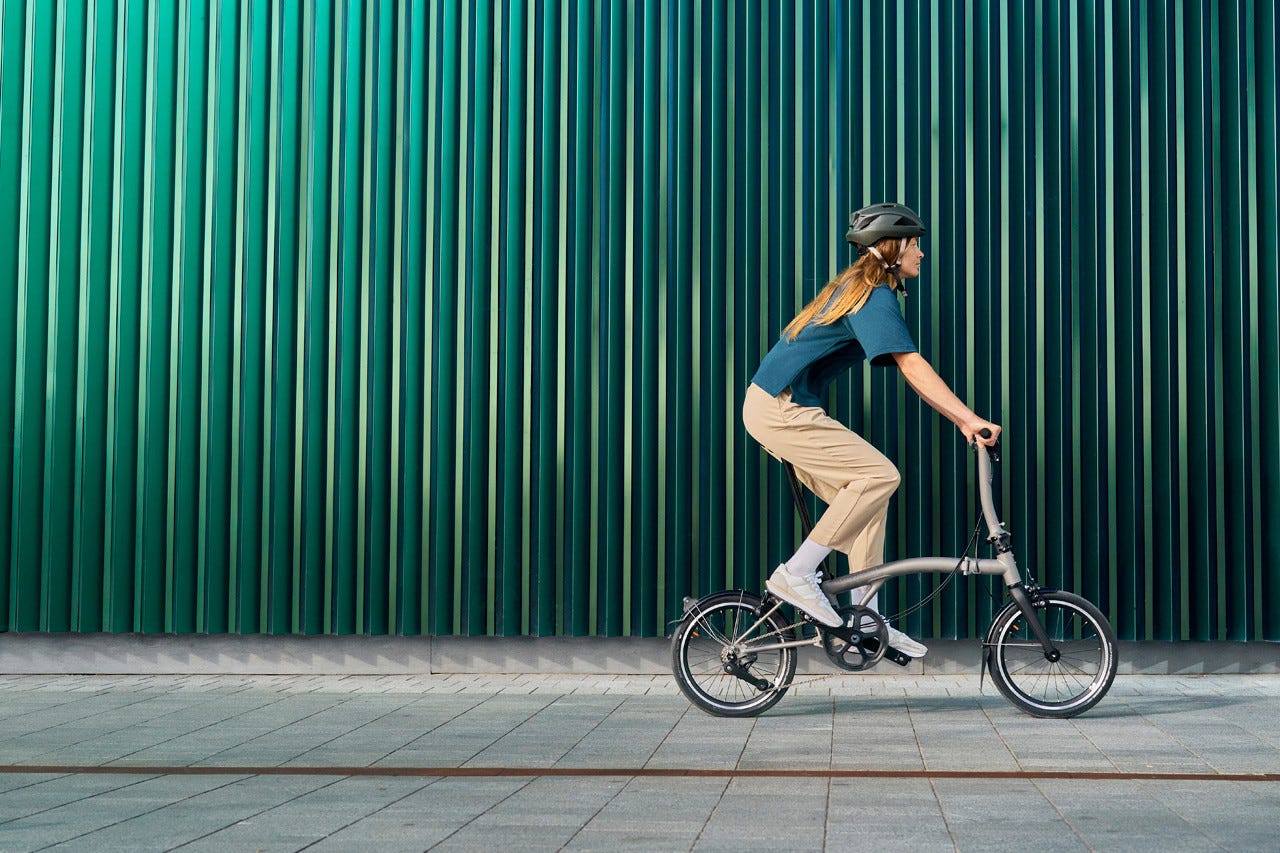
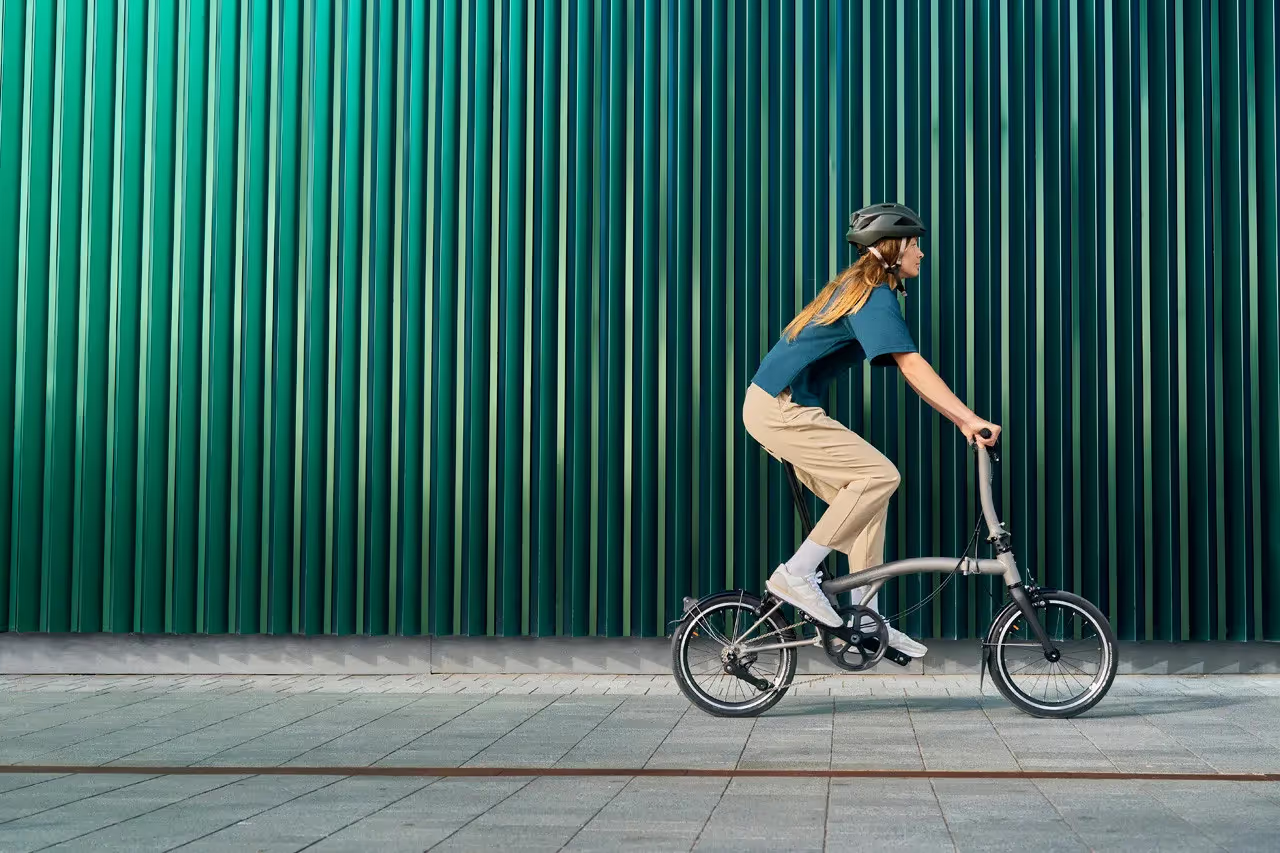
Image Credits: Brompton

Brompton Bicycle Limited designs, manufactures, and sells folding bicycles and related products. The company is based in Greenford, London, UK, and sells globally through distributors, subsidiaries, retail partners, and direct-to-consumer channels, including e-commerce.

Brompton’s stated purpose is “to create urban freedom for happier lives,” emphasizing practical, high-quality transport solutions that help people move around cities with ease. The company is also a certified B Corporation, reflecting a commitment to social and environmental responsibility alongside business performance.

As the UK’s largest bicycle manufacturer, Brompton is best known for its compact folding bikes, which are popular with commuters and urban riders worldwide.

History
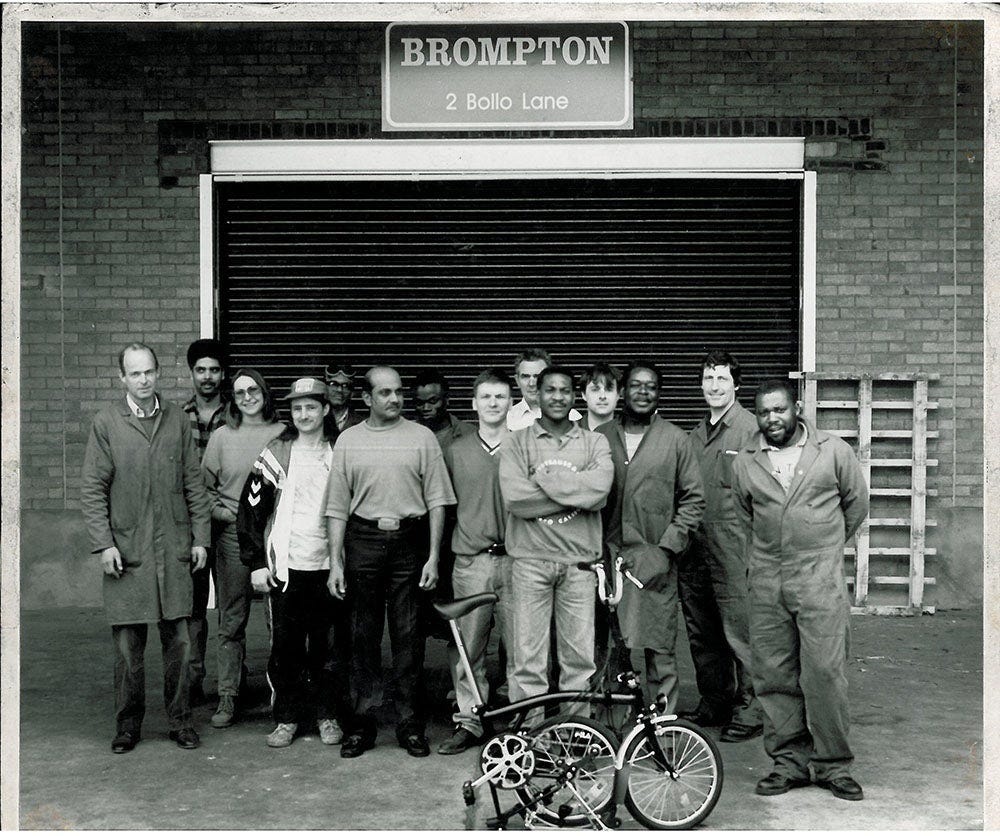
Brompton’s origins go back to 1975, when engineer Andrew Ritchie began designing a folding bicycle in his London flat overlooking the Brompton Oratory. He aimed to create a bike that folded easily, travelled well, and could go anywhere a person needed to be in a city. Over the next decade, he refined this design by hand, building prototype bikes in a small workshop.

In 1987, after many years of independent development and repeated rejections by banks and industry players, the Brompton folding bike won Best Product Award at the Cyclex Bike Show in London. This recognition helped spur wider production and interest.

The first Brompton factory was set up in railway arches in Brentford, West London, where the team handmade around 60 bikes per month. By 1991, Brompton had 56 outlets in the UK and an even bigger export market.
The company entered a new phase of global expansion in 2011 with the opening of its first Brompton Junction retail store in Kobe, Japan, marking a stronger direct-to-consumer presence outside the UK. In recent years, Brompton has focused on technical evolution, including lightweight materials, electric folding bikes, and the launch of the T Line in 2022, the lightest Brompton ever produced.

Operations

Brompton designs, manufactures, and sells folding bicycles, parts, and accessories. It reaches customers through retail partners, distributors, franchise arrangements, subsidiaries, and direct-to-consumer channels, including e-commerce.

In addition to bicycle sales, Brompton Bike Hire operates in the UK, with 79 docking locations and approximately 1.3k bicycles, supporting shared urban mobility initiatives.

During the year, the Group employed an average of 790 people globally. The workforce breakdown was as follows:

  • 404 in manufacturing and distribution
  • 319 in administration
  • 67 shop assistants

During FY2025, Brompton continued to invest in new product development and range expansion, with capitalised development costs relating to products launched during the year. These initiatives support a strategic focus on innovation and higher-value product categories.

Electric Bike Expansion & Smart e-Motiq System
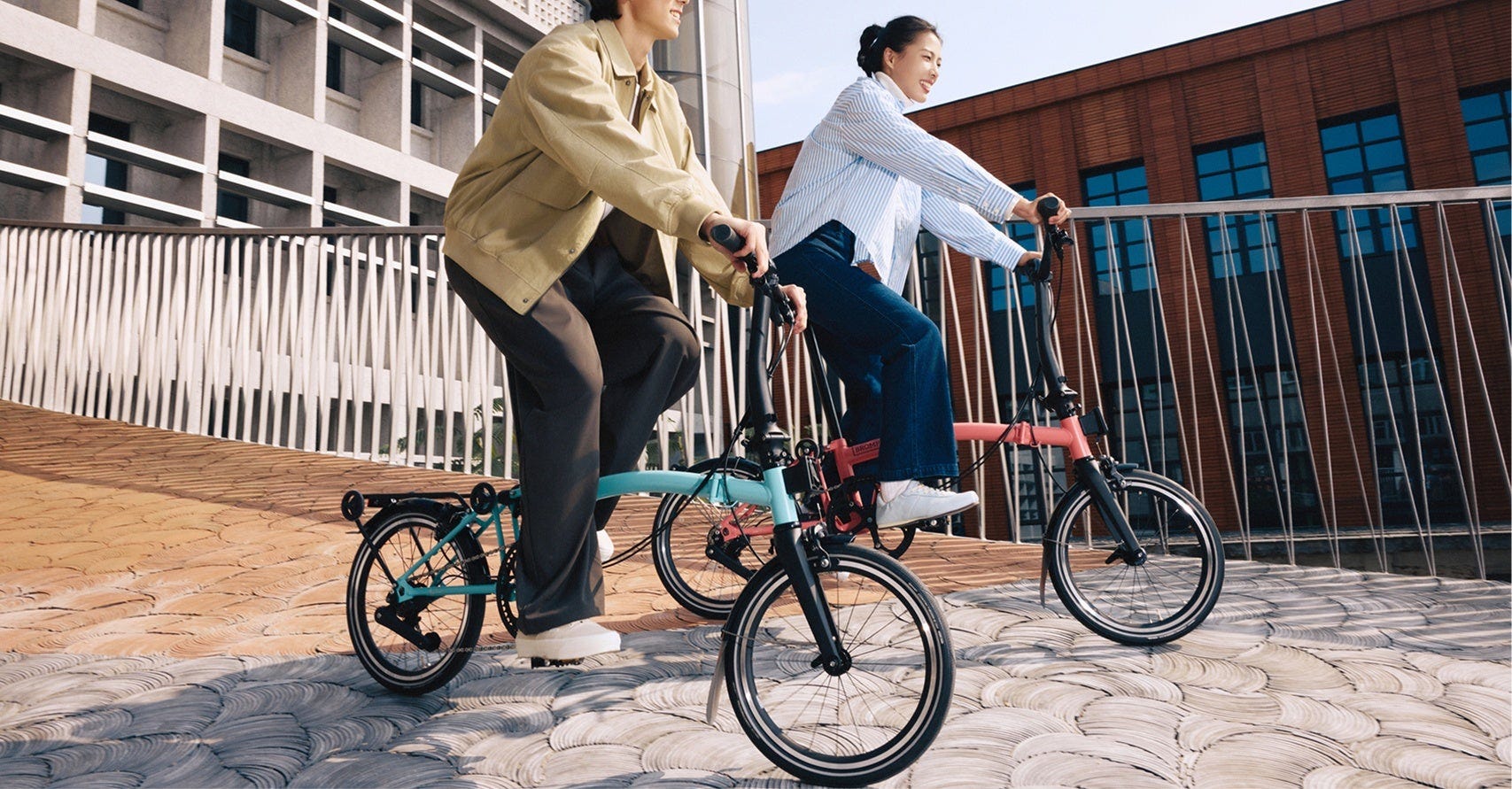
Brompton has significantly expanded its electric bike lineup with a family of models built around its e-Motiq electric drive system, a smart, integrated rear hub motor and battery platform designed from scratch in the UK. Recent launches include:

  • Electric T Line: a lightweight, fully-electric folding bike weighing around 11.2 kg without battery and ~14.1 kg with battery. It features advanced materials such as titanium alloy and carbon fibre and the new e-Motiq smart system, which offers natural power assistance, walk assist, and start assist modes, plus OTA (over-the-air) software updates and up to 90 km of range on a single charge.
  • Electric G Line: a comfort-focused electric variant with ergonomic features, improved shock absorption tyres, and the e-Motiq system. Launched across the UK and European markets, the model has performed strongly, contributing approximately 9% of total sales by volume (6.7k bikes) and 9.8% of Group turnover (around £12m), highlighting its early commercial success.
  • P Line Electric: another e-Motiq-equipped model with a 345 Wh removable battery and up to 90 km of range, torque-sensing ride assist, and smart connectivity.

Alongside its electric expansion, Brompton has continued to develop its non-electric product range through limited and special-edition releases. This includes Tour de France-themed C Line and P Line models, launched ahead of the 2025 Tour de France, featuring race-inspired colorways and graphics produced using advanced sublimation printing techniques. While these editions are non-electric, they form part of Brompton’s broader strategy of range diversification, premiumization, and brand storytelling, extending the appeal of its folding bikes beyond pure commuting into wider cycling culture and lifestyle segments.

Market Shifts

Amid geopolitical trade tensions and ongoing tariff uncertainty in the U.S., Brompton has recalibrated its global retail strategy. While the company has scaled back direct retail expansion in the US, allowing branded stores to close as leases expired, it has simultaneously accelerated investment in China, which it views as a more stable and predictable business environment.

Brompton now operates a mixed retail model in China, combining company-owned stores with a franchise network. With a 17-year presence, China has become Brompton’s largest market, supported by three company-owned stores and 14 franchise locations, and is considered one of its most strategically important regions.

CEO Will Butler-Adams noted that unpredictable U.S. tariffs make long-term commitments increasingly risky, prompting a more cautious and flexible approach to investment in the American market while reinforcing Brompton’s presence elsewhere.

Risk of Over-Dependence on China

Brompton has aligned its intercompany transfer pricing policies with global standards to ensure compliance and accurate profit allocation. This approach has increased the proportion of profits recognised in the UK. Additionally, Brompton has implemented 30% prepayments on all orders to reduce cash exposure in China. Growth initiatives in other key markets, including Germany, Japan, and the U.S., aim to reduce dependency on China and ensure greater operational and financial resilience.

Ownership Structure

Brompton Bicycle Limited is a private company limited by shares, registered in England and Wales. The company has ordinary shares and Class A ordinary shares.

In an earlier funding round, Brompton also received approximately £3m from existing shareholders alongside the £16m injection from external investor BGF, helping to shore up the company’s balance sheet and service debt obligations. The Class A ordinary shares were issued to BGF as part of a £16m equity investment. These shares carry different rights, including a 7.5% cumulative preferential dividend payable from 2030, subject to performance conditions. As the directors expect these conditions to be met, no liability has been recognised in the financial statements.

As of March 31, 2025, the issued share capital comprised:

  • 106.12k ordinary shares
  • 9.84k Class A ordinary shares

There is no ultimate controlling party.

FY2025 Financial Performance
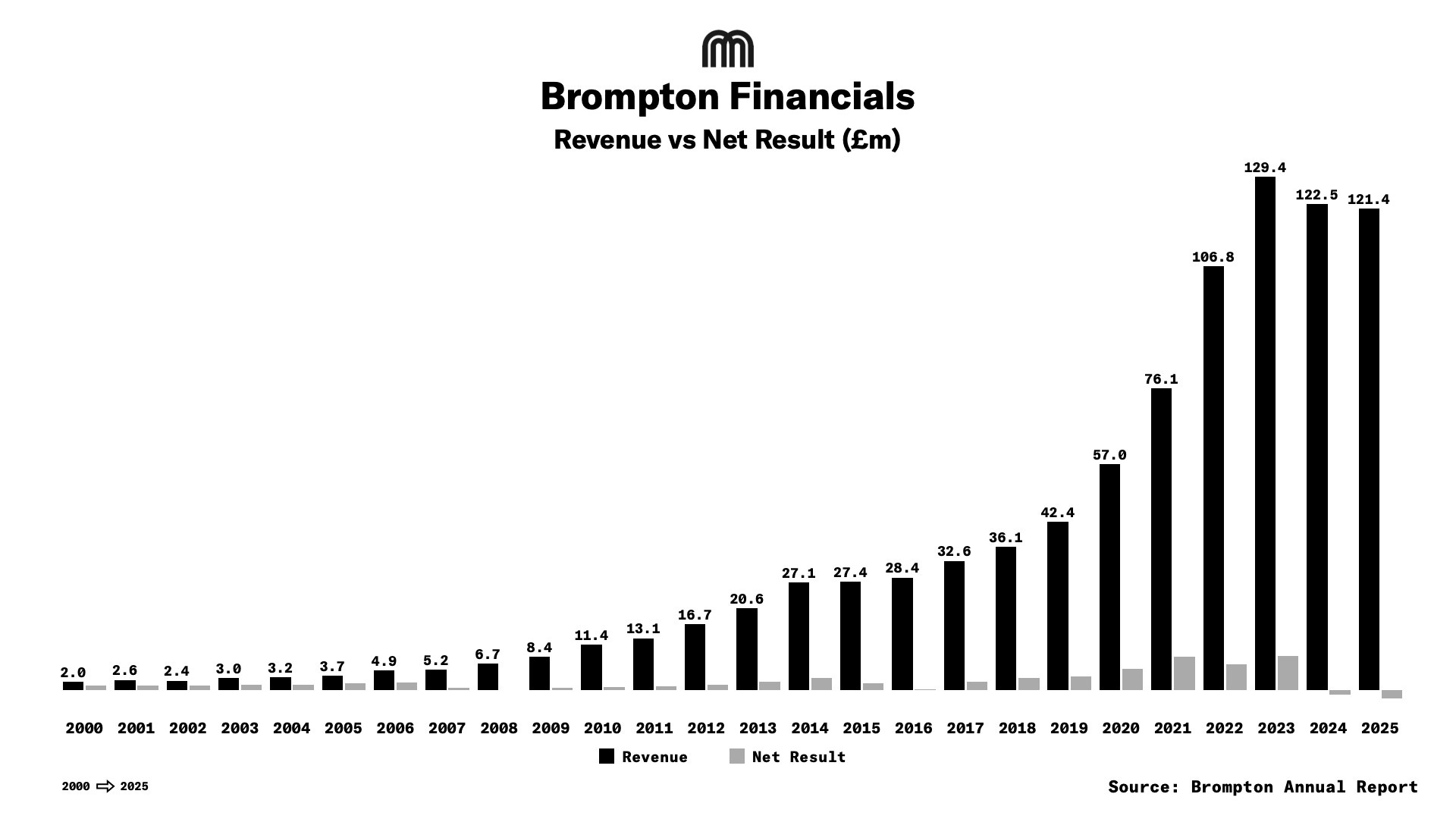
For the year ended March 31, 2025, Brompton reported group turnover of £121.45m, compared with £122.57m in FY2024, representing a marginal YoY decline.

Profit before taxation increased to £130.47k, up from £4.6k in the prior year. This improvement reflects changes in operating performance and cost control, alongside other income and reduced administrative expenses.

Despite the improvement at the pre-tax level, the Group reported a net loss of £2.08m (FY2024: £1.05m loss). This outcome was primarily driven by taxation effects, including deferred tax movements and the treatment of historic losses.

As a result, net assets declined to £60.81m, compared with £65.12m at the end of FY2024.

Also, during the year, the Group paid dividends of £1.36m (£12 a share) (2024: nil). There were 475 ordinary shares issued from the exercise of options during the year. A total of 617 nil-paid shares were also cancelled, resulting in a slight reduction in share capital.

Bike Sales and Product Mix
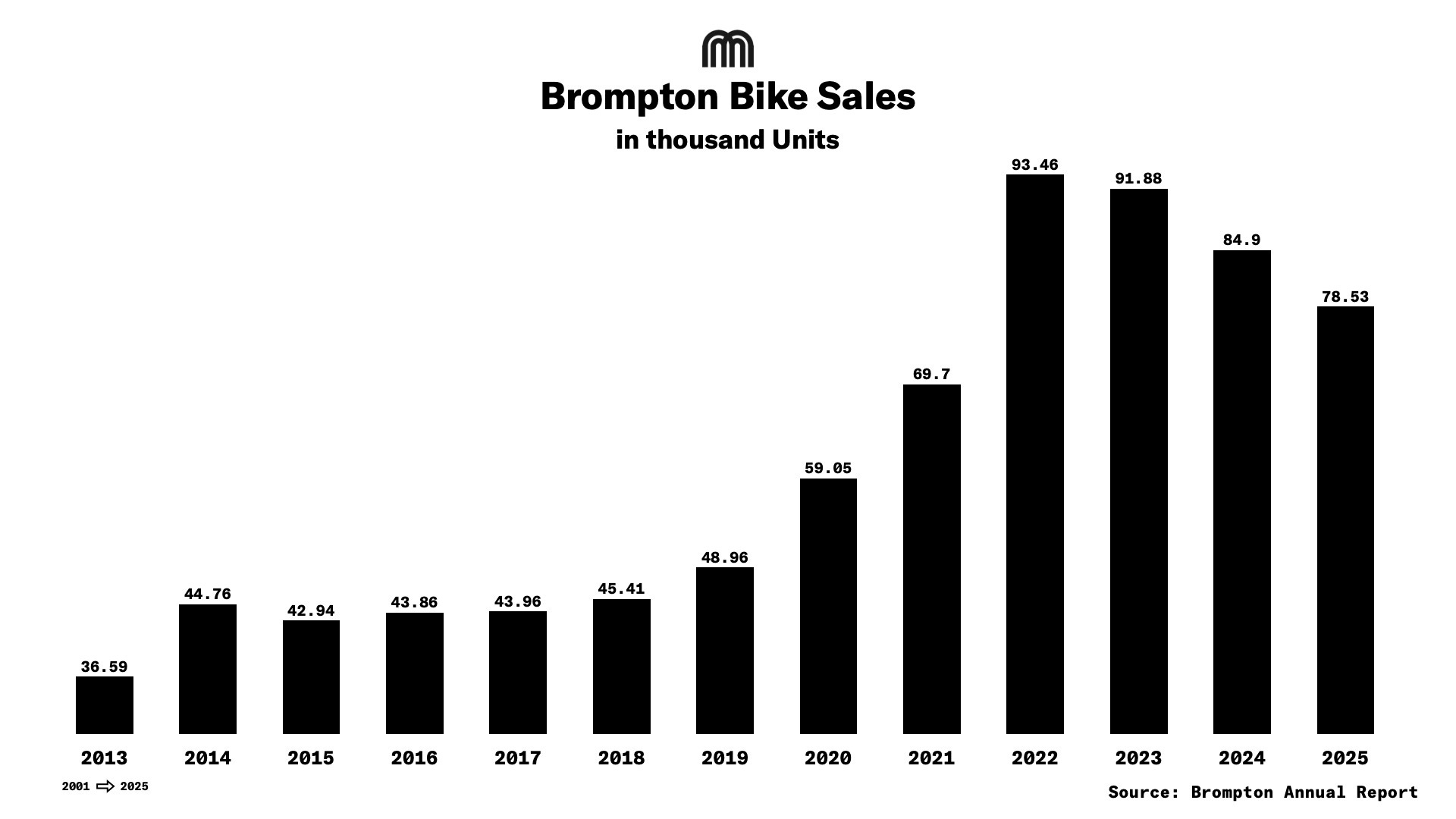
Bike unit sales during FY2025 totaled 78.53k (FY2024: 84.89k), representing a 7.5% decline YoY, driven by wider global economic uncertainty and continued challenges across the cycling industry. Exports accounted for 80% of total bike unit sales, consistent with the prior year.
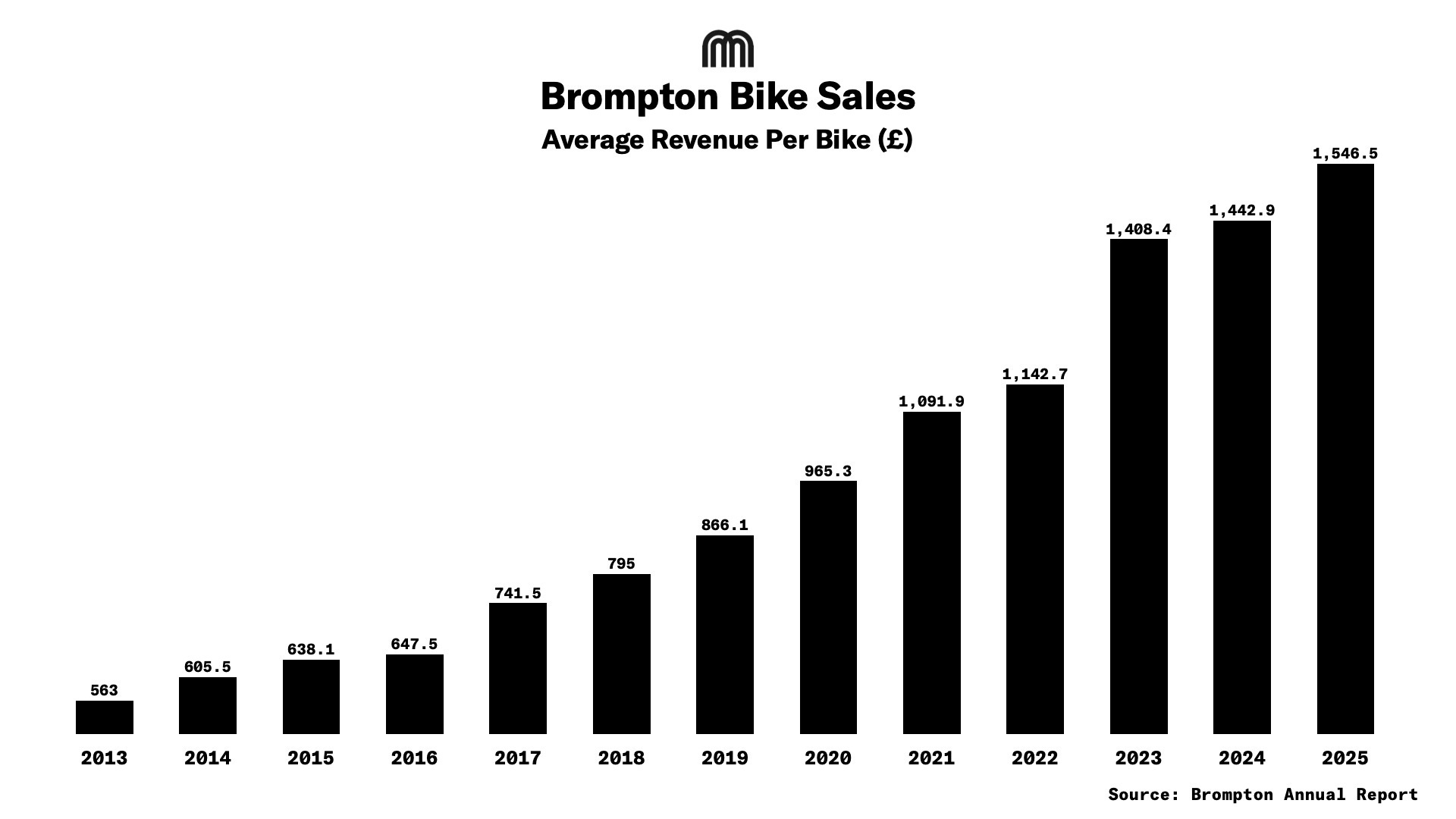
Despite lower volumes, the continued ramp-up of G Line, T Line, and P Line products accelerated a shift toward more premium models in the range. This resulted in a significant increase in average revenue per bike, enabling the Group to largely offset the revenue impact of reduced unit sales.

Sales through direct-to-consumer (DTC) channels, excluding franchises, remained broadly in line with the prior year at 18.69k units (2024: 18.78k), underlining the resilience of Brompton’s owned retail and e-commerce channels despite softer overall market conditions.

Revenue Breakdown by Region
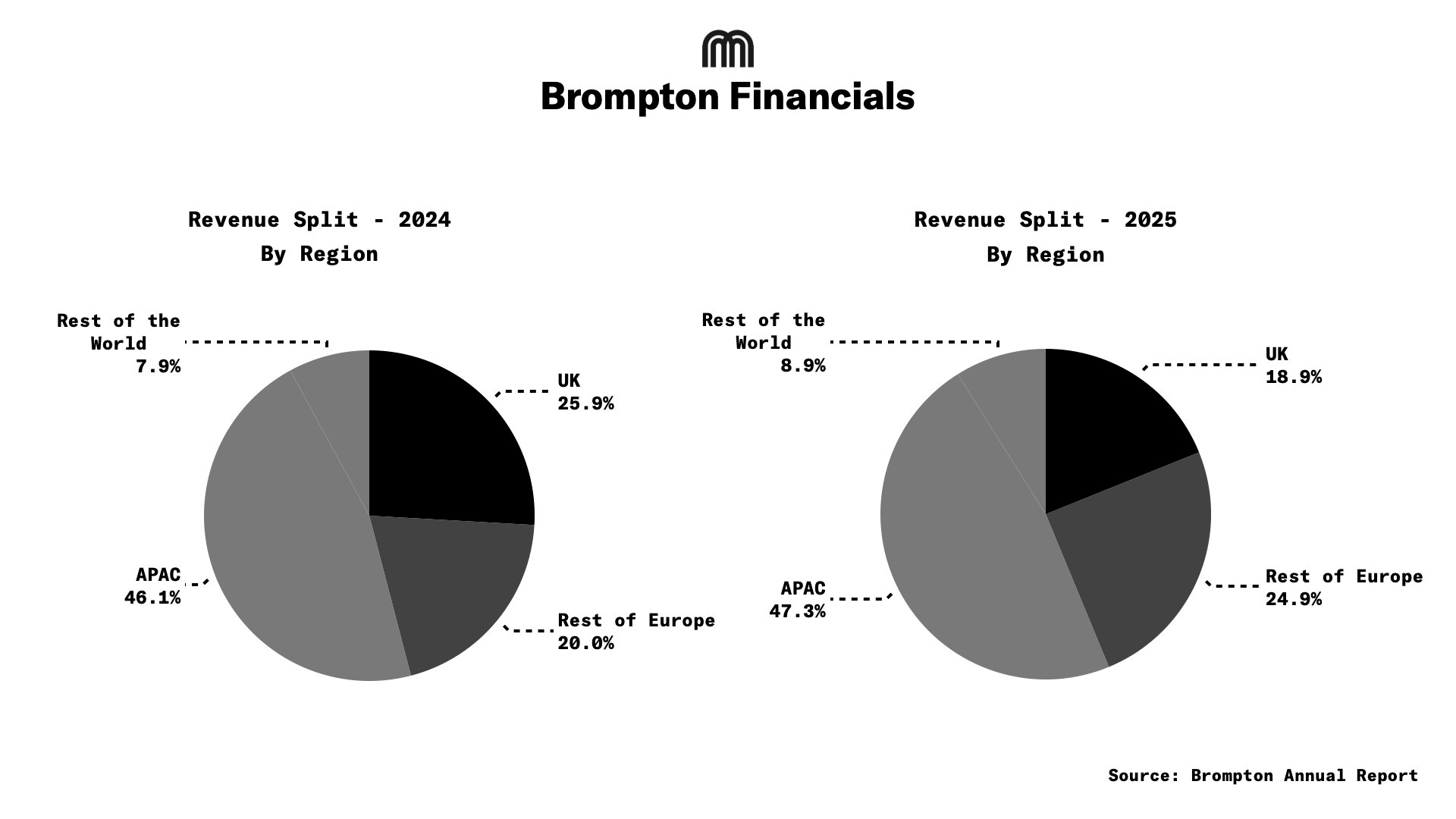
Brompton generated the majority of its revenue outside the UK during FY2025. Regional turnover was as follows:

  • UK: £22.95m
  • Europe: £30.19m
  • APAC: £57.45m
  • Rest of World: £10.85m

The APAC region remained the largest contributor to revenue.

Cost Structure, Margins and Investment
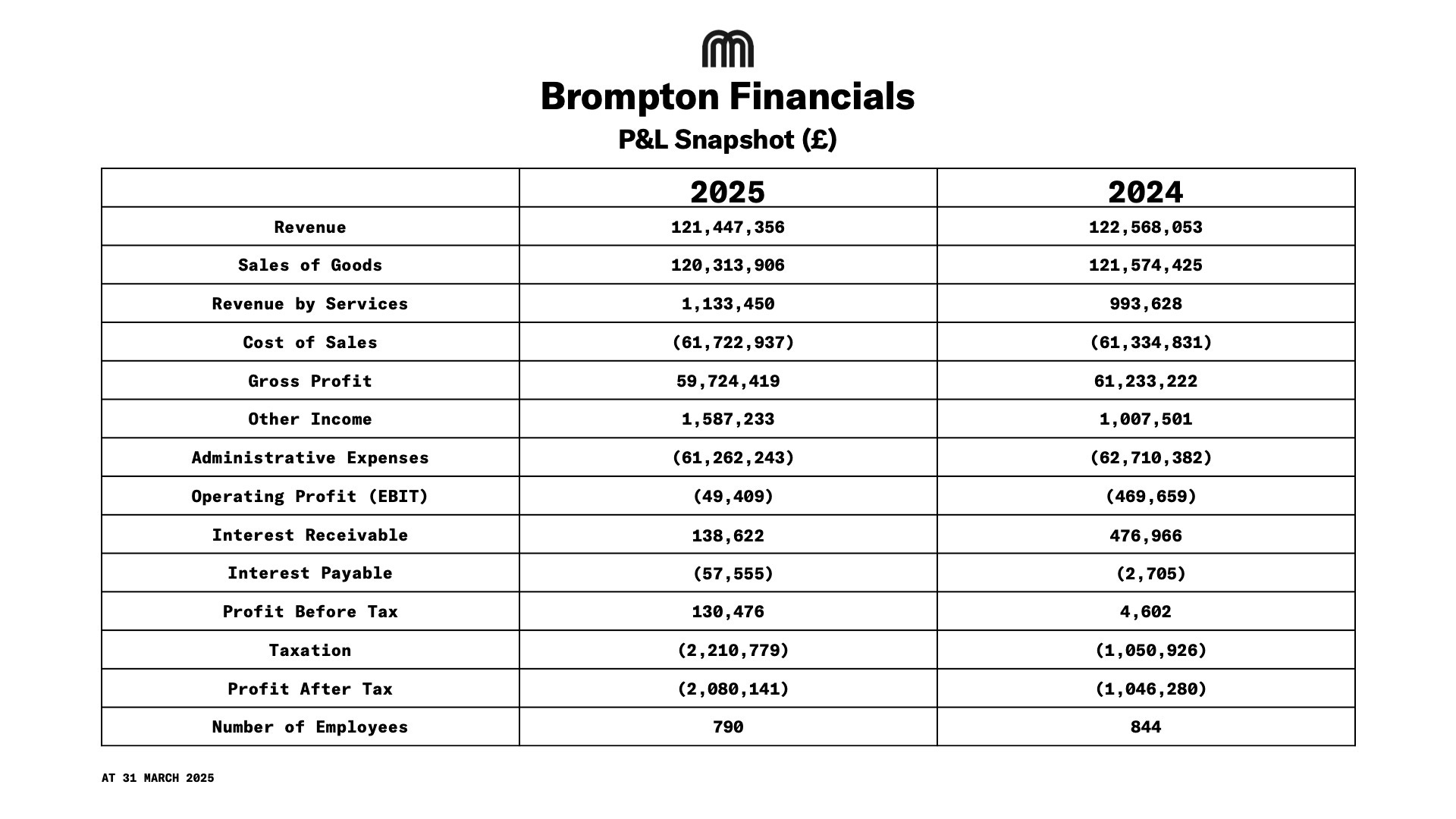
Gross profit for FY2025 was £59.72m, compared with £61.23m in FY2024.

The YoY decrease in gross margin was primarily driven by higher import duty costs on goods imported into China and the U.S., alongside increased carriage costs resulting from the use of airfreight to meet strong demand for G Line products.

Administrative expenses declined YoY, reflecting continued focus on operational efficiency.

Research and development expenditure recognised in the income statement amounted to £1.42m during the year. In addition, Brompton capitalized £8.16m of development costs, relating to new products launched during FY2025.

Cash Position and Financing
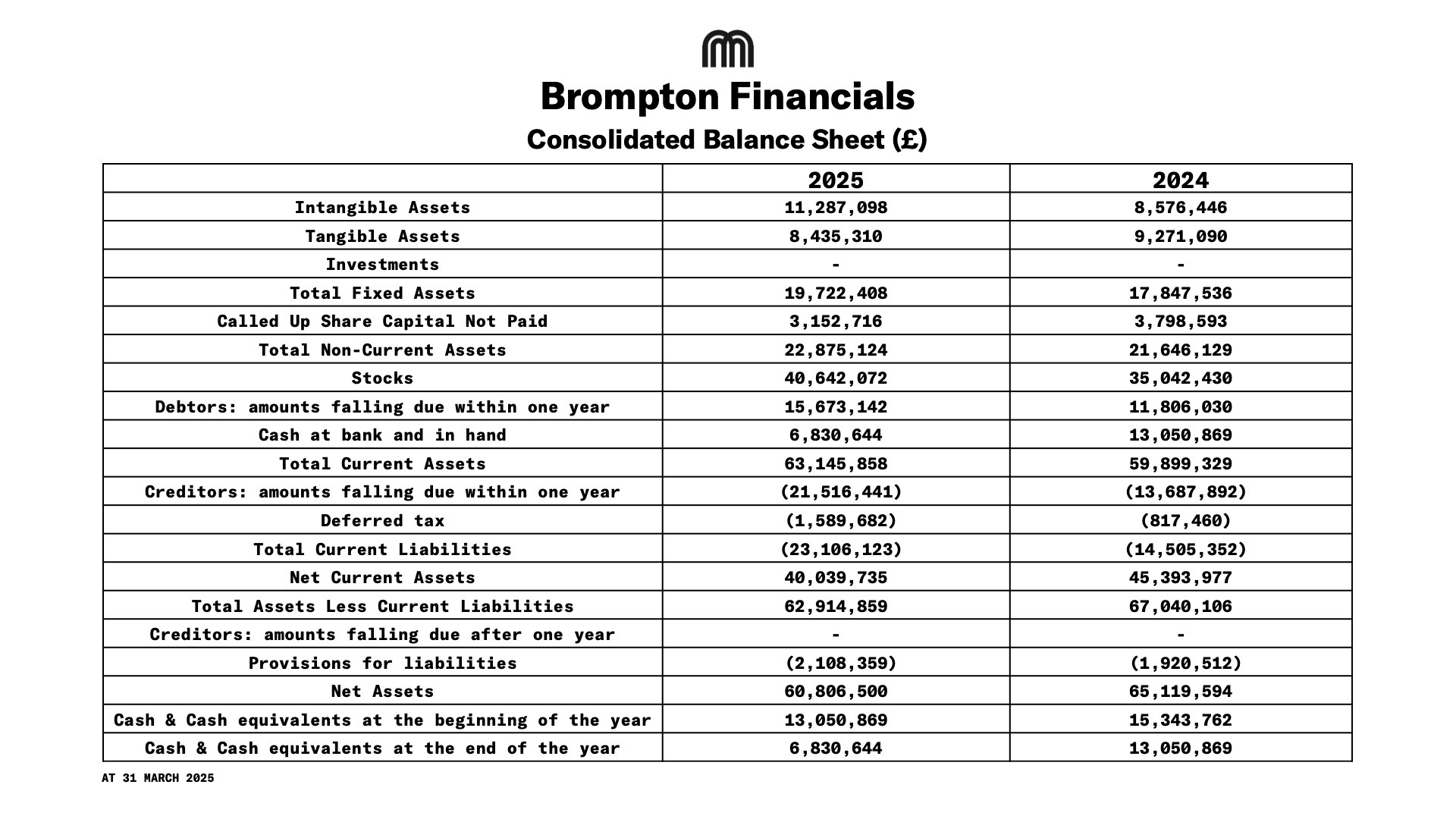

At March 31, 2025, Brompton held £6.83m in cash and cash equivalents, compared with £13.05m in the prior year.

The reduction primarily reflects changes in working capital, including an increase in inventory. Stock levels rose to £40.64m, up from £35.04m, driven mainly by higher finished goods balances.

During the year, the Group drew £5m from its £20m revolving credit facility with HSBC.

After the balance sheet date, the Group announced plans to transition from the revolving credit facility to HSBC Trade Pay, a supplier-finance platform, while retaining a smaller credit facility for liquidity purposes.

Conclusion

Brompton is playing the long game. FY2025 was a tough year for the cycling industry, and while bike volumes fell, the company held up well by shifting toward premium and electric models. Higher-value products helped protect revenue and reinforced Brompton’s position as a high-quality urban mobility brand rather than a volume player.

Strategically, Brompton is being cautious and pragmatic, pulling back where risk is high, investing where the outlook is stronger, and continuing to spend on innovation. Overall, the company remains stable, focused, and well-placed to grow as cities continue to move toward cleaner, more compact transport solutions.

Got your micromobility moment to share? Email us at press@micromobility.io

Loving the vibe? Hop on and ride with us! Subscribe!
Twitter | YouTube | LinkedIn | Instagram | Blog | Podcast

Sign up for free for the Micromobility Newsletter - the world’s largest newsletter about small vehicles - and receive best-in-class insights, analysis, and commentary. Trusted by over 75,000 riders, insiders, builders and enthusiasts.

Welcome to Micromobility Pro, a bi-weekly publication which is part of The Micromobility Newsletter, where we deep-dive into the financials of micromobility companies and share exclusive insights tailored for professionals and members.

Hurry! Early Bird Sale Ends in 2 days!

If you’re reading this… it’s a sign.
(And sure, technically you subscribed - but let’s go with destiny 😉)

Berlin is calling! Micromobility Europe 2026 is planned for June 2-3, where the passionate folks shaping the future of urban mobility actually meet. Two days of talks, hands-on demos, and conversations that could spark your next big idea and make all vision to reality!

Last chance to get your Early Bird tickets at €375 and it expires on 28 February. Grab your spot and join the movement. Will you be there?

Get Your Ticket

Join McKinsey, Rivian’s ALSO, Lyft, Dott, NextBike, POLIS, Urban Sharing, Navee, CityFi, Valeo, XYTE, Vmax and many others!

[Sponsor/Exhibit] | [Speak at the Event] | [Exhibit as a Startup] | [Get A Free Pass]

And to find all about Micromobility America | Nov 11-12 | Palace of Fine Arts, SFO - HERE! (Limited Launch Tickets are on sale at $199)

Contents

  • About Brompton
  • History
  • Operations
  • Electric Bike Expansion & Smart e-Motiq System
  • Market Shifts
  • Ownership Structure
  • 2025 Financial Performance
  • Chart: Revenue & Net Loss (2020-2024)
  • Bike Sales and Product Mix
  • Chart: Yearly Bike Sales
  • Chart: Average Revenue Per Bike
  • Revenue Breakdown by Region
  • Chart: Revenue Split by Region
  • Cost Structure, Margins and Investment
  • Table: P&L Snapshot
  • Cash Position and Financing
  • Table: Balance Sheet Snapshot
  • Conclusion

About Brompton

Image Credits: Brompton

Brompton Bicycle Limited designs, manufactures, and sells folding bicycles and related products. The company is based in Greenford, London, UK, and sells globally through distributors, subsidiaries, retail partners, and direct-to-consumer channels, including e-commerce.

Brompton’s stated purpose is “to create urban freedom for happier lives,” emphasizing practical, high-quality transport solutions that help people move around cities with ease. The company is also a certified B Corporation, reflecting a commitment to social and environmental responsibility alongside business performance.

As the UK’s largest bicycle manufacturer, Brompton is best known for its compact folding bikes, which are popular with commuters and urban riders worldwide.

History

Brompton’s origins go back to 1975, when engineer Andrew Ritchie began designing a folding bicycle in his London flat overlooking the Brompton Oratory. He aimed to create a bike that folded easily, travelled well, and could go anywhere a person needed to be in a city. Over the next decade, he refined this design by hand, building prototype bikes in a small workshop.

In 1987, after many years of independent development and repeated rejections by banks and industry players, the Brompton folding bike won Best Product Award at the Cyclex Bike Show in London. This recognition helped spur wider production and interest.

The first Brompton factory was set up in railway arches in Brentford, West London, where the team handmade around 60 bikes per month. By 1991, Brompton had 56 outlets in the UK and an even bigger export market.
The company entered a new phase of global expansion in 2011 with the opening of its first Brompton Junction retail store in Kobe, Japan, marking a stronger direct-to-consumer presence outside the UK. In recent years, Brompton has focused on technical evolution, including lightweight materials, electric folding bikes, and the launch of the T Line in 2022, the lightest Brompton ever produced.

Operations

Brompton designs, manufactures, and sells folding bicycles, parts, and accessories. It reaches customers through retail partners, distributors, franchise arrangements, subsidiaries, and direct-to-consumer channels, including e-commerce.

In addition to bicycle sales, Brompton Bike Hire operates in the UK, with 79 docking locations and approximately 1.3k bicycles, supporting shared urban mobility initiatives.

During the year, the Group employed an average of 790 people globally. The workforce breakdown was as follows:

  • 404 in manufacturing and distribution
  • 319 in administration
  • 67 shop assistants

During FY2025, Brompton continued to invest in new product development and range expansion, with capitalised development costs relating to products launched during the year. These initiatives support a strategic focus on innovation and higher-value product categories.

Electric Bike Expansion & Smart e-Motiq System

Brompton has significantly expanded its electric bike lineup with a family of models built around its e-Motiq electric drive system, a smart, integrated rear hub motor and battery platform designed from scratch in the UK. Recent launches include:

  • Electric T Line: a lightweight, fully-electric folding bike weighing around 11.2 kg without battery and ~14.1 kg with battery. It features advanced materials such as titanium alloy and carbon fibre and the new e-Motiq smart system, which offers natural power assistance, walk assist, and start assist modes, plus OTA (over-the-air) software updates and up to 90 km of range on a single charge.
  • Electric G Line: a comfort-focused electric variant with ergonomic features, improved shock absorption tyres, and the e-Motiq system. Launched across the UK and European markets, the model has performed strongly, contributing approximately 9% of total sales by volume (6.7k bikes) and 9.8% of Group turnover (around £12m), highlighting its early commercial success.
  • P Line Electric: another e-Motiq-equipped model with a 345 Wh removable battery and up to 90 km of range, torque-sensing ride assist, and smart connectivity.

Alongside its electric expansion, Brompton has continued to develop its non-electric product range through limited and special-edition releases. This includes Tour de France-themed C Line and P Line models, launched ahead of the 2025 Tour de France, featuring race-inspired colorways and graphics produced using advanced sublimation printing techniques. While these editions are non-electric, they form part of Brompton’s broader strategy of range diversification, premiumization, and brand storytelling, extending the appeal of its folding bikes beyond pure commuting into wider cycling culture and lifestyle segments.

Market Shifts

Amid geopolitical trade tensions and ongoing tariff uncertainty in the U.S., Brompton has recalibrated its global retail strategy. While the company has scaled back direct retail expansion in the US, allowing branded stores to close as leases expired, it has simultaneously accelerated investment in China, which it views as a more stable and predictable business environment.

Brompton now operates a mixed retail model in China, combining company-owned stores with a franchise network. With a 17-year presence, China has become Brompton’s largest market, supported by three company-owned stores and 14 franchise locations, and is considered one of its most strategically important regions.

CEO Will Butler-Adams noted that unpredictable U.S. tariffs make long-term commitments increasingly risky, prompting a more cautious and flexible approach to investment in the American market while reinforcing Brompton’s presence elsewhere.

Risk of Over-Dependence on China

Brompton has aligned its intercompany transfer pricing policies with global standards to ensure compliance and accurate profit allocation. This approach has increased the proportion of profits recognised in the UK. Additionally, Brompton has implemented 30% prepayments on all orders to reduce cash exposure in China. Growth initiatives in other key markets, including Germany, Japan, and the U.S., aim to reduce dependency on China and ensure greater operational and financial resilience.

Ownership Structure

Brompton Bicycle Limited is a private company limited by shares, registered in England and Wales. The company has ordinary shares and Class A ordinary shares.

In an earlier funding round, Brompton also received approximately £3m from existing shareholders alongside the £16m injection from external investor BGF, helping to shore up the company’s balance sheet and service debt obligations. The Class A ordinary shares were issued to BGF as part of a £16m equity investment. These shares carry different rights, including a 7.5% cumulative preferential dividend payable from 2030, subject to performance conditions. As the directors expect these conditions to be met, no liability has been recognised in the financial statements.

As of March 31, 2025, the issued share capital comprised:

  • 106.12k ordinary shares
  • 9.84k Class A ordinary shares

There is no ultimate controlling party.

FY2025 Financial Performance

For the year ended March 31, 2025, Brompton reported group turnover of £121.45m, compared with £122.57m in FY2024, representing a marginal YoY decline.

Profit before taxation increased to £130.47k, up from £4.6k in the prior year. This improvement reflects changes in operating performance and cost control, alongside other income and reduced administrative expenses.

Despite the improvement at the pre-tax level, the Group reported a net loss of £2.08m (FY2024: £1.05m loss). This outcome was primarily driven by taxation effects, including deferred tax movements and the treatment of historic losses.

As a result, net assets declined to £60.81m, compared with £65.12m at the end of FY2024.

Also, during the year, the Group paid dividends of £1.36m (£12 a share) (2024: nil). There were 475 ordinary shares issued from the exercise of options during the year. A total of 617 nil-paid shares were also cancelled, resulting in a slight reduction in share capital.

Bike Sales and Product Mix

Bike unit sales during FY2025 totaled 78.53k (FY2024: 84.89k), representing a 7.5% decline YoY, driven by wider global economic uncertainty and continued challenges across the cycling industry. Exports accounted for 80% of total bike unit sales, consistent with the prior year.

Despite lower volumes, the continued ramp-up of G Line, T Line, and P Line products accelerated a shift toward more premium models in the range. This resulted in a significant increase in average revenue per bike, enabling the Group to largely offset the revenue impact of reduced unit sales.

Sales through direct-to-consumer (DTC) channels, excluding franchises, remained broadly in line with the prior year at 18.69k units (2024: 18.78k), underlining the resilience of Brompton’s owned retail and e-commerce channels despite softer overall market conditions.

Revenue Breakdown by Region

Brompton generated the majority of its revenue outside the UK during FY2025. Regional turnover was as follows:

  • UK: £22.95m
  • Europe: £30.19m
  • APAC: £57.45m
  • Rest of World: £10.85m

The APAC region remained the largest contributor to revenue.

Cost Structure, Margins and Investment

Gross profit for FY2025 was £59.72m, compared with £61.23m in FY2024.

The YoY decrease in gross margin was primarily driven by higher import duty costs on goods imported into China and the U.S., alongside increased carriage costs resulting from the use of airfreight to meet strong demand for G Line products.

Administrative expenses declined YoY, reflecting continued focus on operational efficiency.

Research and development expenditure recognised in the income statement amounted to £1.42m during the year. In addition, Brompton capitalized £8.16m of development costs, relating to new products launched during FY2025.

Cash Position and Financing


At March 31, 2025, Brompton held £6.83m in cash and cash equivalents, compared with £13.05m in the prior year.

The reduction primarily reflects changes in working capital, including an increase in inventory. Stock levels rose to £40.64m, up from £35.04m, driven mainly by higher finished goods balances.

During the year, the Group drew £5m from its £20m revolving credit facility with HSBC.

After the balance sheet date, the Group announced plans to transition from the revolving credit facility to HSBC Trade Pay, a supplier-finance platform, while retaining a smaller credit facility for liquidity purposes.

Conclusion

Brompton is playing the long game. FY2025 was a tough year for the cycling industry, and while bike volumes fell, the company held up well by shifting toward premium and electric models. Higher-value products helped protect revenue and reinforced Brompton’s position as a high-quality urban mobility brand rather than a volume player.

Strategically, Brompton is being cautious and pragmatic, pulling back where risk is high, investing where the outlook is stronger, and continuing to spend on innovation. Overall, the company remains stable, focused, and well-placed to grow as cities continue to move toward cleaner, more compact transport solutions.

Got your micromobility moment to share? Email us at press@micromobility.io

Loving the vibe? Hop on and ride with us! Subscribe!

Twitter | YouTube | LinkedIn | Instagram | Blog | Podcast

Sign up for free for the Micromobility Newsletter - the world’s largest newsletter about small vehicles - and receive best-in-class insights, analysis, and commentary. Trusted by over 75,000 riders, insiders, builders and enthusiasts.

Welcome to Micromobility Pro, a bi-weekly publication which is part of The Micromobility Newsletter, where we deep-dive into the financials of micromobility companies and share exclusive insights tailored for professionals and members.

Hurry! Early Bird Sale Ends in 2 days!

If you’re reading this… it’s a sign.
(And sure, technically you subscribed - but let’s go with destiny 😉)

Berlin is calling! Micromobility Europe 2026 is planned for June 2-3, where the passionate folks shaping the future of urban mobility actually meet. Two days of talks, hands-on demos, and conversations that could spark your next big idea and make all vision to reality!

Last chance to get your Early Bird tickets at €375 and it expires on 28 February. Grab your spot and join the movement. Will you be there?

Get Your Ticket

Join McKinsey, Rivian’s ALSO, Lyft, Dott, NextBike, POLIS, Urban Sharing, Navee, CityFi, Valeo, XYTE, Vmax and many others!

[Sponsor/Exhibit] | [Speak at the Event] | [Exhibit as a Startup] | [Get A Free Pass]

And to find all about Micromobility America | Nov 11-12 | Palace of Fine Arts, SFO - HERE! (Limited Launch Tickets are on sale at $199)

Contents

  • About Brompton
  • History
  • Operations
  • Electric Bike Expansion & Smart e-Motiq System
  • Market Shifts
  • Ownership Structure
  • 2025 Financial Performance
  • Chart: Revenue & Net Loss (2020-2024)
  • Bike Sales and Product Mix
  • Chart: Yearly Bike Sales
  • Chart: Average Revenue Per Bike
  • Revenue Breakdown by Region
  • Chart: Revenue Split by Region
  • Cost Structure, Margins and Investment
  • Table: P&L Snapshot
  • Cash Position and Financing
  • Table: Balance Sheet Snapshot
  • Conclusion

About Brompton

Image Credits: Brompton

Brompton Bicycle Limited designs, manufactures, and sells folding bicycles and related products. The company is based in Greenford, London, UK, and sells globally through distributors, subsidiaries, retail partners, and direct-to-consumer channels, including e-commerce.

Brompton’s stated purpose is “to create urban freedom for happier lives,” emphasizing practical, high-quality transport solutions that help people move around cities with ease. The company is also a certified B Corporation, reflecting a commitment to social and environmental responsibility alongside business performance.

As the UK’s largest bicycle manufacturer, Brompton is best known for its compact folding bikes, which are popular with commuters and urban riders worldwide.

History

Brompton’s origins go back to 1975, when engineer Andrew Ritchie began designing a folding bicycle in his London flat overlooking the Brompton Oratory. He aimed to create a bike that folded easily, travelled well, and could go anywhere a person needed to be in a city. Over the next decade, he refined this design by hand, building prototype bikes in a small workshop.

In 1987, after many years of independent development and repeated rejections by banks and industry players, the Brompton folding bike won Best Product Award at the Cyclex Bike Show in London. This recognition helped spur wider production and interest.

The first Brompton factory was set up in railway arches in Brentford, West London, where the team handmade around 60 bikes per month. By 1991, Brompton had 56 outlets in the UK and an even bigger export market.
The company entered a new phase of global expansion in 2011 with the opening of its first Brompton Junction retail store in Kobe, Japan, marking a stronger direct-to-consumer presence outside the UK. In recent years, Brompton has focused on technical evolution, including lightweight materials, electric folding bikes, and the launch of the T Line in 2022, the lightest Brompton ever produced.

Become a Pro member to gain access to this content plus the entire Micromobility Pro archive.

Micromobility Pro

Starter
for up to 2,500 contacts
and up to 37,500 emails/month
$48
/month
What's included:
Email Designer
Campaign Creator
Web Forms
Analytics
Pro
for up to 5,500 contacts
and up to 57,500 emails/month
$78
/month
What's included:
Email Automations
Custom rDNS
User Management
Form with reCAPTCHA
Best Value
Monthy
Join the leaders in the industry and become a Micromobility Pro Member today!
25
/month
What's included:
Micromobility Pro Articles
Micromobility Pro Newsletter
Member Exclusive Content
Yearly
Get the most popular yearly plan at just €20.80/month with extra perks
250
/year
What's included:
Micromobility Pro Articles
Micromobility Pro Newsletter
Access to Members Only Slack
Discounts on Event Tickets
Fast Track Landscape Application
Best Value
Already a member? Login

Welcome to Micromobility Pro, a bi-weekly publication which is part of The Micromobility Newsletter, where we deep-dive into the financials of micromobility companies and share exclusive insights tailored for professionals and members.

Hurry! Early Bird Sale Ends in 2 days!

If you’re reading this… it’s a sign.
(And sure, technically you subscribed - but let’s go with destiny 😉)

Berlin is calling! Micromobility Europe 2026 is planned for June 2-3, where the passionate folks shaping the future of urban mobility actually meet. Two days of talks, hands-on demos, and conversations that could spark your next big idea and make all vision to reality!

Last chance to get your Early Bird tickets at €375 and it expires on 28 February. Grab your spot and join the movement. Will you be there?

Get Your Ticket

Join McKinsey, Rivian’s ALSO, Lyft, Dott, NextBike, POLIS, Urban Sharing, Navee, CityFi, Valeo, XYTE, Vmax and many others!

[Sponsor/Exhibit] | [Speak at the Event] | [Exhibit as a Startup] | [Get A Free Pass]

And to find all about Micromobility America | Nov 11-12 | Palace of Fine Arts, SFO - HERE! (Limited Launch Tickets are on sale at $199)

Contents

  • About Brompton
  • History
  • Operations
  • Electric Bike Expansion & Smart e-Motiq System
  • Market Shifts
  • Ownership Structure
  • 2025 Financial Performance
  • Chart: Revenue & Net Loss (2020-2024)
  • Bike Sales and Product Mix
  • Chart: Yearly Bike Sales
  • Chart: Average Revenue Per Bike
  • Revenue Breakdown by Region
  • Chart: Revenue Split by Region
  • Cost Structure, Margins and Investment
  • Table: P&L Snapshot
  • Cash Position and Financing
  • Table: Balance Sheet Snapshot
  • Conclusion

About Brompton

Image Credits: Brompton

Brompton Bicycle Limited designs, manufactures, and sells folding bicycles and related products. The company is based in Greenford, London, UK, and sells globally through distributors, subsidiaries, retail partners, and direct-to-consumer channels, including e-commerce.

Brompton’s stated purpose is “to create urban freedom for happier lives,” emphasizing practical, high-quality transport solutions that help people move around cities with ease. The company is also a certified B Corporation, reflecting a commitment to social and environmental responsibility alongside business performance.

As the UK’s largest bicycle manufacturer, Brompton is best known for its compact folding bikes, which are popular with commuters and urban riders worldwide.

History

Brompton’s origins go back to 1975, when engineer Andrew Ritchie began designing a folding bicycle in his London flat overlooking the Brompton Oratory. He aimed to create a bike that folded easily, travelled well, and could go anywhere a person needed to be in a city. Over the next decade, he refined this design by hand, building prototype bikes in a small workshop.

In 1987, after many years of independent development and repeated rejections by banks and industry players, the Brompton folding bike won Best Product Award at the Cyclex Bike Show in London. This recognition helped spur wider production and interest.

The first Brompton factory was set up in railway arches in Brentford, West London, where the team handmade around 60 bikes per month. By 1991, Brompton had 56 outlets in the UK and an even bigger export market.
The company entered a new phase of global expansion in 2011 with the opening of its first Brompton Junction retail store in Kobe, Japan, marking a stronger direct-to-consumer presence outside the UK. In recent years, Brompton has focused on technical evolution, including lightweight materials, electric folding bikes, and the launch of the T Line in 2022, the lightest Brompton ever produced.

Become a Pro member to gain access to this content plus the entire Micromobility Pro archive.

Micromobility Pro

Starter
for up to 2,500 contacts
and up to 37,500 emails/month
$48
/month
What's included:
Email Designer
Campaign Creator
Web Forms
Analytics
Pro
for up to 5,500 contacts
and up to 57,500 emails/month
$78
/month
What's included:
Email Automations
Custom rDNS
User Management
Form with reCAPTCHA
Best Value
Monthy
Join the leaders in the industry and become a Micromobility Pro Member today!
25
/month
What's included:
Micromobility Pro Articles
Micromobility Pro Newsletter
Member Exclusive Content
Yearly
Get the most popular yearly plan at just €20.80/month with extra perks
250
/year
What's included:
Micromobility Pro Articles
Micromobility Pro Newsletter
Access to Members Only Slack
Discounts on Event Tickets
Fast Track Landscape Application
Best Value
Already a member? Login