.svg)
%2Bcopy.avif)

.svg)

.jpg)
%20(1).jpeg)
.jpg)

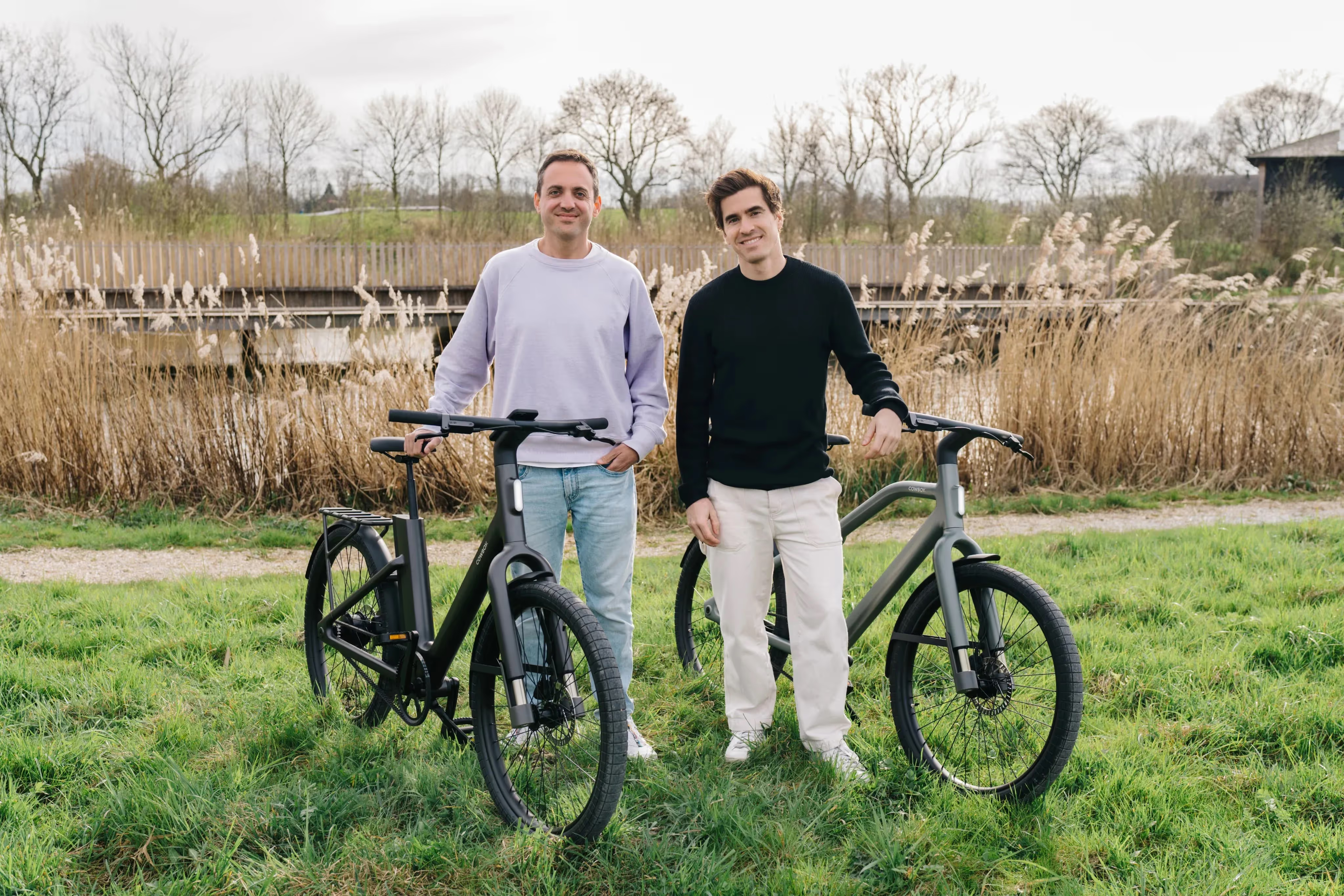
When it comes to modern e-bikes, there are few companies as influential as Cowboy. The Belgian brand was a key driver behind a new type of two-wheeler, one dripping with style, panache, and modernity. Here was a bike that felt closer to an iPhone than the lycra-clad velodrome.
A combination of technology, design, and a direct-to-consumer (D2C) retail approach saw Cowboy, alongside VanMoof and RadPower, as a major innovator in the new space. And, for a while, the world was its oyster.
Unfortunately though, not all good things can last, and Cowboy suffered a series of setbacks, culminating in brushes with bankruptcy. This led to it closing a deal with ReBirth Group Holding — a French company that owns cycling brands Peugeot, Gitane, and Solex — to be acquired at the end of 2025.
Following an influx of funding, Cowboy is gearing up for a new chapter in its illustrious journey. The goal, today, then is to ponder what 2026 might hold for the e-bike pioneer. To truly understand that, though, we need to consider how Cowboy got to where it is today. So let’s dig into that.
The Tesla of e-bikes

Cowboy was founded in 2017 by Adrien Roose, Karim Slaoui, and Tanguy Goretti, alumni from Take Eat Easy, a Belgium-founded food delivery startup. Cowboy stood out almost immediately. Their offering wasn’t just a bike; it was positioned as an ecosystem, with the app being an integral part of the cycling experience.
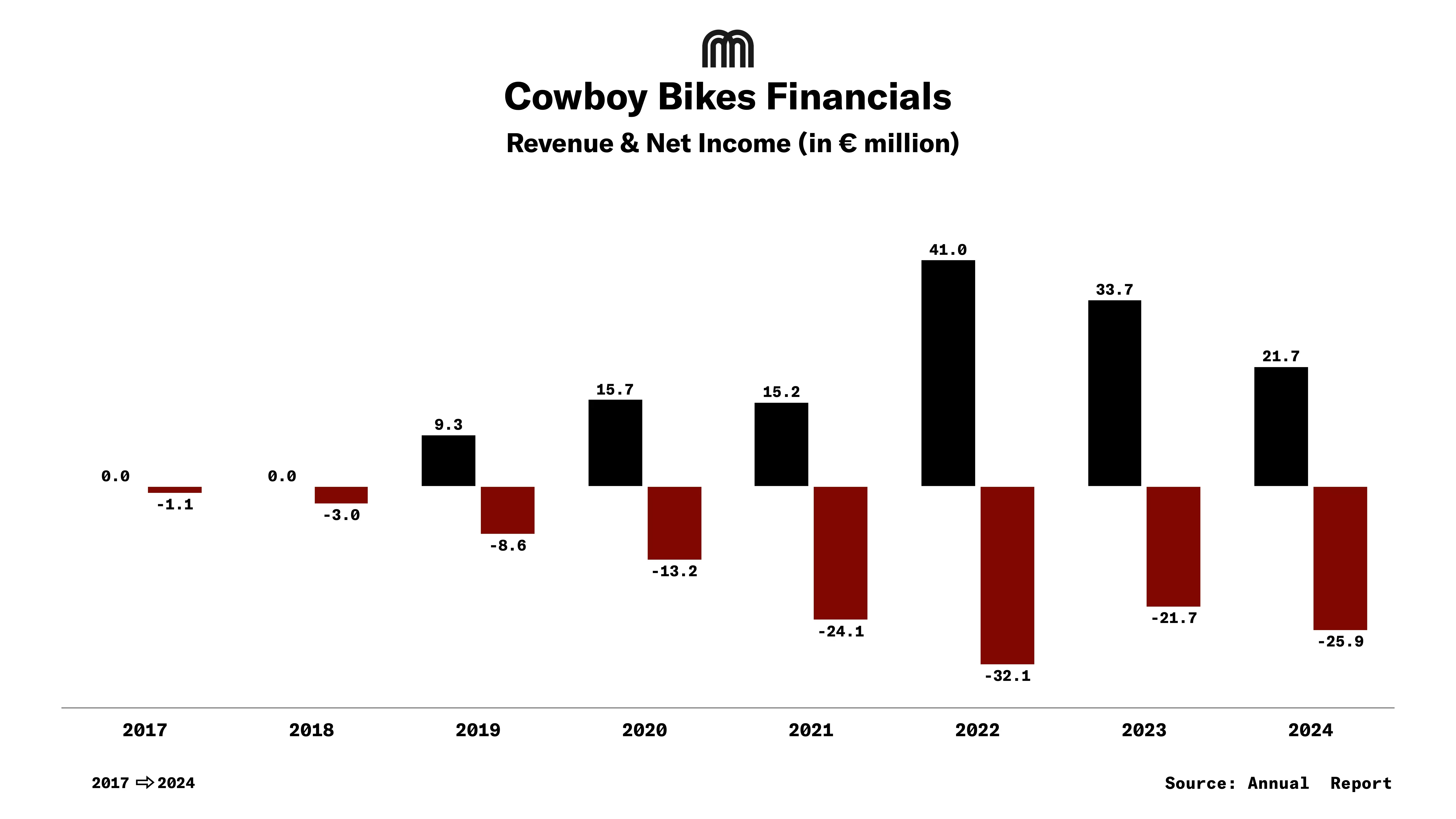
In 2018 and 2019, the company launched the Cowboy 1 and 2 respectively. It expanded into other European markets outside of Belgium, specifically Germany, France, and the Netherlands. This was a period of explosive growth, with revenue rising from €0 in 2018 to €9.3 million in 2019.
The real boom happened — as it did for much of micromobility — during the pandemic. As Cowboy launched the third generation of its bike, it saw revenue jump to €15.6 million in 2020. Market forces and a hunger for e-bikes saw the company raise significant capital in order to try to capitalize on the opportunity.
This led to the launch of the C4 and C4 ST in 2021, something that occurred alongside expansion into the US.
There was a darker side to this growth though. As Cowboy was trying to make the most of a pandemic-driven market opportunity where the public became enamored with e-bikes, it also took on increasing amounts of debt. In 2021, current liabilities (also known as debt within one year) jumped from €7.5M in 2020 to €19.7M, while total liabilities doubled.
Much of this was driven by purchasing the inventory it needed to sell, but it put Cowboy in a tricky position, especially as equity turned negative, hitting -€17.9M in 2021. Despite raising money, Cowboy’s operational burn rate outpaced the cash injection.
The bubble and the burst
If the previous section was about the rise of Cowboy, this segment is about the often cruel nature of reality. While 2022 was the peak of Cowboy’s revenue, it was also the moment that operational issues hit, much of it driven by the supply chain crisis. Sales turnover hit an all-time high of €40.9M, but its operating profit this year was -€27.1M.
There were a record number of sales, but the costs of sourcing components, and issues with long repair and delivery times hampered the company.
When 2023 arrived, a correction was inevitable. Globally, tech investment calmed, with VCs broadly abandoning their “growth at all costs” philosophy. This ushered in an age where funding was focused more on profitability, sustainability, and long-term strategies.
Throughout this time — and amid a post-COVID slip in consumer demand — Cowboy’s revenue dropped to €33.7M. Alongside this, equity plunged to -€22.4M, meaning it was technically insolvent on paper, relying on external financing to keep operating.
This demanded a strategy shift, one that saw the company move away from its D2C model and start working with third parties. Specifically, it started selling its e-bikes through other retailers, helping lower costs and improve servicing ability.
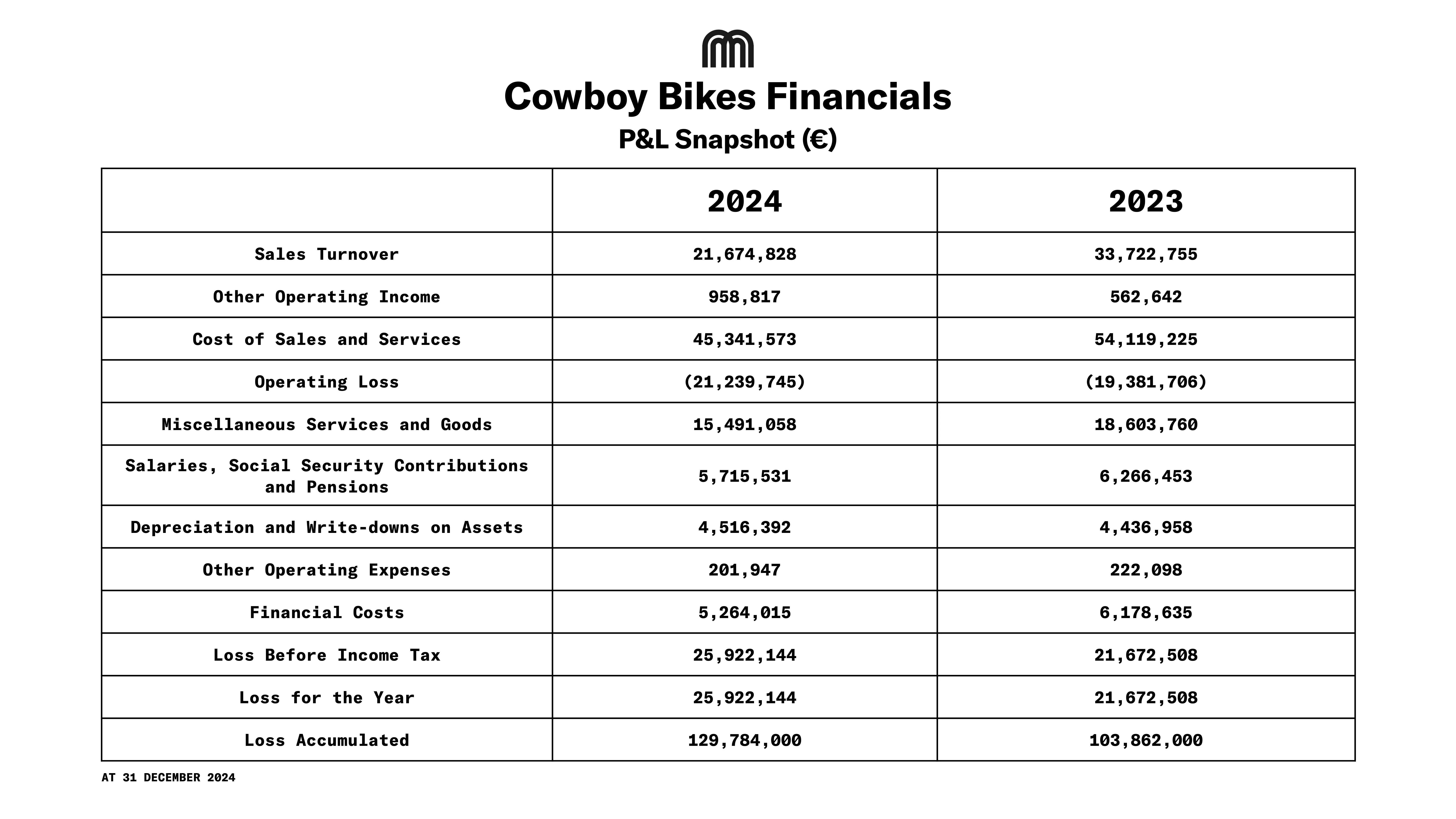
Things got tougher in 2025, though. Revenue dropped 36% to €21.6M, while losses rose. This culminated in ReBirth Group Holding SA acquiring Cowboy at the end of 2025, completing a financial restructuring and bringing in new capital.
This neatly brings us up to today, and brings us back to our original question…
What does 2026 look like for Cowboy?

Likely, the first thing we’ll see from Cowboy in 2026 is a focus on stability. This is something that Adrien Roose, Cowboy co-founder and ex-CEO, mentioned: “My hope is that this new partnership will make Cowboy more reliable for riders in the long term. To keep them on the road and supported in the best way possible.”
To achieve this, Cowboy will probably spend the first part of the year dealing with issues such as the frame recall, the after-effects of the supply chain backlog, and issues with post-purchase services.
Cowboy is still one of the most alluring brands in the e-bike space, and trying to gain and improve consumer trust will be first on the agenda. This is an element that will be bolstered by ReBirth’s industrial credentials.
Grégory Trébaol — the CEO of ReBirth Group Holding SA — says the goal is to “enhance efficiency, reinforce margins, and create a strong foundation for long-term growth.”
Already the signs are there. It’s reported that Cowboy’s production will restart this month at its French assembly facility, with the plan being to produce 1,500 bikes in January and dealing with the existing backlog.

Tied into this — and a key element of Cowboy’s 2026 plans in general — will be rebuilding consumer confidence. As Marta, head of customer success at Cowboy, says “we’re focused on rebuilding trust and delivering the consistent support our customers expect from Cowboy.”
The likely goal is to enable people to quickly buy Cowboy bikes in Q2 with minimal lead times and return to a net neutral as soon as possible.
When we get to the midpoint of 2026, it’s harder to say what’s in store for Cowboy. It’s likely we’ll see a greater presence in France, as the two-wheelers will probably appear in ReBirth’s myriad of stores across the country.
All-in-all, 2026 will likely be a year of stabilisation for Cowboy, of getting back on the bike, if you will. Considering this, it’s unlikely we’ll see a new e-bike launched this year — although we may see some of the technological and software expertise of the Cowboy brand leak into ReBirth’s other bike brands.
Ultimately, Cowboy will go down in the micromobility history books. It was instrumental in the e-bike revolution, defining a sort of urban cool and futuristic approach to transport. Without them, the market wouldn’t be what it is today, and that’s important to remember.
Sure, 2025 saw one chapter in the Cowboy story come to a close, but 2026 offers the opportunity for an entirely new one to begin.