.svg)
%2Bcopy.avif)

.svg)

.jpg)
%20(1).jpeg)
.jpg)


.webp)

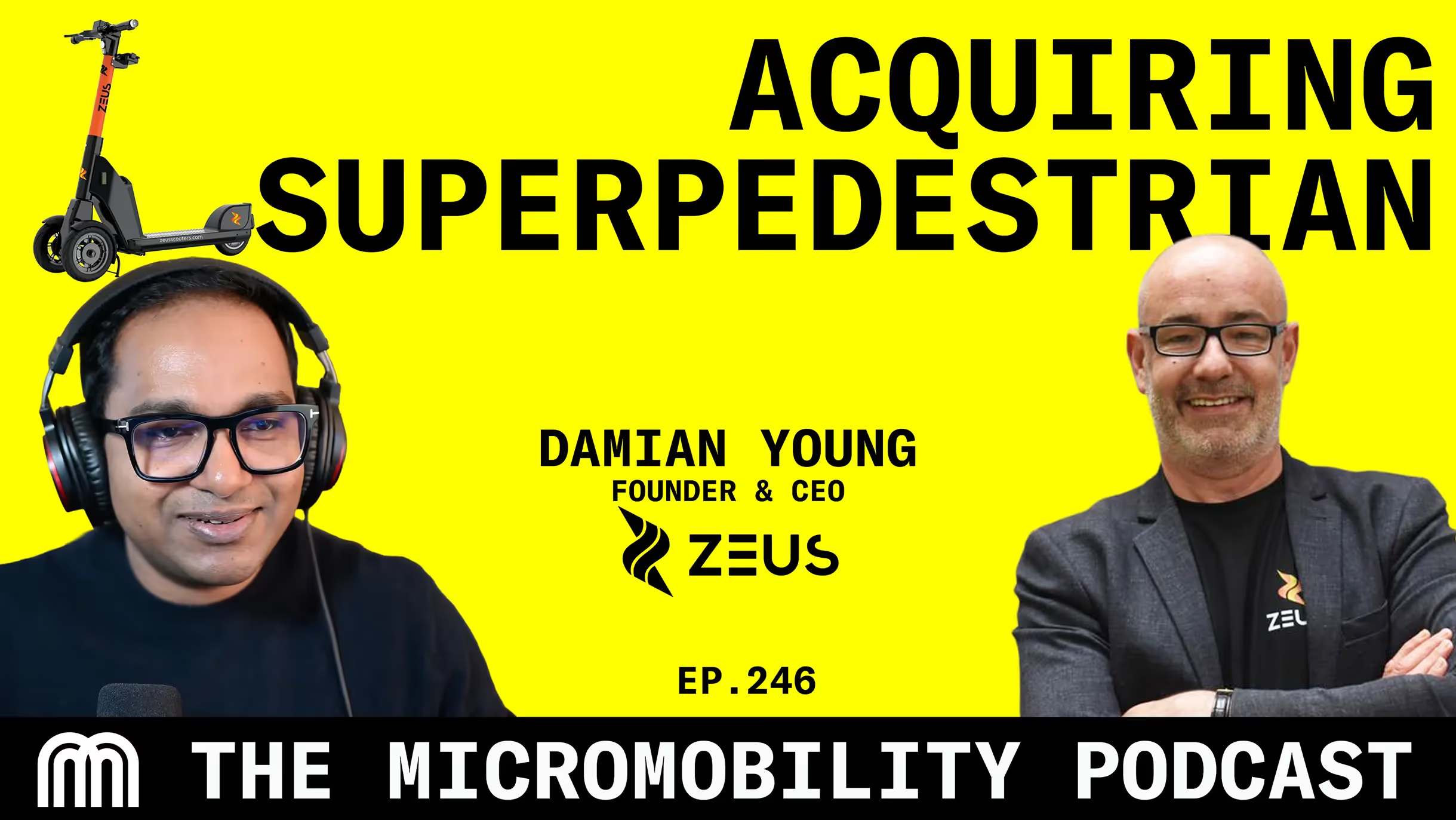
Mergers and acquisitions are becoming a defining theme in micromobility. Over the past few years, consolidation has reshaped the industry as operators look for scale, stronger unit economics, and a path to profitability. The latest move comes from Dublin-based Zeus Scooters, which has acquired the assets of Superpedestrian’s European operations in a deal that could significantly expand its footprint.
The acquisition marks a major step for Zeus founder and CEO Damian Young, who has spent the last 6 years building the company through disciplined growth, careful cost management, and selective acquisitions.
On this week’s Micromobility Podcast, Prabin Joel Jones sits down with Young to discuss the deal, the thinking behind it, and what it signals about the next phase of the micromobility industry.
From banking to micromobility
Young’s path into the industry was not a typical one. Before launching Zeus, he spent roughly 25 years working in banking, focusing on international business banking, liquidity management, and pricing.
After leaving the sector in 2014, he joined a data and analytics company that specialized in pricing models for financial services. The experience would later shape how he approached micromobility as a business.
When Young returned to Ireland in 2019, he encountered shared scooters while traveling across mainland Europe. The experience of moving through cities quickly and easily convinced him there was an opportunity worth pursuing.
Ireland, however, had not yet legalized e-scooters at the time. Faced with a regulatory delay, Zeus launched its first operations in Germany instead.
Designing scooters for a different rider
From the beginning, Zeus tried to approach the market differently.
Young noticed that early scooter users were largely men between the ages of 18 and 26. That observation pushed the company to experiment with a 3 wheeled scooter designed to offer more stability and attract riders who might otherwise hesitate to try micromobility.
The goal was to expand the user base beyond the typical early adopter.
According to Young, the results were encouraging. A significant share of Zeus riders were women, many over the age of thirty. In some cities, older riders also became regular users.
While the company eventually added traditional 2 wheel scooters to its fleet, the three wheel design helped Zeus carve out a distinct identity in the market.
A focus on smaller cities
Another part of Zeus’s strategy was its decision to focus on smaller urban markets.
Rather than competing directly in some of Europe’s largest capitals, the company concentrated on tier two and tier three cities. These locations often lack dense public transport networks, which can make micromobility particularly useful for everyday travel.
Young also saw practical advantages in working with smaller municipalities.
“I hate bureaucracy and politics,” he said. “There is less of that in smaller locations.”
By clustering several smaller cities together, Zeus created regional networks that could rival the demand of larger metropolitan areas.
Rethinking the industry’s key metric
In much of the micromobility sector, performance is often measured using rides per scooter per day. Young believes that metric can be misleading.
“There is vanity and then there is sanity,” he said. “Vanity is I get seven rides per day but I don’t make money. Sanity is I get one ride per day but I earn one euro.”
Instead of maximizing ride volume, Zeus focuses on what Young describes as financial productivity. The goal is to find the balance where each ride contributes positively to the company’s economics rather than simply increasing utilization.
That approach helped Zeus reach EBITDA positive levels in 2023, a milestone that remains difficult for many operators in the industry.
The Superpedestrian opportunity
The company’s latest acquisition grew out of that same mindset.
Superpedestrian had built a reputation as one of the most technologically ambitious companies in micromobility. Its scooters and software systems were designed to detect faults, manage fleets, and monitor performance in real time.
But developing that technology required significant investment.
After Superpedestrian’s European entity entered restructuring proceedings, Zeus began working with the trustee to acquire parts of the business. The deal included several subsidiaries, technology assets, and a large fleet of scooters.
For Zeus, the attraction was clear. The company could integrate advanced hardware and software without having to fund the original development.
A step change in scale
If successfully integrated, the acquisition could significantly expand Zeus’s operations.
Young estimates that the deal could roughly quadruple the company’s business once the assets are redeployed and markets reopen.
The integration process will take time. Thousands of scooters are currently stored across different locations and will need to be redeployed carefully.
But the opportunity is substantial.
Looking ahead
Micromobility has been a challenging industry for many founders. The sector has seen rapid expansion, funding booms, and equally dramatic downturns.
Young acknowledges how difficult the business can be.
“This is a tough business,” he said. “Would I go into it again? Possibly not. But now that I’m in it, I want it to be successful.”
With the acquisition of Superpedestrian’s European assets, Zeus is betting that disciplined growth, strong operations, and selective expansion will define the next phase of the micromobility industry.
And if that bet pays off, the company may soon find itself operating on a very different scale.