.svg)
%2Bcopy.avif)


.svg)


.webp)

.webp)
.avif)
In 2023, 3 companies pulled roughly 15k electric scooters off the streets of Paris. Lime, Dott, and Tier didn't leave because riders had stopped showing up. They left because the city had voted them out.
Six weeks earlier, Paris had held a referendum. Turnout was 7.5%. Of those who showed up, 89% voted to ban shared e-scooters. Madrid followed in 2024. Prague announced a ban from January 2026.
Each time, residents pointed to the same thing. Pavements cluttered with scooters, doorways blocked, public space that felt out of control.
Over time, a simple explanation took hold. Riders just didn't care where they left their scooters.
It's a convincing story. The research tells a different one.
What riders actually knew
A survey of 391 e-scooter users across Auckland, Cologne, Milton Keynes, Nashville, and Rome asked a simple question. Have you ever misparked?
9% said yes.

Among those who said they always parked correctly, 61% gave the same reason. It wasn’t that they knew the rules, but that they cared about the effect their parking had on other people. When shown images of scooters in different positions, accuracy was high on the obvious cases. 96% correctly identified a scooter blocking a curb cut as wrong. 90% got a blocked doorway right.
The harder cases were where it got interesting. Whether parking at a bike rack was permitted depended entirely on local regulations. 79% of respondents said the bike rack scenario was fine, which was the correct answer in some of the cities surveyed, but not all.
Then, researchers showed riders the city’s actual parking rules. The share who admitted to ever misparking jumped from 8.6% to 26%. With the rules in front of them, riders estimated they had misparked after roughly 7% of their trips, consistent with field observations from US cities, where between 1.7 and 8% of scooters were found blocking access at any given time.
The picture that emerges is not one of indifference. Riders had good instincts - don't block a door, don't block a dropped curb. But had thin knowledge of local regulations that most cities had never clearly communicated. The compliance gap was largely an information gap. And an information gap has a different solution than a behaviour problem.
The cities that treated it as an infrastructure problem
Sweden passed a national law in September 2022 ending free-floating parking entirely; scooters had to go in bike racks or formally designated spaces. Stockholm then built quickly to match. Around 700 dedicated spots added in autumn 2022, existing bike racks opened to scooters, and data-sharing agreements with every operator feeding real-time location data into hotspot identification and future bay planning.
Compliance improved sharply. But a KTH Royal Institute of Technology study found a real side effect. More than 80% of respondents reported having to walk farther to find or return a scooter near bus and train stations. Around 40% said journey times got longer. In Stockholm specifically, 60% said they were using scooters less often as a result.
The KTH research pointed to why this mattered. Roughly 30% of weekday morning trips ended in the final minutes before the hour, right before work, lectures, and exams. Scooters were functioning as a last-minute gap-closer when transit ran late, a use case that depends entirely on finding one quickly near a transit stop. The parking zones had made that harder. The study made a clear point. The strategy was right, but the density of bays was not yet high enough to preserve the convenience that had made the mode useful. Stockholm had solved the problem of where scooters go. It hadn't yet solved whether you could find one when you needed it.
Berlin pulled a different lever. Rather than slashing the fleet, the city set a cap of 19k scooters within the S-Bahn ring, down from roughly 25k, and then did something that required no construction budget at all. From January 2023, rented scooters, e-bikes, and personally owned bikes were permitted to use car parking spaces for free, with no risk of fines. Existing curb space, previously reserved for cars became legal scooter and bike parking overnight. No new bays. No months of planning. Just a reclassification.
Brussels moved decisively. Before 2023, it had one of the densest shared scooter markets in Europe, with over 20k vehicles, 9 operators, and no coherent answer to where any of it should go. The city cut the fleet to 8k, reduced operators from 9 to 2, and confined parking to 1.5k designated drop zones. The same logic extended across shared vehicles, caps on bikes, cargo bikes, and mopeds. By 2025, Brussels had around 2.2k dedicated parking spots for 7.2k e-scooters. The idea was simple, a smaller fleet with fewer operators is a manageable problem. 22k vehicles across 9 companies were not.
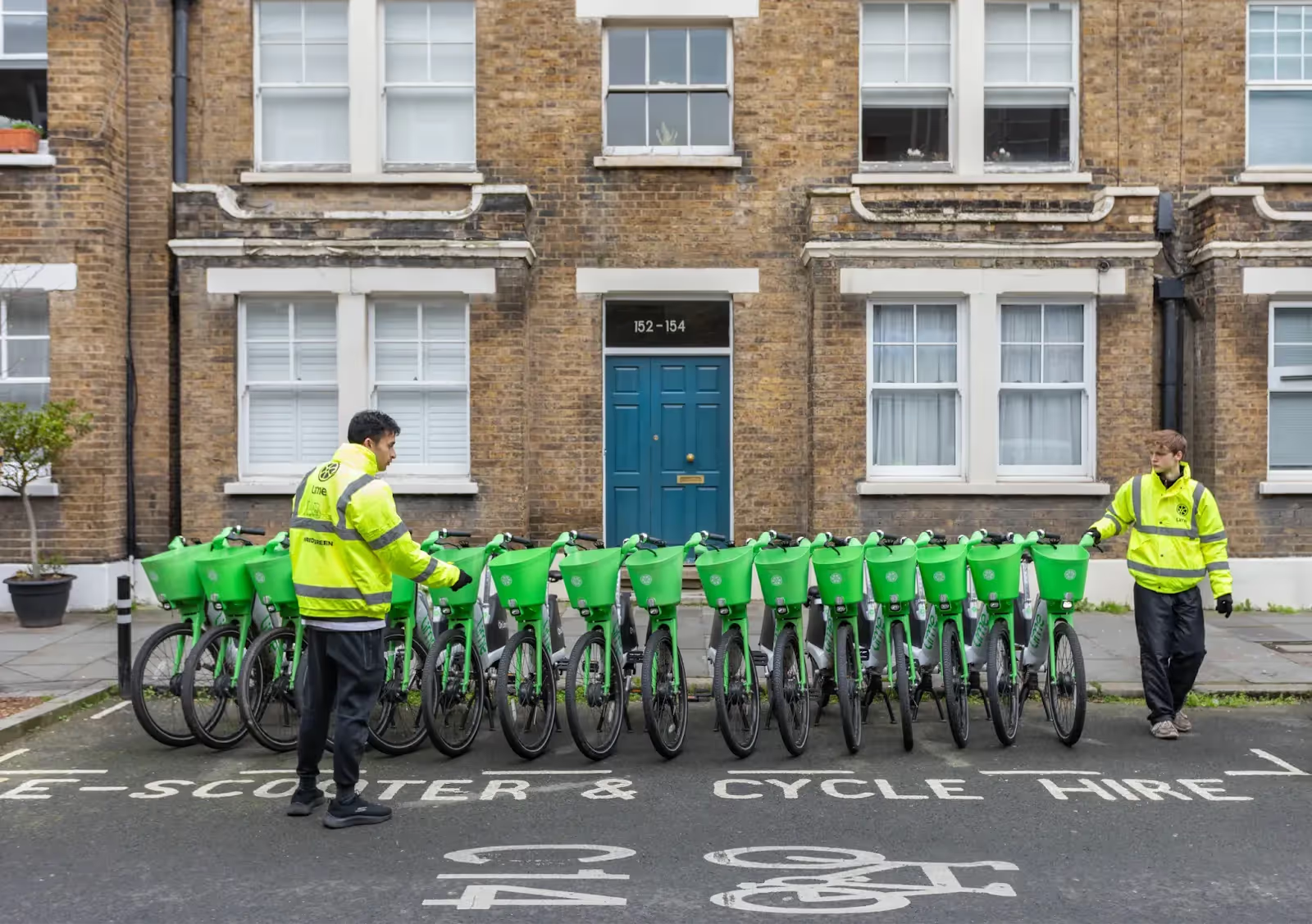
London arrived at the same problem from a different direction. E-scooters operated under a formal trial, with geofencing and over 600 parking bays in place. Shared e-bikes existed in a different regulatory universe entirely, TfL has no direct powers to regulate rental bikes. 95% of London's roads are managed by individual boroughs, and enforcement varied street by street. In November 2024, TfL committed almost £1m for 7.5k new spaces, with targets of 800 on the capital's busiest roads by mid-2025 and 3k by the end of 2026. Lime announced a £20m action plan covering 2.5k dedicated spaces and a 60% increase in on-street patrols. The mayor set a broader target of 40k new bike parking spaces by 2030, with more than 20k already in place across rail and underground stations. The numbers are serious. The governance problem hasn't gone away. It's a work in progress on both counts.
Making it the default
For most of its short history, micromobility parking policy has been invented city by city. A directive passed in April 2024 starts to change that architecture.
Twenty member states adopted the Energy Performance of Buildings Directive, which sets minimum bike parking standards across residential and non-residential buildings throughout Europe. New residential buildings with more than 3 car parking spaces must include at least 2 bike spaces per unit. New non-residential buildings with more than 5 car parking spaces must dedicate at least 15% of average user capacity to bike parking. Member states have until 2026 to put it into national law.
That's a meaningful shift. Bike parking moves from a city-level discretionary decision to a continent-wide minimum standard. The curb is no longer the only place where the question gets resolved.
Where things stand
Paris, Madrid, and Prague licensed shared e-scooter fleets before deciding what to do with the curb. The bill came as complaints, then restrictions, then bans.
Brussels, Berlin, Stockholm, and London looked at the same problem and asked a different question - what would riders actually need in order to park correctly? Then they built it, legislated for it, or both. Each city points to what still needs work. Stockholm's bays still aren't dense enough near transit. London's e-bike governance remains split. But problems are being managed rather than left to accumulate, and that's the difference.
What looked like a behaviour problem was mostly just the predictable result of a new transport mode arriving before anyone had decided what the curb was for. The cities that figured that out stopped trying to change the riders. They changed the infrastructure instead.
Image credits: Voi