12.9M Reasons Why Chicago Got Micromobility Right

Riya Das
News
March 12, 2026

Subscribe

Welcome to Micromobility Pro, a bi-weekly publication which is part of The Micromobility Newsletter, where we deep-dive into the financials of micromobility companies and share exclusive insights tailored for professionals and members.

Micromobility Europe 2026
Join Micromobility Europe 2026 for just €399 today!

Grab your ticket for just €399 and join two days of bold ideas, expert insights, and networking with the innovators shaping the future of urban mobility. This limited-time offer ends on March 16th, so secure your spot today.

Secure your spot today, don’t miss out!

Get Your Ticket

Join McKinsey, Rivian’s ALSO, LYFT, RYDE, Dott, NextBike, POLIS, Urban Sharing, Navee, CityFi, Valeo, XYTE, Vmax and many others!

[Sponsor/Exhibit] | [Speak at the Event] | [Exhibit as a Startup] | [Get A Free Pass]

And to find all about Micromobility America | Nov 11-12 | Palace of Fine Arts, SFO - HERE!

Contents

  • Introduction
  • A City Built on Getting Around
    • Chart: Chicago Shared Micromobility Analysis (2025)
  • Where It Began
    • Chart: Divvy Bikeshare Rides in Chicago (2024 & 2025)
  • Scooters Came in Differently
    • Chart: E-Scooter Trips by Private Operators (2022-2025)
  • Building the Bike Network
  • The Ridership Numbers
    • Chart: Divvy Trips by Vehicle Type (2019-2025)
  • Equity as a Design Choice
  • Where It Goes From Here

Introduction

Chicago is the kind of city that moves on its own terms. It has a transit network that stretches across 77 community areas, a lakefront that draws millions every summer, and winters cold enough to test even the most committed commuter. Yet over the past few years, Chicagoans have been getting on bikes and scooters in numbers that keep breaking records, 8.7m shared trips in 2023, 11m in 2024, and 12.9m in 2025.

To understand how that happened, we have to go back further than the numbers.

A City Built on Getting Around
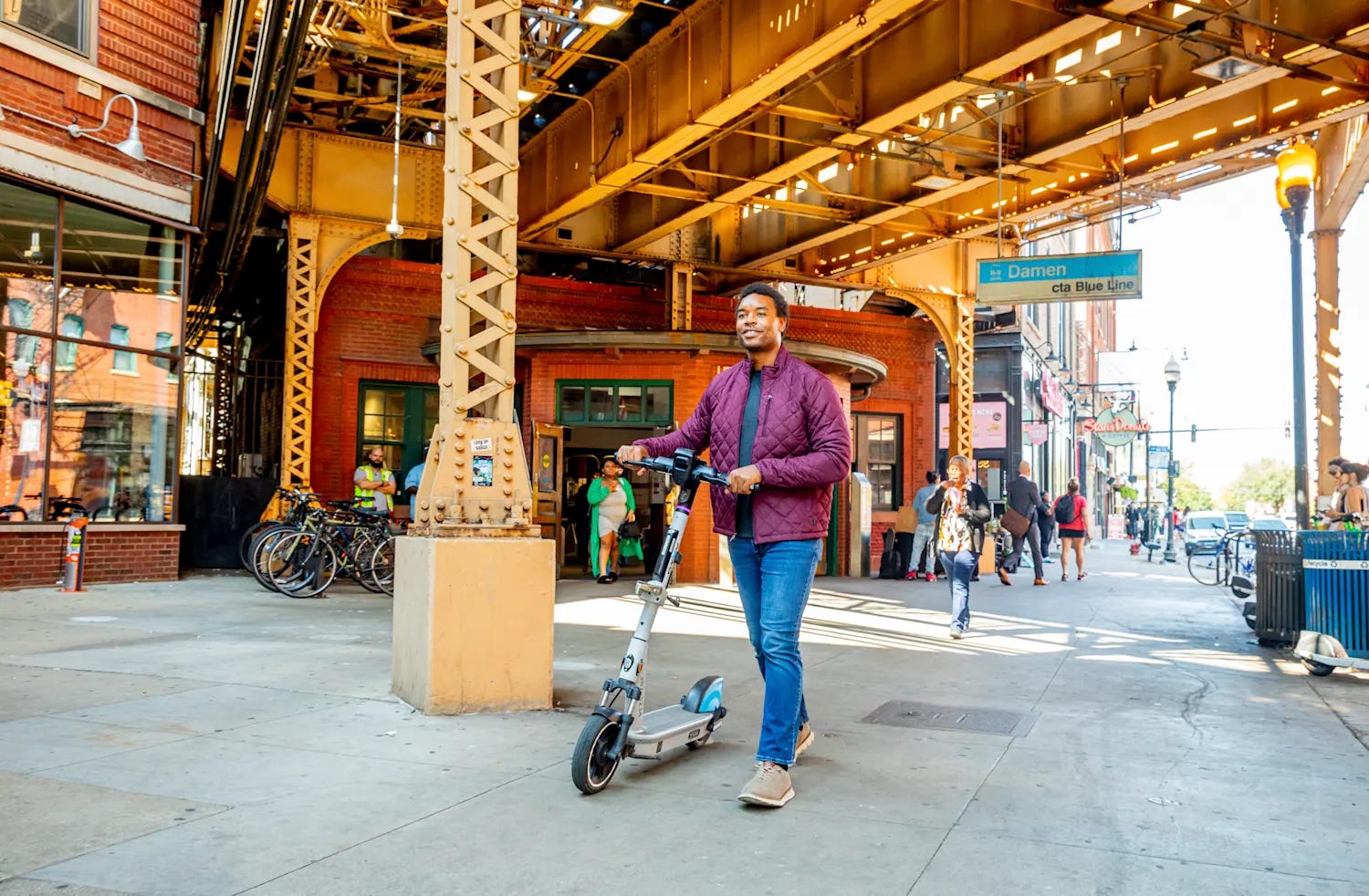
Image credit: Divvy

Chicago has always taken transportation seriously. The “L” train has been running since 1892. The city sits at the intersection of major Amtrak corridors, Metra commuter rail lines, and one of the most extensive CTA bus networks in the country. Getting around without a car has never been impossible here, but it has always had gaps.

Those gaps are exactly where micromobility found its footing. The last stretch from a train station to a workplace, the crosstown trip that requires two transfers, and the neighborhood on the South or West Side where buses run less frequently, these are the problems that bikes and scooters started solving. And as transportation data analytics firm INRIX named Chicago the most congested city in America in fall 2025, with drivers losing roughly 112 hours to traffic congestion that year alone, up 10% from the year before, the case for alternatives only got stronger.

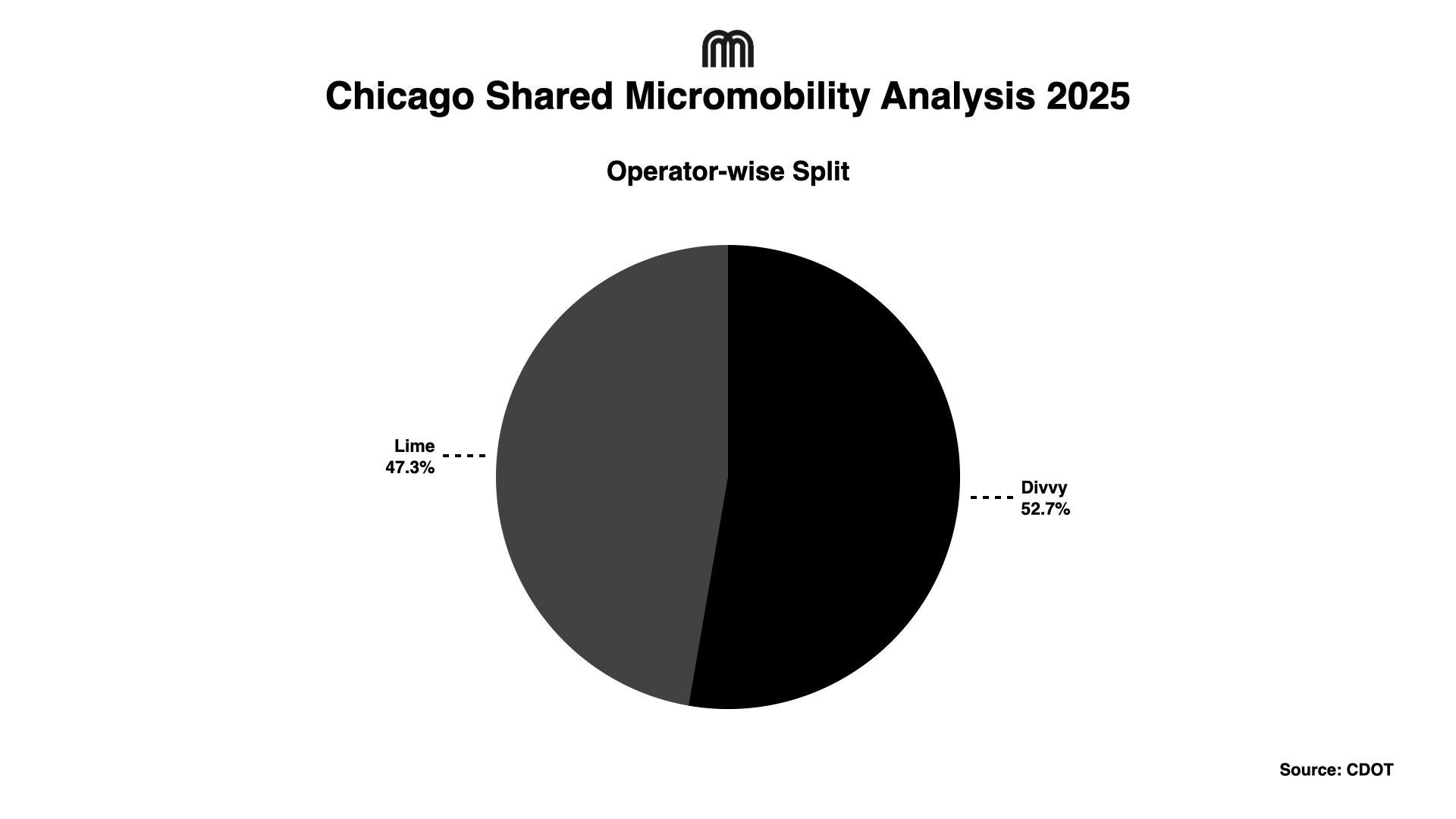
Today, Chicago’s shared micromobility market is served by 2 operators. Divvy, the city-owned bikeshare system operated by Lyft, which offers classic bikes, e-bikes, and docked e-scooters, and Lime, the only independently licensed scooter operator in the city outside downtown. Together, they logged all 12.9m trips taken in 2025.
“Chicago stands out because of its strong public-sector partnership in micromobility and its deeply integrated transportation network. Micromobility helps relieve pressure on both roadways and transit, while giving riders more flexibility and control over their trips. It also expands access in areas where bus and rail service may be limited or less frequent.” - LeAaron Foley, Lime

The physical integration between Divvy and Chicago’s rail network has become a measurable reality. From January through September 2025, approximately 15% of Divvy trips started or ended at the Divvy station nearest to a CTA rail station. More strikingly, 97% of CTA stations within Chicago, 122 of 126,  have a Divvy station nearby, and 16 of those CTA-adjacent stations rank within the top 10% of the system by trip activity. On the Metra side, 72% of stations within the city have a nearby Divvy station, with 9 of them among the system’s busiest performers.

That integration has roots going back over a decade.

Where It Began
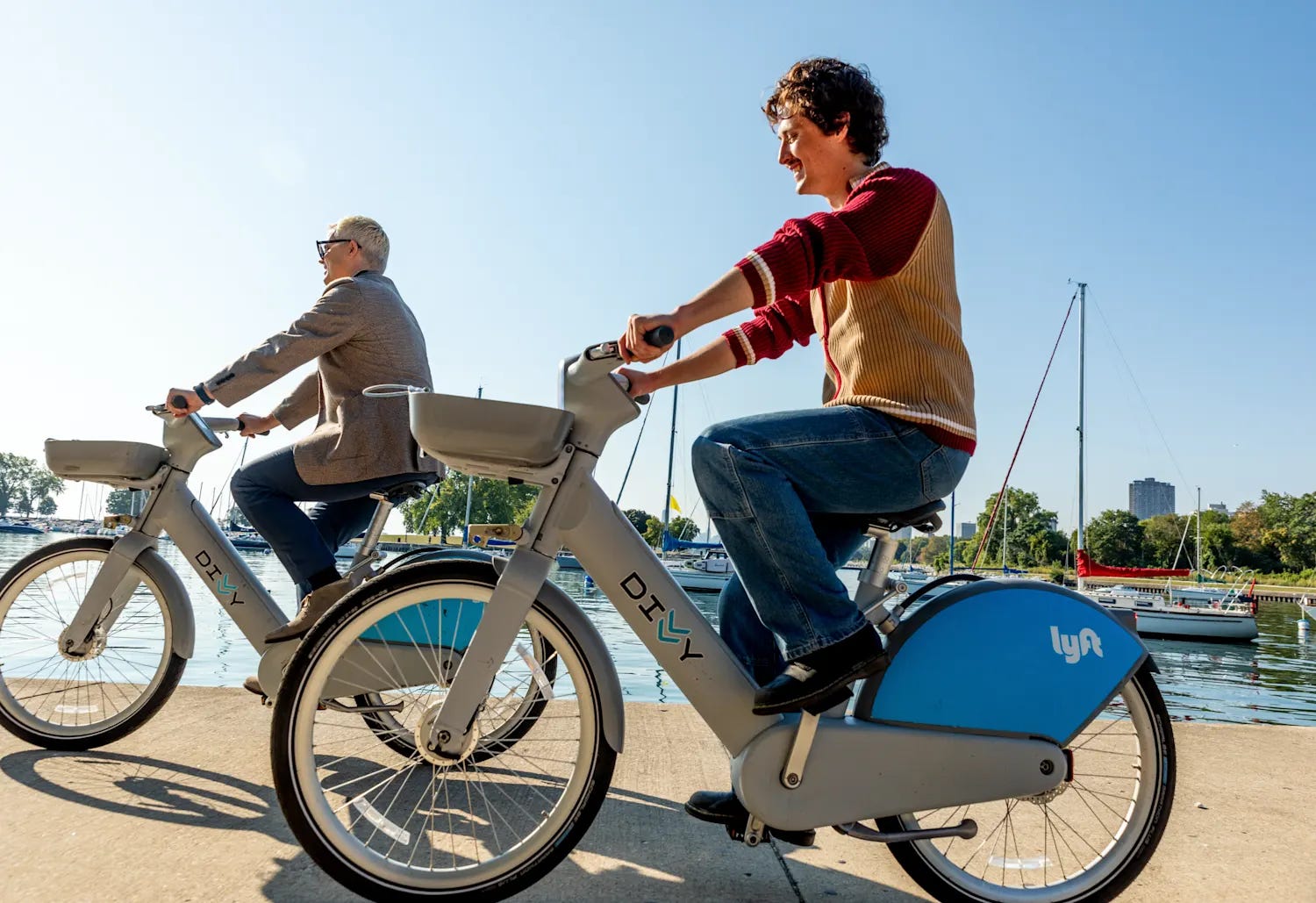
Image credit: Divvy

In 2007, then-Mayor Richard M. Daley visited Paris and encountered Vélib’, the city’s bike-share system. He came back to Chicago and asked the private sector to build something similar. 6 years later, in 2013, Divvy launched with 750 bicycles at 75 stations, covering a corridor from the Loop south to 59th Street and west to Kedzie Avenue. That first weekend, Chicagoans took ~4.12k trips on bikes painted Chicago blue.

The system grew steadily through the decade, but the real shift came in 2019 when the Chicago City Council approved a $50m expansion tied to a new operating agreement with Lyft. The deal brought in 10.5k new electric pedal-assist bikes and 175 new stations, with e-bikes formally introduced as a Divvy category in 2020. Lyft became the operator, while the city retained ownership of the equipment, a structure that has largely defined how Divvy has developed since.
By June 2024, Divvy had grown to more than 17k bikes, 1.5k e-scooters, and 950 docking stations, making it the largest bikeshare system by area in North America. In 2025, the Chicago Department of Transportation (CDOT) expanded 140 new stations, bringing the total to around 1.13k stations citywide. The department also expanded in-station charging for e-bikes and e-scooters, reducing the need for manual battery swapping and improving device availability across the network.

The broader plan to electrify 110 Divvy stations is projected to eliminate nearly 80% of battery-swapping trips, cut 100k vehicle miles traveled annually, and increase e-bike availability by at least 15%.

“The biggest impacts have come from expanding the network where gaps exist, densifying high-demand areas with additional docks, and installing electrified charging equipment that keeps e-devices available throughout the day. Those investments make it easier to find and return bikes and improve overall reliability, which directly supports higher ridership.” - Chicago Department of Transportation (CDOT)

Pricing has also been adjusted to keep pace with these investments. Effective March 11, 2026, Divvy raised several of its per-minute rates, scooter rides from 31¢ to 34¢ per minute, e-bike and classic bike rides from 19¢ to 20¢ per minute after the included 45 minutes, and the daily pass from $18.10 to $19.90. Out-of-station parking fees for e-bikes and scooters rose from $1.30 to $2 for members. The Divvy for Everyone program and its subsidized memberships remain the main buffer for price-sensitive riders.

Scooters Came in Differently

Image credit: Lime

Shared scooters arrived in Chicago the messier way, through a series of pilots that the city used to figure out what it actually wanted.

The first, ran from June to October 2019, across a 50-square-mile area on the northwest and west sides. 10 companies each deployed 250 scooters, and Chicagoans took 821.6k trips over 4 months.

The city learned a lot. Ridership was heaviest in areas that already had good transit. Sidewalk clutter was a genuine complaint. And 192 probable emergency department visits related to scooter incidents were recorded during the pilot period, a rate of 0.23 per 100k trips, with about 93% of those cases involving riders themselves and 98% discharged with non-serious injuries. Of those surveyed, 59% wanted the program to continue, but that figure masked a sharp divide: 84% of actual riders were in favor compared to just 21% of non-riders.

A second pilot followed in August 2020, this time with 3 vendors - Lime, Bird, and Spin, deploying nearly 10k scooters across most of the city. The ER visit rate ticked slightly to 0.27 per 100k trips, and 171 probable ER visits were recorded. New rules required scooters to be locked to fixed objects at the end of each trip, addressing the sidewalk clutter problem that had drawn the most complaints.

In 2021, City Council established a formal scooter sharing license, setting the legal framework for a permanent program.
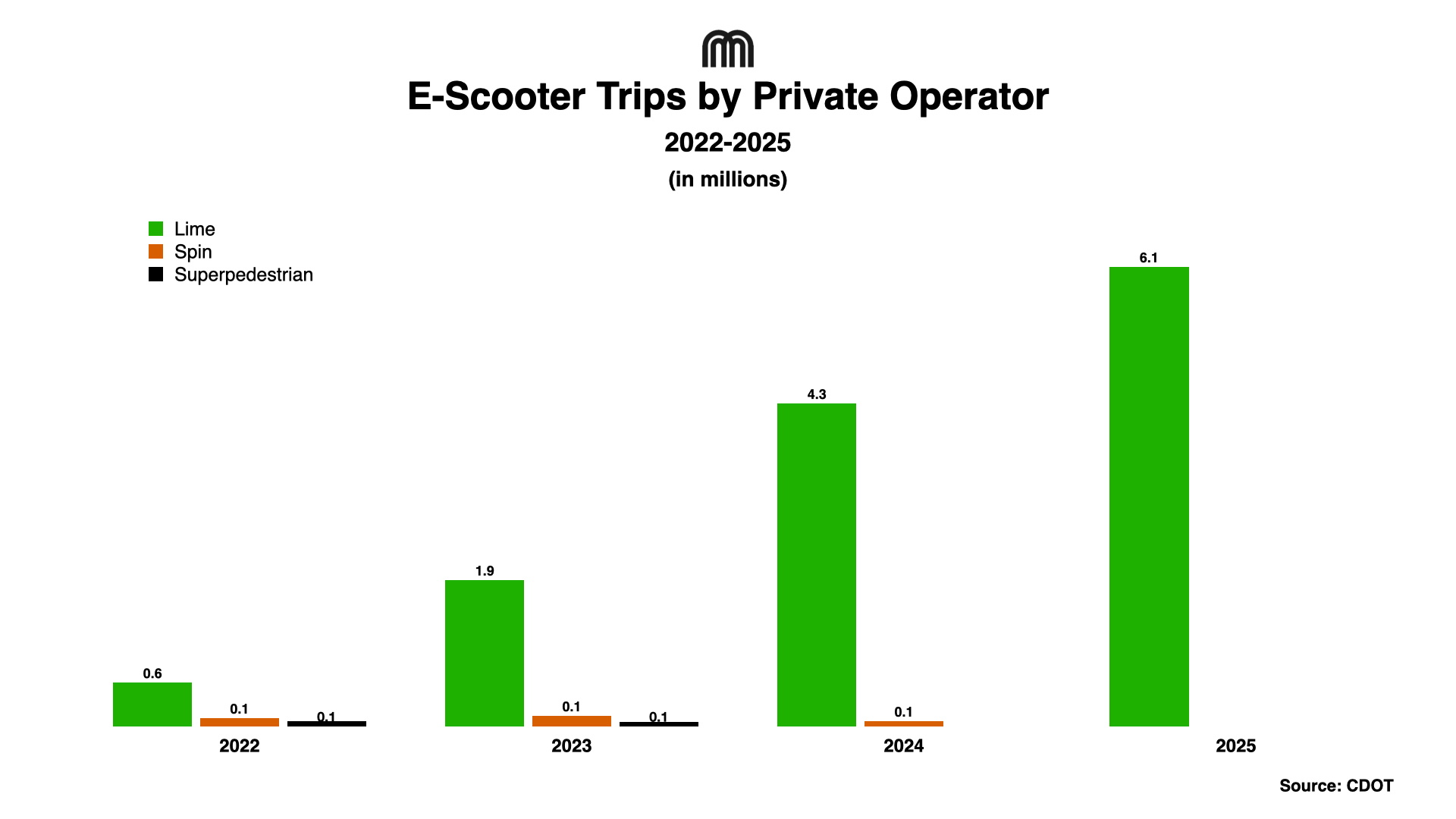
The permanent program launched in May 2022, with licenses awarded to Lime, Spin, and Superpedestrian, each allowed to operate up to 1k scooters, expandable to 2k. Divvy simultaneously added 1k docked scooters at 230 stations in and near downtown, becoming the first bikeshare system in the country to incorporate docked e-scooters.

Superpedestrian exited the Chicago market in September 2023, citing the competitive difficulty of operating alongside Lyft, which had preferential access to the Central Business District through its Divvy contract. With 12.5% of the city’s scooters but only 4% of rides, the economics hadn’t worked. Spin continued operating through 2024 before also winding down, leaving Lime as the sole licensed scooter operator outside downtown.

In 2024, the city updated its scooter ordinance in a few meaningful ways. Operating hours extended to include midnight through 5 a.m., offering more options for late-shift workers. The licensing fee structure shifted from a per-scooter formula to a flat $250k two-year license plus a usage-based service fee. The ordinance also required that at least 5% of each operator’s fleet consist of seated scooters, expanding accessibility for riders who cannot or prefer not to stand.

Safety has improved considerably alongside the program’s maturation. The injury rate dropped from roughly 28 per 100k trips during the pilot programs to approximately 14 per 100k under the permanent program.

In 2025, CDOT and the Chicago Department of Business Affairs and Consumer Protection (BACP) went further, requiring every shared scooter operating in Chicago to include sidewalk riding detection technology to improve pedestrian safety and parking compliance.

Building the Bike Network
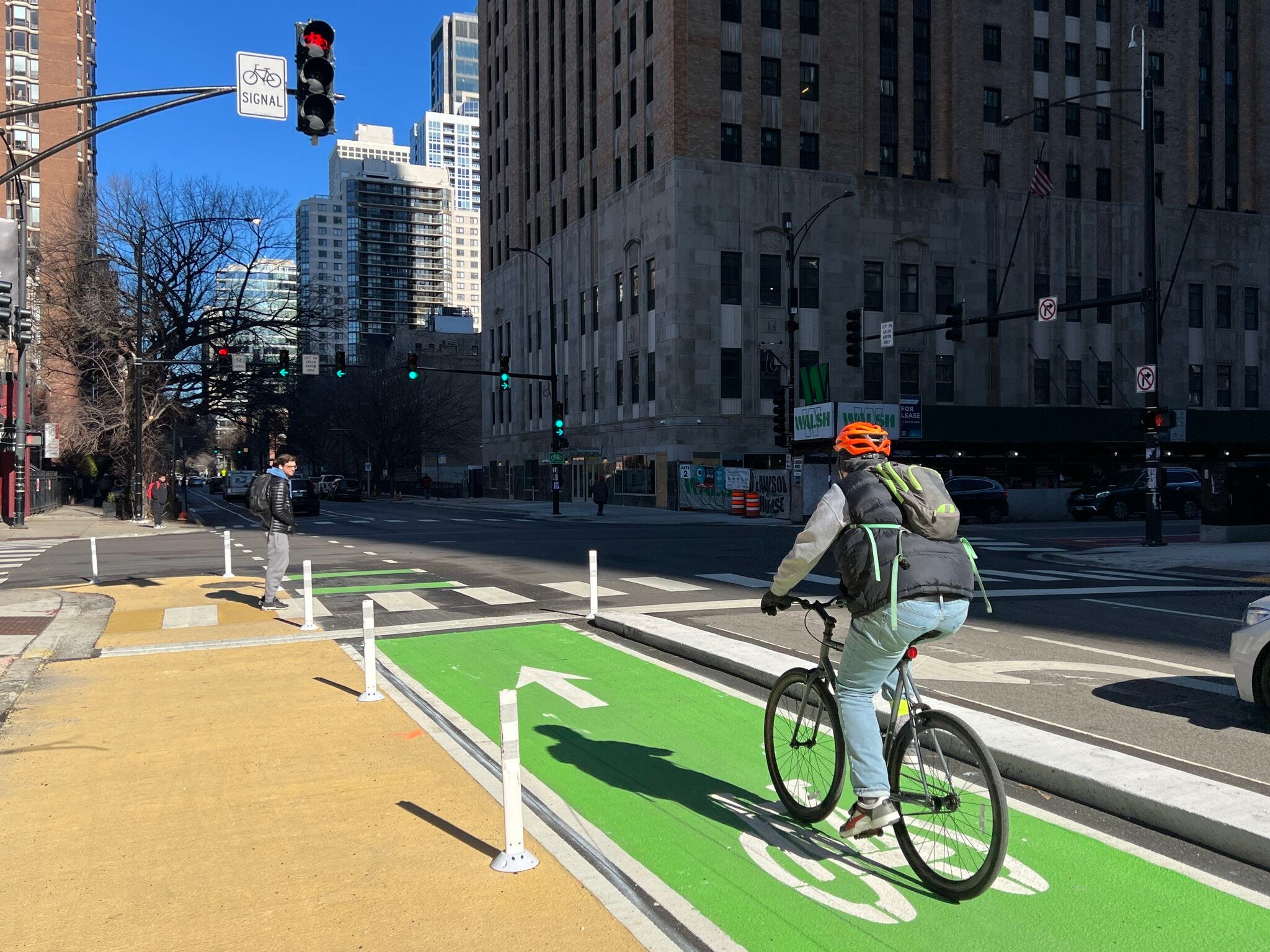
Image credit: CDOT

The ridership growth didn’t happen in a vacuum. Chicago was simultaneously building out the physical infrastructure that made biking and riding scooters more practical, and doing it faster than it ever had before.

For most of the 2010s, the city added roughly 15 miles of new bike lanes per year. That pace doubled after 2020, when dedicated funding from Mayor Lightfoot’s Chicago Works capital plan began flowing into bicycle and pedestrian infrastructure. In 2022, CDOT announced the largest protected bike lane expansion in the city’s history, 25 miles of new concrete-protected lanes, along with plans to upgrade all existing delineator-protected lanes to concrete by the end of 2023.

The Chicago Cycling Strategy, released in March 2023, set out the longer-term vision - 150 new miles of bikeways, with 85% of them being protected lanes or neighborhood greenways. The goal was to raise the share of Chicagoans living within half a mile of a low-stress bikeway from 50% to 70%. CDOT installed roughly 55 miles of bikeways in 2023 alone, including 27 miles of new or upgraded protected bike lanes and 18 miles of neighborhood greenways. By the end of 2024, Chicago’s cycling network had reached a total of 478 miles total.

A joint analysis by CDOT and Replica found that cycling in Chicago grew 119% between fall 2019 and spring 2023, the highest growth rate among the 10 largest cities in the United States. Crosstown trips were up 180%, neighborhood trips up 113%. Growth cut across demographic groups, with a 166% increase among people of color cyclists and 207% among zero-car households.

“The City significantly expanded the Divvy network with Lyft, continued deploying electrified charging infrastructure, and made pricing changes that lowered barriers for new riders. At the same time, Chicago has installed more than 100 miles of new bikeways in the past two years. When the network grows, the bikes are reliably charged, and the streets feel safer — ridership follows.” - Chicago Department of Transportation (CDOT)

The Ridership Numbers
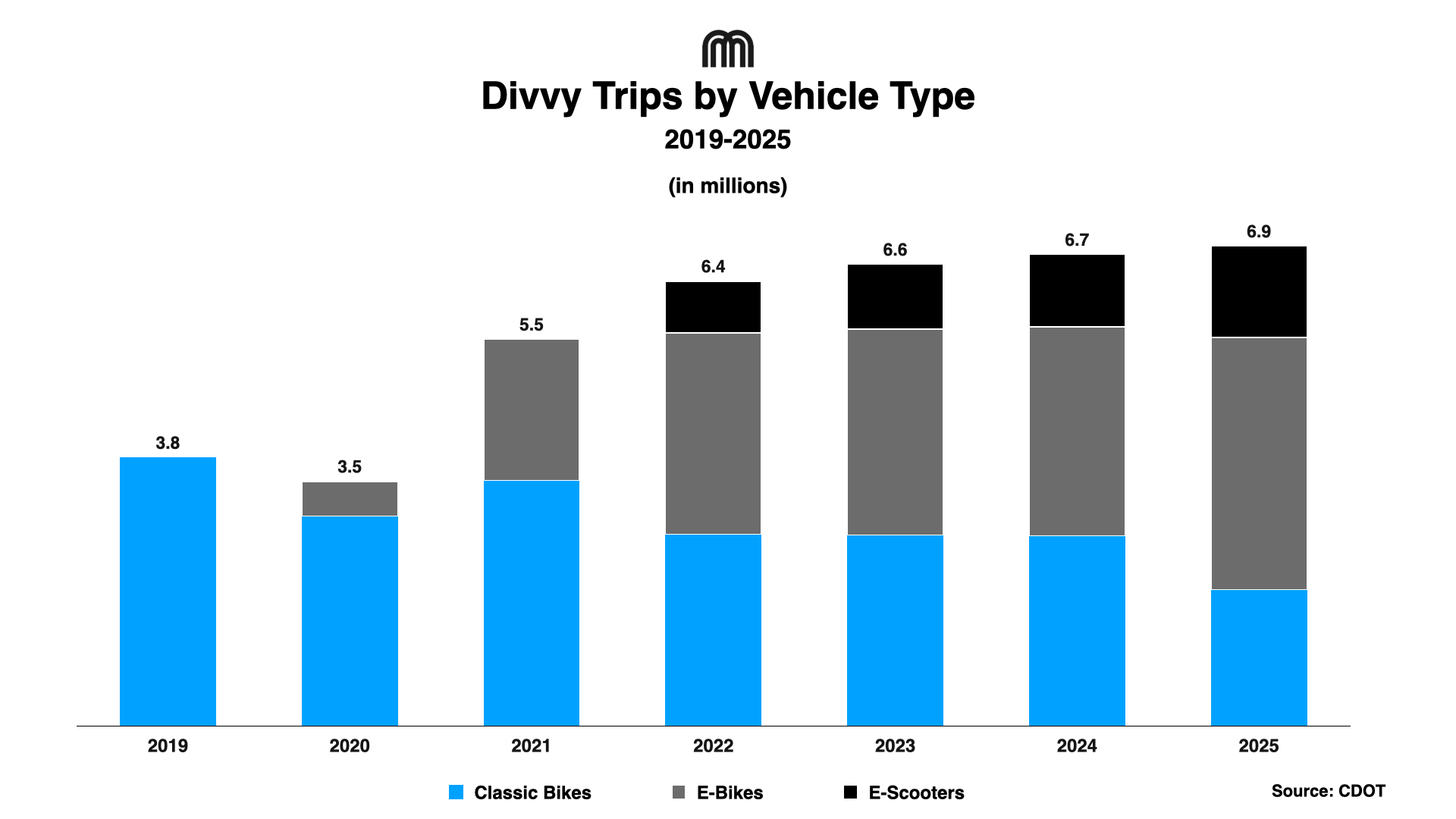
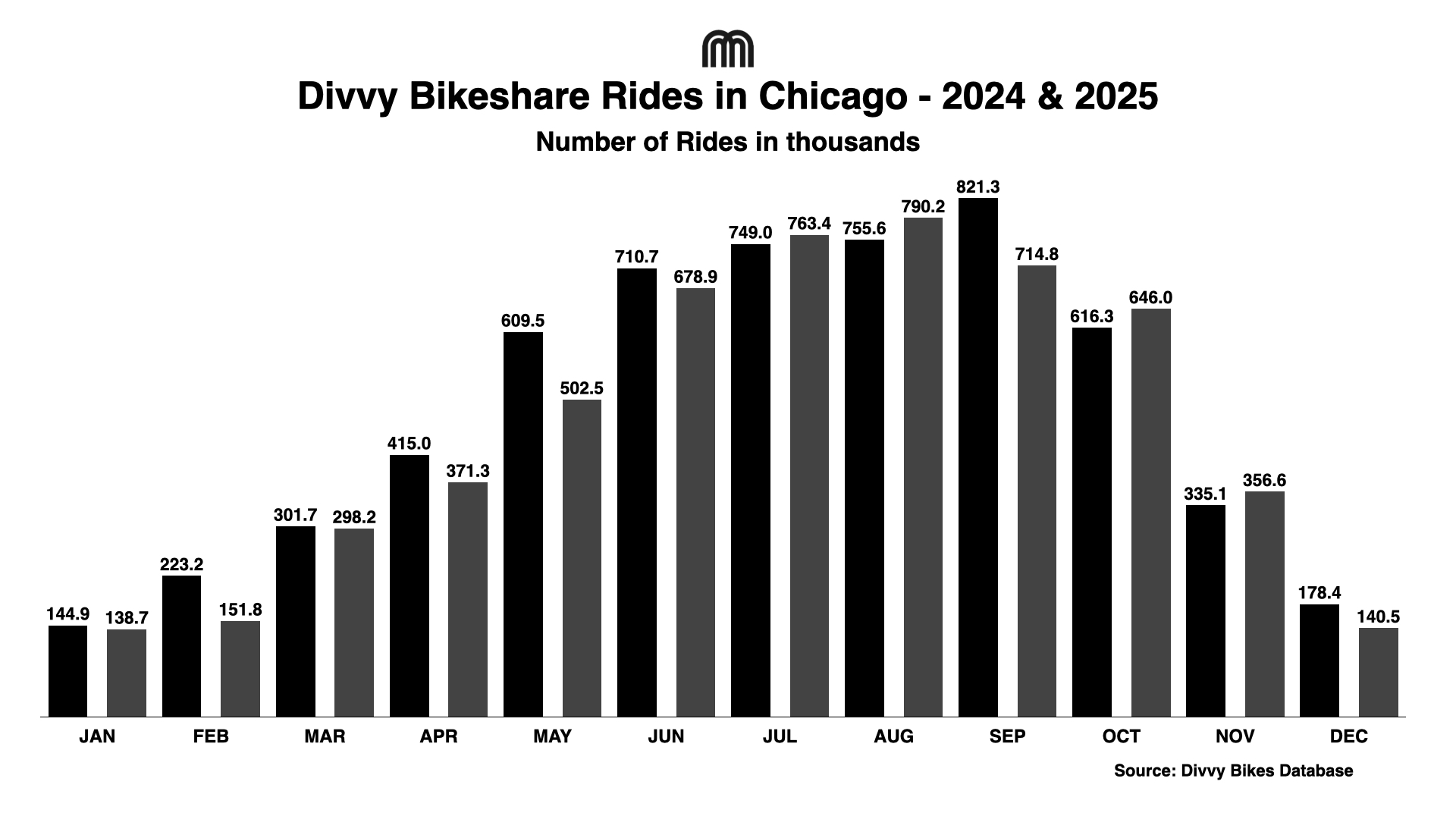
Divvy hit record ridership for 4 consecutive years leading into 2024, logging 6.6m trips in 2023 and 6.7m in 2024. In 2025, it reached 6.8m, its highest annual total ever, with e-bike and scooter rides each growing by over 20%.

Lime’s trajectory has been steeper still, from just over 1m rides in 2023, to 4.3m in 2024, to 6.1m in 2025.

“In 2025, riders took more than 6 million trips on Lime, reflecting growing demand for affordable transportation, particularly along the city’s newest protected bike lane corridors. Our continued partnership with the City of Chicago focuses on expanding access through affordable rides and greater availability to help ensure shared mobility works for all 77 communities across the city.” - LeAaron Foley, Lime

Chicago also held firm through winter. The 2025 ridership record was set across a full calendar year, including the months most likely to keep riders indoors. Lime manages the cold through a combination of operational protocols and real-time monitoring.

“We work closely with the city on keeping wheels on the ground for our dedicated Chicago riders who don’t let the cold stop them. We pay close attention to weather reports and alerts, and remove the ability to rent a fleet when conditions are dangerous, such as icy roads and temperatures below 20°F. All that said, Chicago residents and visitors are folks who don’t let a little cold weather stop them from getting where they need to go. At Lime, our team handles in-field repairs, tidiness and routine maintenance to keep the fleet out and about for those who need them.” - LeAaron Foley, Lime

Equity as a Design Choice

From early on, both the city and its operators treated access as something that needed to be built deliberately rather than assumed.

The permanent scooter program required operators to deploy at least 50% of their fleets in designated Equity Priority Areas on the South and West Sides, neighborhoods where residents have fewer public transportation options and lower car ownership rates. By the time Superpedestrian exited, about 42% of all scooter trips systemwide were beginning in these communities, up from 23% during the 2020 pilot.

Lime’s equity approach goes beyond deployment requirements. The company offers automatic 50% discounts on rides that start on the South and West Sides, and its Lime Access program extends 50% discounts to any Chicago rider receiving city, state, or federal subsidies, regardless of where in the city they live. In 2024, riders in Lime’s Equity Priority Areas took 1.66m trips and saved a combined $3.8m. Since Lime launched in Chicago, low-income and equity zone riders have taken 2.7m trips, saving more than $6.2m in total.

On Divvy’s side, the Divvy for Everyone (D4E) program offers $5 annual memberships and reduced per-minute rates for income-eligible residents. Enrollment quadrupled between 2020 and 2023, reaching 8k members. In 2025, the city invested more than $3m into Divvy, including a $550k subsidy that froze annual membership prices at $143 for over 9.2k members instead of the new rate of $159, and added more than 5.5k discounted $99 memberships for new or returning riders.

CDOT measures the success of these programs through a combination of participation metrics, geographic coverage, and usage data. The department tracks D4E enrollment growth, with a 2026 target of 500 net new members, along with outreach event attendance in Equity Priority Areas, engagement from targeted ad campaigns, and YoY D4E retention rates. Sign-up has also been streamlined via QR codes and the Divvy website.

Where It Goes From Here

A decade ago, Chicago was a city with a strong transit backbone and a patchwork of bike lanes. Today, it has 478 miles of cycling infrastructure, 1.13k Divvy stations, a citywide licensed scooter operator, and 12.9m shared trips in a single year. This is the result of a city that ran pilots, learned from them, built policy around what worked, and kept investing even when the numbers were still small.

The momentum heading into 2026 is real. The citywide bike network is on track to surpass 500 miles. More than 200 new Divvy stations are planned for installation this year, pushing deeper into neighborhoods that have historically had the fewest options. Electrified station charging, already reducing battery swap trips by up to 80%, will keep more e-bikes and scooters available throughout the day. Lime, now in its seventh year in Chicago, has committed to investing up to $40m in the city over the next few years, signaling that the private operators see a long-term future here too.

The case Chicago has built, that shared micromobility works best when it is treated as part of a transit system rather than an add-on to one, is now backed by years of ridership data, equity outcomes, and infrastructure investment. The next record is not a question of whether Chicagoans want to ride. They’ve already answered that.

Got your micromobility moment to share? Email us at press@micromobility.io

Loving the vibe? Hop on and ride with us! Subscribe!

Twitter | YouTube | LinkedIn | Instagram | Blog | Podcast

Sign up for free for the Micromobility Newsletter - the world’s largest newsletter about small vehicles - and receive best-in-class insights, analysis, and commentary. Trusted by over 75,000 riders, insiders, builders and enthusiasts.

Welcome to Micromobility Pro, a bi-weekly publication which is part of The Micromobility Newsletter, where we deep-dive into the financials of micromobility companies and share exclusive insights tailored for professionals and members.

Micromobility Europe 2026

Join Micromobility Europe 2026 for just €399 today!

Grab your ticket for just €399 and join two days of bold ideas, expert insights, and networking with the innovators shaping the future of urban mobility. This limited-time offer ends on March 16th, so secure your spot today.

Secure your spot today, don’t miss out!

Get Your Ticket

Join McKinsey, Rivian’s ALSO, LYFT, RYDE, Dott, NextBike, POLIS, Urban Sharing, Navee, CityFi, Valeo, XYTE, Vmax and many others!

[Sponsor/Exhibit] | [Speak at the Event] | [Exhibit as a Startup] | [Get A Free Pass]

And to find all about Micromobility America | Nov 11-12 | Palace of Fine Arts, SFO - HERE!

Contents

  • Introduction
  • A City Built on Getting Around
    • Chart: Chicago Shared Micromobility Analysis (2025)
  • Where It Began
    • Chart: Divvy Bikeshare Rides in Chicago (2024 & 2025)
  • Scooters Came in Differently
    • Chart: E-Scooter Trips by Private Operators (2022-2025)
  • Building the Bike Network
  • The Ridership Numbers
    • Chart: Divvy Trips by Vehicle Type (2019-2025)
  • Equity as a Design Choice
  • Where It Goes From Here

Introduction

Chicago is the kind of city that moves on its own terms. It has a transit network that stretches across 77 community areas, a lakefront that draws millions every summer, and winters cold enough to test even the most committed commuter. Yet over the past few years, Chicagoans have been getting on bikes and scooters in numbers that keep breaking records, 8.7m shared trips in 2023, 11m in 2024, and 12.9m in 2025.

To understand how that happened, we have to go back further than the numbers.

A City Built on Getting Around

Image credit: Divvy

Chicago has always taken transportation seriously. The “L” train has been running since 1892. The city sits at the intersection of major Amtrak corridors, Metra commuter rail lines, and one of the most extensive CTA bus networks in the country. Getting around without a car has never been impossible here, but it has always had gaps.

Those gaps are exactly where micromobility found its footing. The last stretch from a train station to a workplace, the crosstown trip that requires two transfers, and the neighborhood on the South or West Side where buses run less frequently, these are the problems that bikes and scooters started solving. And as transportation data analytics firm INRIX named Chicago the most congested city in America in fall 2025, with drivers losing roughly 112 hours to traffic congestion that year alone, up 10% from the year before, the case for alternatives only got stronger.

Today, Chicago’s shared micromobility market is served by 2 operators. Divvy, the city-owned bikeshare system operated by Lyft, which offers classic bikes, e-bikes, and docked e-scooters, and Lime, the only independently licensed scooter operator in the city outside downtown. Together, they logged all 12.9m trips taken in 2025.

“Chicago stands out because of its strong public-sector partnership in micromobility and its deeply integrated transportation network. Micromobility helps relieve pressure on both roadways and transit, while giving riders more flexibility and control over their trips. It also expands access in areas where bus and rail service may be limited or less frequent.” - LeAaron Foley, Lime

The physical integration between Divvy and Chicago’s rail network has become a measurable reality. From January through September 2025, approximately 15% of Divvy trips started or ended at the Divvy station nearest to a CTA rail station. More strikingly, 97% of CTA stations within Chicago, 122 of 126,  have a Divvy station nearby, and 16 of those CTA-adjacent stations rank within the top 10% of the system by trip activity. On the Metra side, 72% of stations within the city have a nearby Divvy station, with 9 of them among the system’s busiest performers.

That integration has roots going back over a decade.

Where It Began

Image credit: Divvy

In 2007, then-Mayor Richard M. Daley visited Paris and encountered Vélib’, the city’s bike-share system. He came back to Chicago and asked the private sector to build something similar. 6 years later, in 2013, Divvy launched with 750 bicycles at 75 stations, covering a corridor from the Loop south to 59th Street and west to Kedzie Avenue. That first weekend, Chicagoans took ~4.12k trips on bikes painted Chicago blue.

The system grew steadily through the decade, but the real shift came in 2019 when the Chicago City Council approved a $50m expansion tied to a new operating agreement with Lyft. The deal brought in 10.5k new electric pedal-assist bikes and 175 new stations, with e-bikes formally introduced as a Divvy category in 2020. Lyft became the operator, while the city retained ownership of the equipment, a structure that has largely defined how Divvy has developed since.

By June 2024, Divvy had grown to more than 17k bikes, 1.5k e-scooters, and 950 docking stations, making it the largest bikeshare system by area in North America. In 2025, the Chicago Department of Transportation (CDOT) expanded 140 new stations, bringing the total to around 1.13k stations citywide. The department also expanded in-station charging for e-bikes and e-scooters, reducing the need for manual battery swapping and improving device availability across the network.

The broader plan to electrify 110 Divvy stations is projected to eliminate nearly 80% of battery-swapping trips, cut 100k vehicle miles traveled annually, and increase e-bike availability by at least 15%.

“The biggest impacts have come from expanding the network where gaps exist, densifying high-demand areas with additional docks, and installing electrified charging equipment that keeps e-devices available throughout the day. Those investments make it easier to find and return bikes and improve overall reliability, which directly supports higher ridership.” - Chicago Department of Transportation (CDOT)

Pricing has also been adjusted to keep pace with these investments. Effective March 11, 2026, Divvy raised several of its per-minute rates, scooter rides from 31¢ to 34¢ per minute, e-bike and classic bike rides from 19¢ to 20¢ per minute after the included 45 minutes, and the daily pass from $18.10 to $19.90. Out-of-station parking fees for e-bikes and scooters rose from $1.30 to $2 for members. The Divvy for Everyone program and its subsidized memberships remain the main buffer for price-sensitive riders.

Scooters Came in Differently

Image credit: Lime

Shared scooters arrived in Chicago the messier way, through a series of pilots that the city used to figure out what it actually wanted.

The first, ran from June to October 2019, across a 50-square-mile area on the northwest and west sides. 10 companies each deployed 250 scooters, and Chicagoans took 821.6k trips over 4 months.

The city learned a lot. Ridership was heaviest in areas that already had good transit. Sidewalk clutter was a genuine complaint. And 192 probable emergency department visits related to scooter incidents were recorded during the pilot period, a rate of 0.23 per 100k trips, with about 93% of those cases involving riders themselves and 98% discharged with non-serious injuries. Of those surveyed, 59% wanted the program to continue, but that figure masked a sharp divide: 84% of actual riders were in favor compared to just 21% of non-riders.

A second pilot followed in August 2020, this time with 3 vendors - Lime, Bird, and Spin, deploying nearly 10k scooters across most of the city. The ER visit rate ticked slightly to 0.27 per 100k trips, and 171 probable ER visits were recorded. New rules required scooters to be locked to fixed objects at the end of each trip, addressing the sidewalk clutter problem that had drawn the most complaints.

In 2021, City Council established a formal scooter sharing license, setting the legal framework for a permanent program.

The permanent program launched in May 2022, with licenses awarded to Lime, Spin, and Superpedestrian, each allowed to operate up to 1k scooters, expandable to 2k. Divvy simultaneously added 1k docked scooters at 230 stations in and near downtown, becoming the first bikeshare system in the country to incorporate docked e-scooters.

Superpedestrian exited the Chicago market in September 2023, citing the competitive difficulty of operating alongside Lyft, which had preferential access to the Central Business District through its Divvy contract. With 12.5% of the city’s scooters but only 4% of rides, the economics hadn’t worked. Spin continued operating through 2024 before also winding down, leaving Lime as the sole licensed scooter operator outside downtown.

In 2024, the city updated its scooter ordinance in a few meaningful ways. Operating hours extended to include midnight through 5 a.m., offering more options for late-shift workers. The licensing fee structure shifted from a per-scooter formula to a flat $250k two-year license plus a usage-based service fee. The ordinance also required that at least 5% of each operator’s fleet consist of seated scooters, expanding accessibility for riders who cannot or prefer not to stand.

Safety has improved considerably alongside the program’s maturation. The injury rate dropped from roughly 28 per 100k trips during the pilot programs to approximately 14 per 100k under the permanent program.

In 2025, CDOT and the Chicago Department of Business Affairs and Consumer Protection (BACP) went further, requiring every shared scooter operating in Chicago to include sidewalk riding detection technology to improve pedestrian safety and parking compliance.

Building the Bike Network

Image credit: CDOT

The ridership growth didn’t happen in a vacuum. Chicago was simultaneously building out the physical infrastructure that made biking and riding scooters more practical, and doing it faster than it ever had before.

For most of the 2010s, the city added roughly 15 miles of new bike lanes per year. That pace doubled after 2020, when dedicated funding from Mayor Lightfoot’s Chicago Works capital plan began flowing into bicycle and pedestrian infrastructure. In 2022, CDOT announced the largest protected bike lane expansion in the city’s history, 25 miles of new concrete-protected lanes, along with plans to upgrade all existing delineator-protected lanes to concrete by the end of 2023.

The Chicago Cycling Strategy, released in March 2023, set out the longer-term vision - 150 new miles of bikeways, with 85% of them being protected lanes or neighborhood greenways. The goal was to raise the share of Chicagoans living within half a mile of a low-stress bikeway from 50% to 70%. CDOT installed roughly 55 miles of bikeways in 2023 alone, including 27 miles of new or upgraded protected bike lanes and 18 miles of neighborhood greenways. By the end of 2024, Chicago’s cycling network had reached a total of 478 miles total.

A joint analysis by CDOT and Replica found that cycling in Chicago grew 119% between fall 2019 and spring 2023, the highest growth rate among the 10 largest cities in the United States. Crosstown trips were up 180%, neighborhood trips up 113%. Growth cut across demographic groups, with a 166% increase among people of color cyclists and 207% among zero-car households.

“The City significantly expanded the Divvy network with Lyft, continued deploying electrified charging infrastructure, and made pricing changes that lowered barriers for new riders. At the same time, Chicago has installed more than 100 miles of new bikeways in the past two years. When the network grows, the bikes are reliably charged, and the streets feel safer — ridership follows.” - Chicago Department of Transportation (CDOT)

The Ridership Numbers

Divvy hit record ridership for 4 consecutive years leading into 2024, logging 6.6m trips in 2023 and 6.7m in 2024. In 2025, it reached 6.8m, its highest annual total ever, with e-bike and scooter rides each growing by over 20%.

Lime’s trajectory has been steeper still, from just over 1m rides in 2023, to 4.3m in 2024, to 6.1m in 2025.

“In 2025, riders took more than 6 million trips on Lime, reflecting growing demand for affordable transportation, particularly along the city’s newest protected bike lane corridors. Our continued partnership with the City of Chicago focuses on expanding access through affordable rides and greater availability to help ensure shared mobility works for all 77 communities across the city.” - LeAaron Foley, Lime

Chicago also held firm through winter. The 2025 ridership record was set across a full calendar year, including the months most likely to keep riders indoors. Lime manages the cold through a combination of operational protocols and real-time monitoring.

“We work closely with the city on keeping wheels on the ground for our dedicated Chicago riders who don’t let the cold stop them. We pay close attention to weather reports and alerts, and remove the ability to rent a fleet when conditions are dangerous, such as icy roads and temperatures below 20°F. All that said, Chicago residents and visitors are folks who don’t let a little cold weather stop them from getting where they need to go. At Lime, our team handles in-field repairs, tidiness and routine maintenance to keep the fleet out and about for those who need them.” - LeAaron Foley, Lime

Equity as a Design Choice

From early on, both the city and its operators treated access as something that needed to be built deliberately rather than assumed.

The permanent scooter program required operators to deploy at least 50% of their fleets in designated Equity Priority Areas on the South and West Sides, neighborhoods where residents have fewer public transportation options and lower car ownership rates. By the time Superpedestrian exited, about 42% of all scooter trips systemwide were beginning in these communities, up from 23% during the 2020 pilot.

Lime’s equity approach goes beyond deployment requirements. The company offers automatic 50% discounts on rides that start on the South and West Sides, and its Lime Access program extends 50% discounts to any Chicago rider receiving city, state, or federal subsidies, regardless of where in the city they live. In 2024, riders in Lime’s Equity Priority Areas took 1.66m trips and saved a combined $3.8m. Since Lime launched in Chicago, low-income and equity zone riders have taken 2.7m trips, saving more than $6.2m in total.

On Divvy’s side, the Divvy for Everyone (D4E) program offers $5 annual memberships and reduced per-minute rates for income-eligible residents. Enrollment quadrupled between 2020 and 2023, reaching 8k members. In 2025, the city invested more than $3m into Divvy, including a $550k subsidy that froze annual membership prices at $143 for over 9.2k members instead of the new rate of $159, and added more than 5.5k discounted $99 memberships for new or returning riders.

CDOT measures the success of these programs through a combination of participation metrics, geographic coverage, and usage data. The department tracks D4E enrollment growth, with a 2026 target of 500 net new members, along with outreach event attendance in Equity Priority Areas, engagement from targeted ad campaigns, and YoY D4E retention rates. Sign-up has also been streamlined via QR codes and the Divvy website.

Where It Goes From Here

A decade ago, Chicago was a city with a strong transit backbone and a patchwork of bike lanes. Today, it has 478 miles of cycling infrastructure, 1.13k Divvy stations, a citywide licensed scooter operator, and 12.9m shared trips in a single year. This is the result of a city that ran pilots, learned from them, built policy around what worked, and kept investing even when the numbers were still small.

The momentum heading into 2026 is real. The citywide bike network is on track to surpass 500 miles. More than 200 new Divvy stations are planned for installation this year, pushing deeper into neighborhoods that have historically had the fewest options. Electrified station charging, already reducing battery swap trips by up to 80%, will keep more e-bikes and scooters available throughout the day. Lime, now in its seventh year in Chicago, has committed to investing up to $40m in the city over the next few years, signaling that the private operators see a long-term future here too.

The case Chicago has built, that shared micromobility works best when it is treated as part of a transit system rather than an add-on to one, is now backed by years of ridership data, equity outcomes, and infrastructure investment. The next record is not a question of whether Chicagoans want to ride. They’ve already answered that.

Got your micromobility moment to share? Email us at press@micromobility.io

Loving the vibe? Hop on and ride with us! Subscribe!

Twitter | YouTube | LinkedIn | Instagram | Blog | Podcast

Sign up for free for the Micromobility Newsletter - the world’s largest newsletter about small vehicles - and receive best-in-class insights, analysis, and commentary. Trusted by over 75,000 riders, insiders, builders and enthusiasts.

Welcome to Micromobility Pro, a bi-weekly publication which is part of The Micromobility Newsletter, where we deep-dive into the financials of micromobility companies and share exclusive insights tailored for professionals and members.

Micromobility Europe 2026

Join Micromobility Europe 2026 for just €399 today!

Grab your ticket for just €399 and join two days of bold ideas, expert insights, and networking with the innovators shaping the future of urban mobility. This limited-time offer ends on March 16th, so secure your spot today.

Secure your spot today, don’t miss out!

Get Your Ticket

Join McKinsey, Rivian’s ALSO, Dott, NextBike, POLIS, Urban Sharing, Navee, CityFi, Valeo, XYTE, Vmax and many others!

[Sponsor/Exhibit] | [Speak at the Event] | [Exhibit as a Startup] | [Get A Free Pass]

And to find all about Micromobility America | Nov 11-12 | Palace of Fine Arts, SFO - HERE!

Contents

  • Introduction
  • A City Built on Getting Around
    • Chart: Chicago Shared Micromobility Analysis (2025)
  • Where It Began
    • Chart: Divvy Bikeshare Rides in Chicago (2024 & 2025)
  • Scooters Came in Differently
    • Chart: E-Scooter Trips by Private Operators (2022-2025)
  • Building the Bike Network
  • The Ridership Numbers
    • Chart: Divvy Trips by Vehicle Type (2019-2025)
  • Equity as a Design Choice
  • Where It Goes From Here

Introduction

Chicago is the kind of city that moves on its own terms. It has a transit network that stretches across 77 community areas, a lakefront that draws millions every summer, and winters cold enough to test even the most committed commuter. Yet over the past few years, Chicagoans have been getting on bikes and scooters in numbers that keep breaking records, 8.7m shared trips in 2023, 11m in 2024, and 12.9m in 2025.

To understand how that happened, we have to go back further than the numbers.

A City Built on Getting Around

Image credit: Divvy

Chicago has always taken transportation seriously. The “L” train has been running since 1892. The city sits at the intersection of major Amtrak corridors, Metra commuter rail lines, and one of the most extensive CTA bus networks in the country. Getting around without a car has never been impossible here, but it has always had gaps.

Become a Pro member to gain access to this content plus the entire Micromobility Pro archive.

Micromobility Pro

Starter
for up to 2,500 contacts
and up to 37,500 emails/month
$48
/month
What's included:
Email Designer
Campaign Creator
Web Forms
Analytics
Pro
for up to 5,500 contacts
and up to 57,500 emails/month
$78
/month
What's included:
Email Automations
Custom rDNS
User Management
Form with reCAPTCHA
Best Value
Monthy
Join the leaders in the industry and become a Micromobility Pro Member today!
25
/month
What's included:
Micromobility Pro Articles
Micromobility Pro Newsletter
Member Exclusive Content
Yearly
Get the most popular yearly plan at just €20.80/month with extra perks
250
/year
What's included:
Micromobility Pro Articles
Micromobility Pro Newsletter
Access to Members Only Slack
Discounts on Event Tickets
Fast Track Landscape Application
Best Value
Already a member? Login

Welcome to Micromobility Pro, a bi-weekly publication which is part of The Micromobility Newsletter, where we deep-dive into the financials of micromobility companies and share exclusive insights tailored for professionals and members.

Micromobility Europe 2026

Join Micromobility Europe 2026 for just €399 today!

Grab your ticket for just €399 and join two days of bold ideas, expert insights, and networking with the innovators shaping the future of urban mobility. This limited-time offer ends on March 16th, so secure your spot today.

Secure your spot today, don’t miss out!

Get Your Ticket

Join McKinsey, Rivian’s ALSO, Dott, NextBike, POLIS, Urban Sharing, Navee, CityFi, Valeo, XYTE, Vmax and many others!

[Sponsor/Exhibit] | [Speak at the Event] | [Exhibit as a Startup] | [Get A Free Pass]

And to find all about Micromobility America | Nov 11-12 | Palace of Fine Arts, SFO - HERE!

Contents

  • Introduction
  • A City Built on Getting Around
    • Chart: Chicago Shared Micromobility Analysis (2025)
  • Where It Began
    • Chart: Divvy Bikeshare Rides in Chicago (2024 & 2025)
  • Scooters Came in Differently
    • Chart: E-Scooter Trips by Private Operators (2022-2025)
  • Building the Bike Network
  • The Ridership Numbers
    • Chart: Divvy Trips by Vehicle Type (2019-2025)
  • Equity as a Design Choice
  • Where It Goes From Here

Introduction

Chicago is the kind of city that moves on its own terms. It has a transit network that stretches across 77 community areas, a lakefront that draws millions every summer, and winters cold enough to test even the most committed commuter. Yet over the past few years, Chicagoans have been getting on bikes and scooters in numbers that keep breaking records, 8.7m shared trips in 2023, 11m in 2024, and 12.9m in 2025.

To understand how that happened, we have to go back further than the numbers.

A City Built on Getting Around

Image credit: Divvy

Chicago has always taken transportation seriously. The “L” train has been running since 1892. The city sits at the intersection of major Amtrak corridors, Metra commuter rail lines, and one of the most extensive CTA bus networks in the country. Getting around without a car has never been impossible here, but it has always had gaps.

Become a Pro member to gain access to this content plus the entire Micromobility Pro archive.

Micromobility Pro

Starter
for up to 2,500 contacts
and up to 37,500 emails/month
$48
/month
What's included:
Email Designer
Campaign Creator
Web Forms
Analytics
Pro
for up to 5,500 contacts
and up to 57,500 emails/month
$78
/month
What's included:
Email Automations
Custom rDNS
User Management
Form with reCAPTCHA
Best Value
Monthy
Join the leaders in the industry and become a Micromobility Pro Member today!
25
/month
What's included:
Micromobility Pro Articles
Micromobility Pro Newsletter
Member Exclusive Content
Yearly
Get the most popular yearly plan at just €20.80/month with extra perks
250
/year
What's included:
Micromobility Pro Articles
Micromobility Pro Newsletter
Access to Members Only Slack
Discounts on Event Tickets
Fast Track Landscape Application
Best Value
Already a member? Login