.svg)
%2Bcopy.webp)


.svg)



.webp)


.webp)

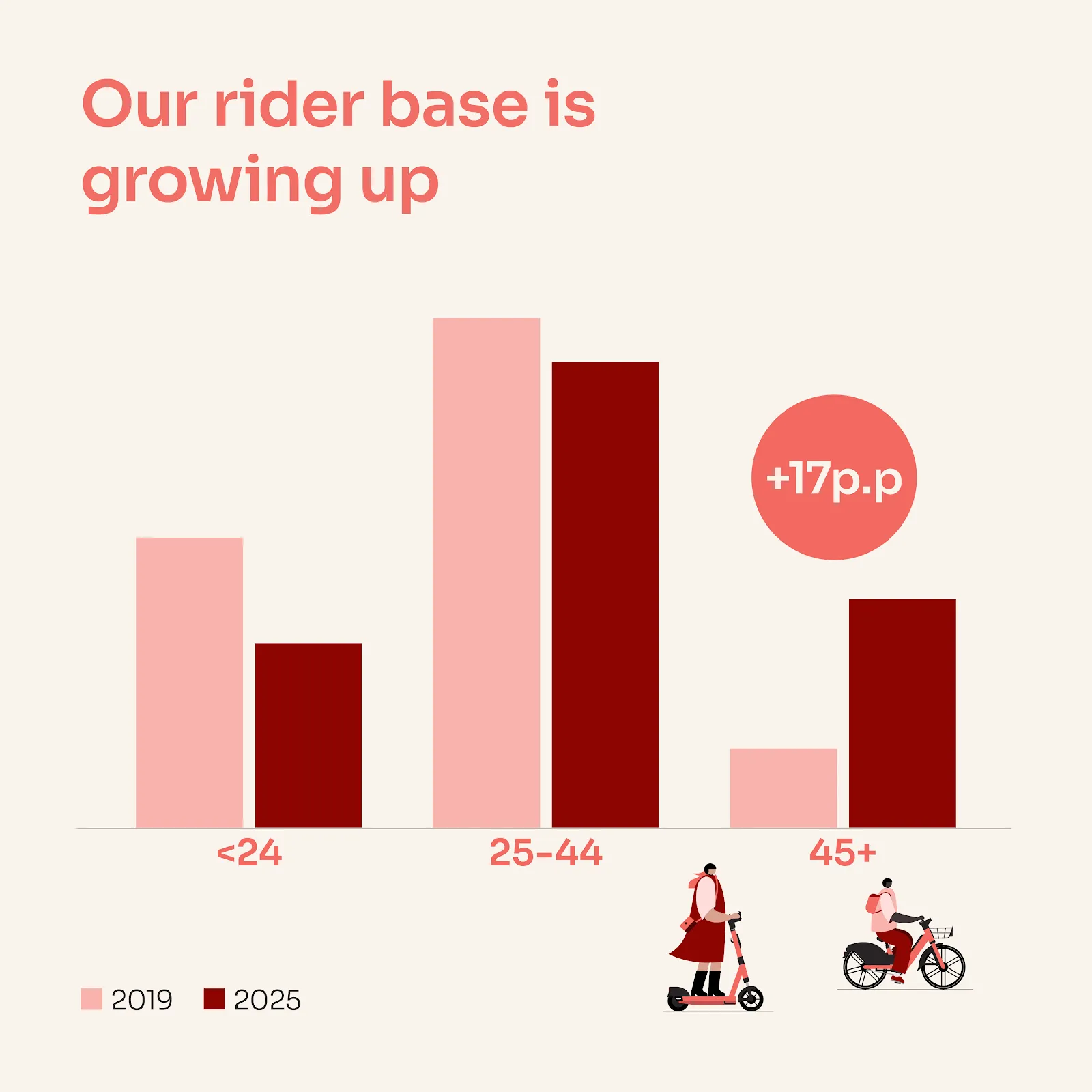
Voi, the European e-scooter and e-bike sharing company, revealed in its latest user survey, the startling growth of over-45 riders, an age bracket that has doubled since 2019. The report suggests that these sorts of micromobility services are true habit changers, with 40% of users saying they drive less since using the service.
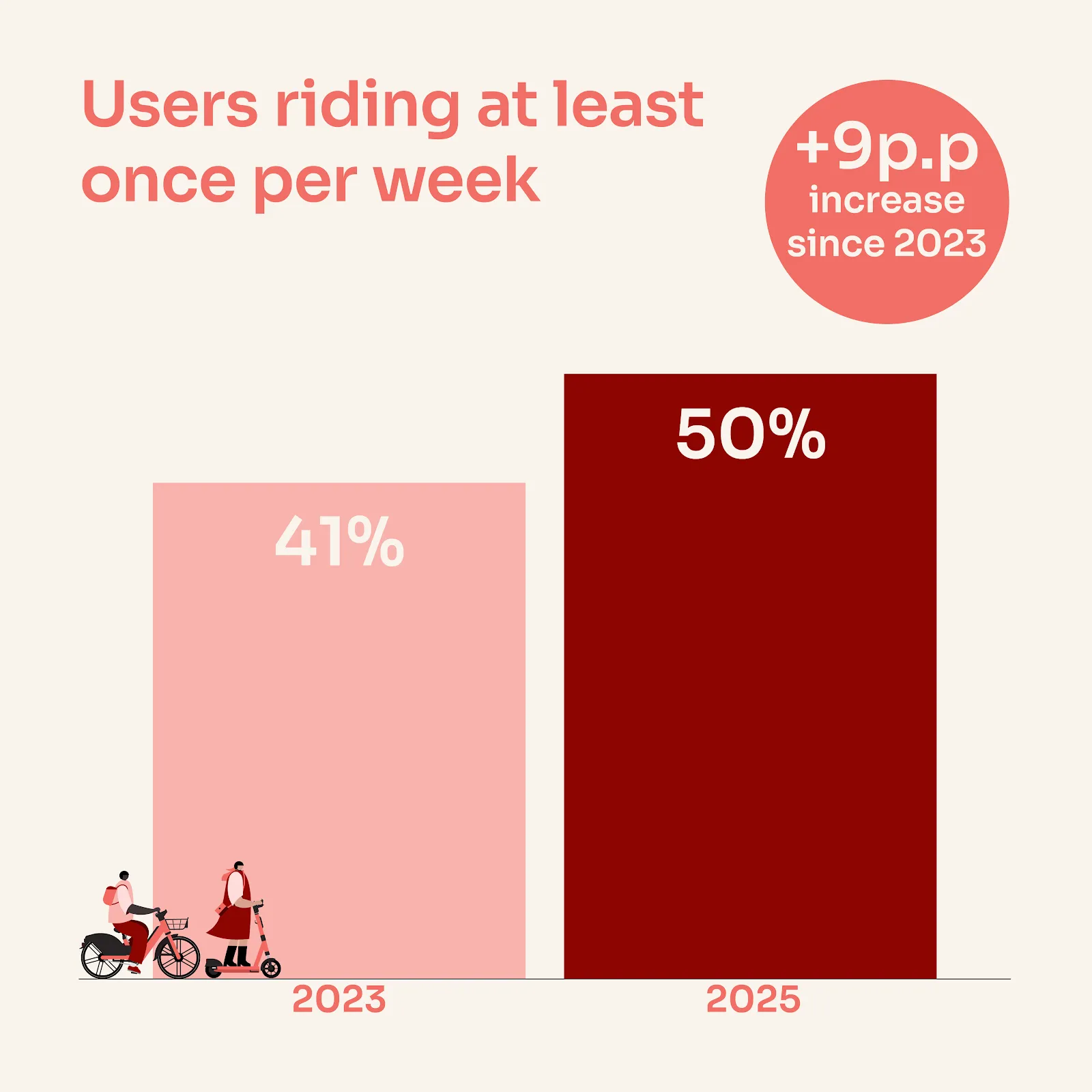
Voi’s 2025 Global User Survey is based on close to 12,000 responses from riders across 12 countries. A key takeaway from the research is the uptick in how regularly people are using Voi hardware. In 2023, 41% of users rode once a week, a figure that rose to 50% in 2025.
On this, Gustaf Soldan, chief product officer at Voi, says that “micromobility is no longer a novelty but a reliable part of cities’ infrastructure.” Shared micromobility isn’t the remit of trips for fun or entertainment alone, instead, the most common usage is commuting, with social events and appointments during working hours following respectively.
This points to an environment where shared mobility is shifting away from early adopters and toward mainstream acceptance.
The aforementioned demographic change reflects this. Back in 2019 (when Voi began conducting annual user surveys) over-45s made up about 10% of the user base. This year, that rose to 25%. On top of this, those 55 and older are the fastest-growing segment.
What makes this even more fascinating is these groups are displaying the broadest behavioural change. While 4 in 10 riders say they drive less thanks to shared micromobility, this rises to 5 in 10 among those over 45.
On this shift, Soldan states that Voi’s mission “is to provide micromobility for everyone, and the growth among older and more car-dependent groups is important to us. That’s where we see the biggest potential for real environmental impact.”
Seeing statistical evidence that older generations are embracing micromobility is heartening for the entire industry. Most car journeys are comparatively short, with some research saying that 50% of these trips in Europe are under 6km. While in most countries it’s the 50 to 64 age bracket that has the highest proportion of automobile owners.
Shared micromobility is a solution to this — and Voi’s data shows that this shift is happening. “As micromobility becomes part of everyday travel patterns,” Soldan says, “its benefits grow exponentially.” All it takes are swathes of individuals making small decisions, like taking a scooter instead of a taxi, to completely reshape cities.
This is the promise of micromobility, and if the growth of it among older generations is true beyond Voi’s users, this could be the start of a new era for the sector. The more people embrace shared micromobility, the greater the chance we have to improve our cities, towns, and the environment.
Image Credits: Voi