.svg)
%2Bcopy.avif)

.svg)


%20(1).jpg)


.webp)


Micromobility has grown up.
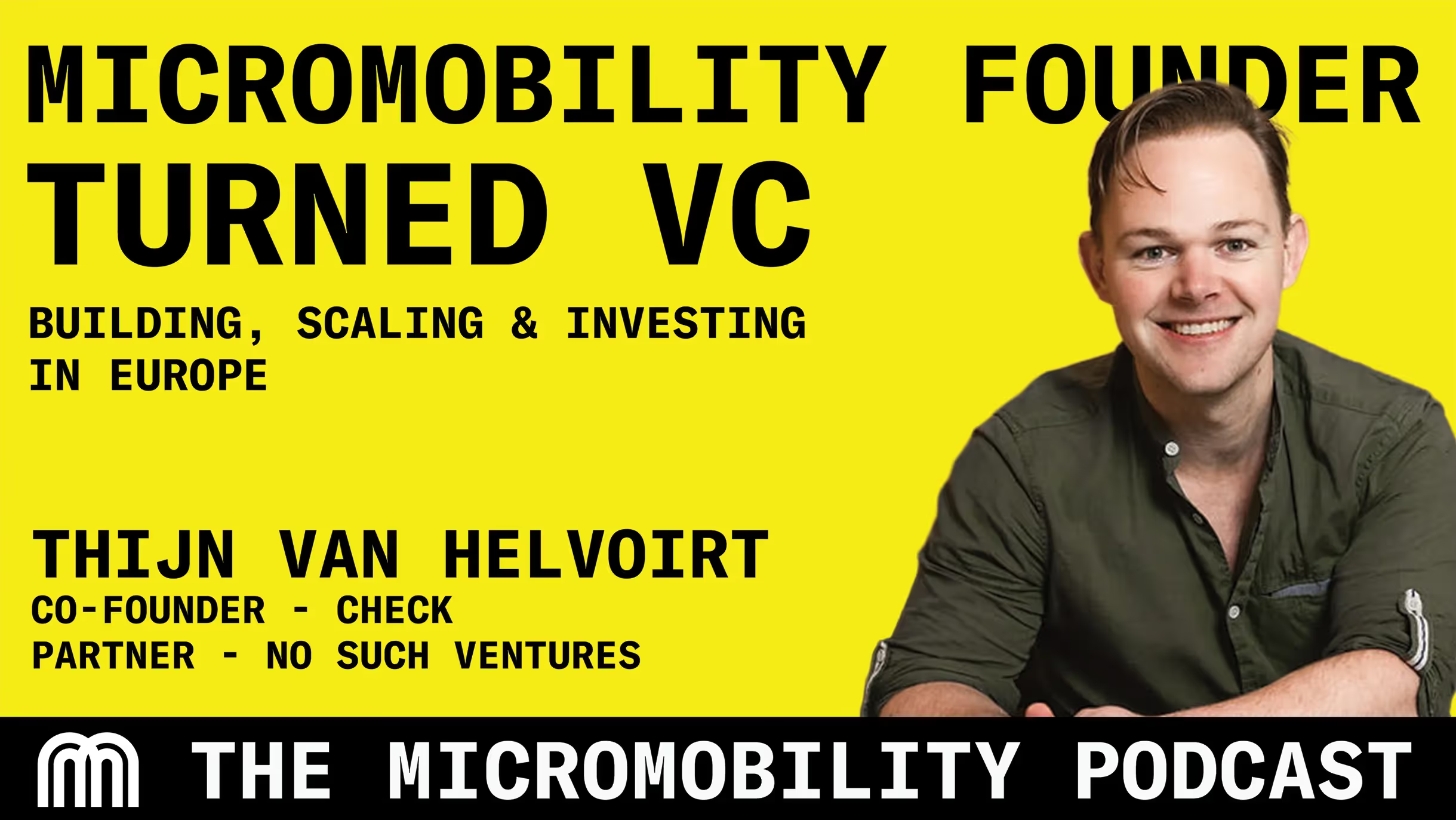
The era of growth at any cost is over. Operators are now expected to be profitable, capital efficient, and operationally disciplined. Few people understand this shift better than Thijn van Helvoirt, co-founder of CHECK and now a VC at No Such Ventures.
In this episode of The Micromobility Podcast, we spoke about what it really took to build CHECK, why many micromobility strategies failed, and how those lessons now shape Thijn’s approach as an investor.
This was not a theoretical discussion. It was an operator’s view of what works and what does not.
Building CHECK Against the Market Narrative
CHECK launched in 2018, at a time when most micromobility companies were focused on rapid expansion. Capital was easy to raise and profitability was something to be addressed later.
CHECK took a different path.
From day one, the company focused on unit economics, operational discipline, and data driven decision making. That approach was unpopular at the time. Other founders openly questioned why CHECK was not expanding faster.
Sixteen months after launch, CHECK reached profitability and never slipped back.
That single decision shaped everything that followed.
Data Over Opinions
One of Thijn’s strongest beliefs is that founders consistently overestimate the value of customer opinions and underestimate the importance of observed behavior.
Surveys, personas, and workshops can be useful, but they are often misleading when taken at face value. People regularly say one thing and do another.
At CHECK, decisions were based on measurable behavior:
- Where trips actually started and ended
- How far users were willing to walk to a vehicle
- What truly influenced conversion in the app
- Which operational costs mattered and which were noise
This mindset forced uncomfortable conclusions, but it led to better strategy.
Why Density Matters More Than Coverage
During micromobility’s early years, most operators believed success required large service areas.
CHECK discovered the opposite.
Data showed that roughly 95 percent of trips occurred within a small portion of the permitted service area. At the same time, users were multi homing. They had multiple micromobility apps installed and chose the closest vehicle.
The implication was clear:
- Smaller service areas
- Higher vehicle density
- Shorter distance to the nearest vehicle
- Higher conversion when users opened the app
CHECK optimized for the trips that mattered most rather than trying to serve every possible journey.
Capital Efficiency as a Strategic Advantage
CHECK remained intentionally lean.
There was no large social media team, no bloated headquarters, and no marketing spend disconnected from on street reality. Vehicles themselves became the primary marketing channel.
Keeping the core team small was not only about cost control. Thijn believes teams below roughly 30 to 35 people retain stronger ownership, alignment, and execution speed. Beyond that, internal friction grows quickly.
Capital efficiency was not a constraint. It was a competitive advantage.
From Founder to Investor
After building CHECK and assembling a strong leadership team, Thijn stepped away from daily operations and joined No Such Ventures.
The fund reflects his operator mindset:
- Entrepreneurs invest alongside entrepreneurs
- Portfolio companies get access to experienced operators
- Founders receive practical help without cluttering their cap tables
As an investor, Thijn looks for the same fundamentals he valued as a founder:
- Clear commercial traction
- Meaningful KPIs rather than vanity metrics
- Evidence that founders can adapt when reality contradicts the plan
Rigid investment checklists are a red flag. The best companies rarely fit clean templates.
The State of Micromobility Funding
The market is improving, but slowly.
Capital is available, but it is selective. Series B and later stages remain difficult. Enterprise sales cycles are still long, especially in automotive and industrial markets.
The upside is that weak companies are no longer kept alive by easy money. Talent is gradually flowing toward stronger operators and better ideas.
For disciplined founders, the environment is challenging but fair.
AI, Autonomy, and Real Opportunities
AI will reshape mobility, but not in the way many pitch decks suggest.
Autonomy, computer vision, and AI driven operations will matter, but founders do not need to build full autonomous stacks. Many of the best opportunities sit in infrastructure, tooling, and software layers that support autonomy rather than compete with it.
As with previous technology cycles, the bubble may burst. The technology will remain.
Why Europe Still Matters
Despite regulatory complexity, Thijn is bullish on Europe.
Europe is dense, wealthy, and increasingly aligned around innovation, productivity, and technological sovereignty. Regulation creates friction, but it also creates defensible markets for companies that learn to operate within it early.
Founders who treat Europe as a single market, rather than a collection of obstacles, have a real advantage.
Final Thought
Micromobility no longer rewards optimism alone.
It rewards founders who respect unit economics, trust data over opinion, build lean teams, and adapt faster than their assumptions.
Thijn van Helvoirt has lived both sides of that journey. As a founder and now as a VC, his message is consistent.
Reality always wins. Build for it.