.svg)
%2Bcopy.avif)

.svg)


.webp)

.webp)
.avif)
The micromobility industry has gone through a difficult few years. Funding slowed, several high-profile companies struggled, and many began questioning whether the sector had peaked.
But occasionally a moment arrives that reminds everyone why the industry exists in the first place.
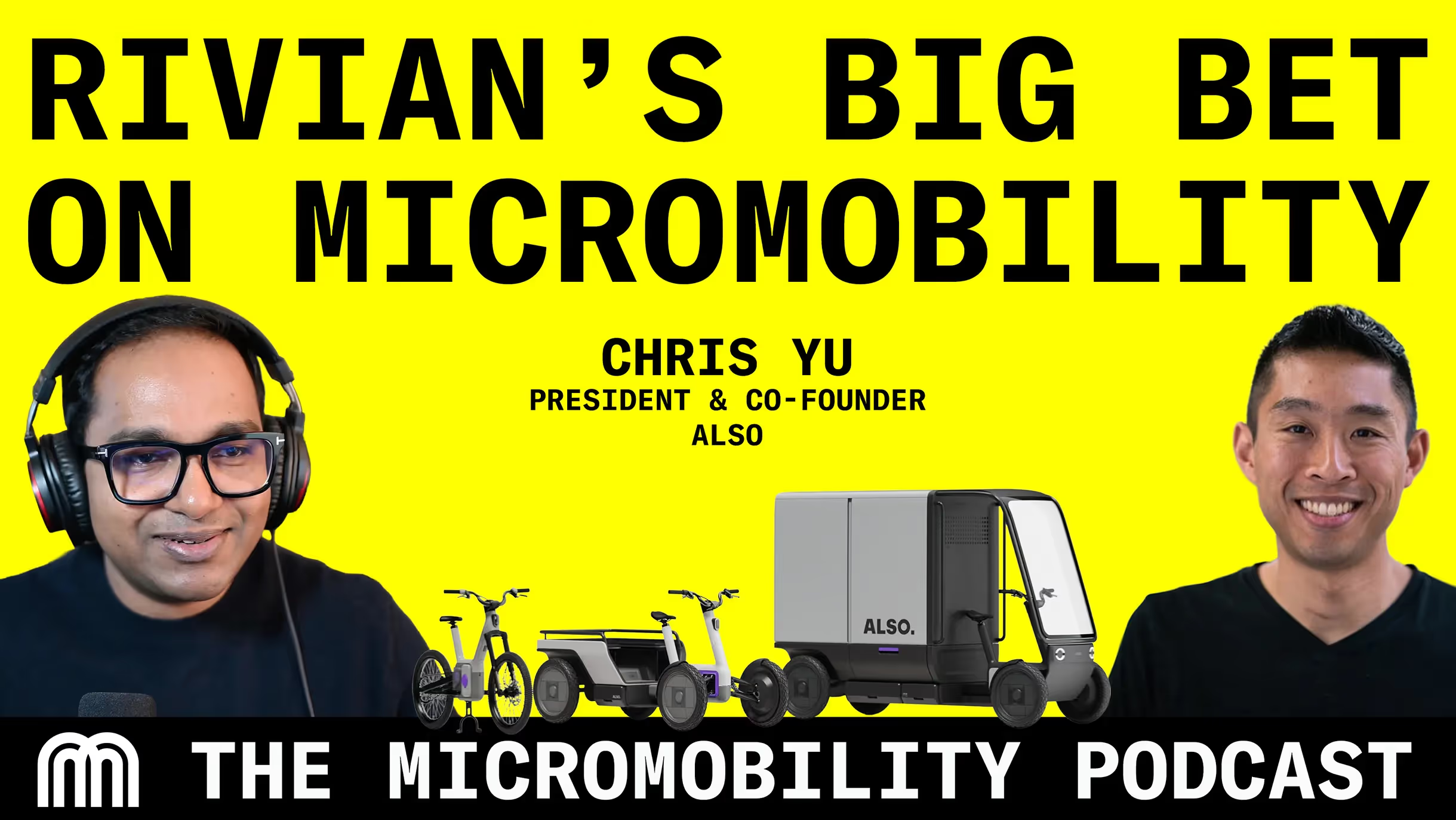
The launch of ALSO, a new micromobility company spun out of Rivian, may be one of those moments.
On this week’s Micromobility Podcast, I spoke with Chris Yu, co-founder and president of ALSO, about why Rivian decided to enter micromobility, why the company is rethinking how electric bikes are engineered, and why he believes the future of transportation will inevitably get smaller.
Why Rivian Entered Micromobility
The idea behind ALSO started several years ago when Chris Yu connected with RJ Scaringe, the founder of Rivian.
The original concept inside Rivian was simple: if electric cars can deliver a radically better product experience through software and vertical integration, why doesn’t the same experience exist for smaller vehicles?
Modern EVs like Rivian and Tesla introduced a new philosophy in automotive design. Vehicles became software-defined, deeply integrated, and capable of improving over time through over-the-air updates.
But when Yu and Scaringe looked at the micromobility space, they saw something very different.
Most e-bikes still follow a traditional bike industry model: manufacturers assemble components sourced from various suppliers. Motors, controllers, displays, and battery systems often come from different vendors, each with its own firmware and limitations.
The result is a fragmented product experience.
ALSO wanted to change that.
Instead of assembling off-the-shelf components, the company chose a vertically integrated approach, designing nearly every core system in-house.
The goal was not just to build another e-bike, but to build a new type of small electric vehicle platform.
The Philosophy Behind “ALSO”
Naming a company is rarely easy. But for Yu and the team, the name ALSO captured a fundamental belief about transportation.
For more than a century, mobility has been segmented. Cars belong to one category, bikes to another, and smaller vehicles somewhere in between.
In reality, transportation is multimodal.
Large vehicles make sense for certain trips, while smaller vehicles make sense for others.
“ALSO” reflects the idea that the future of transportation isn’t about replacing one mode with another. It’s about adding more options to the system.
Cars will remain important. But smaller vehicles will play a far larger role in moving people and goods.
“Small Is Inevitable”
Yu describes the shift toward smaller vehicles as almost unavoidable.
Several macro trends are converging at the same time:
1. Electrification of Small Vehicles
Globally, the majority of trips already happen on vehicles smaller than cars. In many parts of the world these are scooters, motorcycles, or other light vehicles.
However, electrification of these vehicles remains relatively low.
As electric alternatives become cheaper and better, this segment will electrify rapidly.
2. Urban Mode Shift
Cities across Europe and North America are redesigning streets around bikes and micromobility.
Cycle networks are expanding rapidly, congestion is increasing, and policymakers are encouraging smaller vehicles.
This shift is already visible in cities like Paris and London, where bike usage has surged over the past decade.
3. The Explosion of Urban Delivery
E-commerce and quick commerce are creating millions of new urban trips.
Delivery time expectations are shrinking from days to hours and even minutes.
Moving goods through dense urban environments requires vehicles that are compact, efficient, and capable of navigating city infrastructure.
All three trends point in the same direction.
Smaller vehicles are becoming essential.
Rethinking the Electric Bike
One of ALSO’s first products is the TMB, an electric bike designed around a radically different engineering philosophy.
Instead of simply adding an electric motor to a traditional bike design, ALSO approached the problem from first principles.
Yu explained that the company began by identifying the biggest barriers preventing people from adopting e-bikes.
One major issue was complexity.
For someone new to cycling, the variety of e-bike categories can be confusing. Different bikes exist for commuting, cargo, recreation, or trails.
ALSO’s solution was to build a modular platform that can adapt to multiple use cases. Riders can configure the bike for different purposes without needing to buy multiple vehicles.
DreamRide: Pedal-By-Wire
The most unusual feature of the TMB is a system called DreamRide.
Traditional bikes transmit power mechanically through a chain or belt. Riders pedal, and that mechanical energy drives the rear wheel.
DreamRide works differently.
It uses a pedal-by-wire architecture.
When riders pedal, they are not directly turning the wheel. Instead, they generate electrical power through a generator motor. That electricity then drives a separate traction motor that powers the rear wheel.
In other words, the mechanical drivetrain is replaced by a software-controlled electric system.
This architecture gives ALSO enormous flexibility.
Because the system is software-defined, the riding experience can be tuned dynamically. Riders can choose a simple automatic mode, or configure more advanced settings.
The system can even adapt as riders’ fitness levels or riding habits change.
Why ALSO Built Its Own Motors
Most e-bike manufacturers rely on third-party motor suppliers such as Bosch, Shimano, or Bafang.
ALSO chose a different route.
The company designed its own motors, inverters, and control systems from the ground up.
This decision reflects the same philosophy used by modern EV manufacturers.
When companies control both hardware and software, they can deliver a far more cohesive product experience.
It also allows features like predictive diagnostics, over-the-air updates, and advanced vehicle control systems.
Designing for Reliability
Another major frustration for e-bike owners is servicing.
When something breaks, riders often need to bring the bike to a local shop and wait for repairs.
ALSO approached the problem differently.
Instead of designing the bike like a traditional bicycle, the team designed it like an electric vehicle.
That means more robust components, integrated diagnostics, and predictive maintenance systems capable of detecting issues before riders experience them.
Wear items such as tires and brake pads remain standard and easily replaceable.
But the rest of the system is engineered to behave more like a modern EV.
Beyond Bikes: The Pedal Quad
ALSO’s ambitions extend beyond consumer e-bikes.
The company has also developed the TMQ, a pedal-powered electric quad designed for commercial delivery.
These vehicles combine the regulatory advantages of bikes with the cargo capacity required for urban logistics.
They are especially well suited to dense cities where vans struggle with congestion and parking.
ALSO is already working with major partners, including **Amazon, to explore deployment of these vehicles in urban delivery networks.
Lessons from the First Wave of E-Bike Startups
Over the past decade, companies such as Cowboy, VanMoof, and Rad Power Bikes helped push e-bikes into the mainstream.
Yu has deep respect for those brands.
Building a successful micromobility company is extraordinarily difficult.
But ALSO believes that the next phase of the industry will require deeper technical integration and platform thinking.
Instead of designing single products, the goal is to build technology platforms that can power multiple vehicle types across different markets.
A Message for Founders
Despite recent industry turbulence, Yu remains optimistic about the sector.
Micromobility is not a zero-sum game.
The global transportation system is enormous, and the transition toward smaller electric vehicles will create opportunities for many companies.
Cities are changing, logistics networks are evolving, and electrification is accelerating.
The opportunity ahead is massive.
And if ALSO’s launch proves anything, it’s that some of the most sophisticated EV companies in the world now believe the future of mobility won’t just be electric.
It will also be small.