.svg)
%2Bcopy.avif)

.webp)
.svg)

.jpg)
%20(1).jpeg)
.jpg)


.webp)
If you ride a bike or scooter in a city, a rider's instinct takes over. You keep your head on a swivel. You watch the front wheels of the car waiting at the junction, looking for that subtle twitch that says they haven’t seen you. You fear the sudden door opening, the distracted drift, the "sorry mate, I didn't see you."
For years, the arrival of autonomous vehicles (AVs) felt like a sci-fi threat. The fear was that a computer couldn't possibly understand the quick, sudden movements of city cycling. But a massive new dataset suggests the opposite might be true. It turns out that when you remove the human from the driver's seat, the streets get significantly safer for everyone on two wheels.
The 56 Million Mile Test
We don't have to guess how these vehicles perform anymore. Waymo, the autonomous driving company, recently released a retrospective study covering 56.7 million miles of "rider-only" driving, meaning fully autonomous trips with no humans behind the wheel.
These miles weren't driven on empty test tracks. They happened on the messy, congested surface streets of San Francisco, Los Angeles, Phoenix, and Austin.
The results are striking. When compared to human driving benchmarks in those same cities, the automated system didn't just match human safety, it outperformed it. Specifically, the data shows an 82% reduction in injury-causing crashes involving cyclists and motorcyclists.
This difference was observed over tens of millions of miles and was consistent enough to reach statistical significance.
It represents a fundamental shift in how large vehicles interact with vulnerable road users.
The Intersection Problem
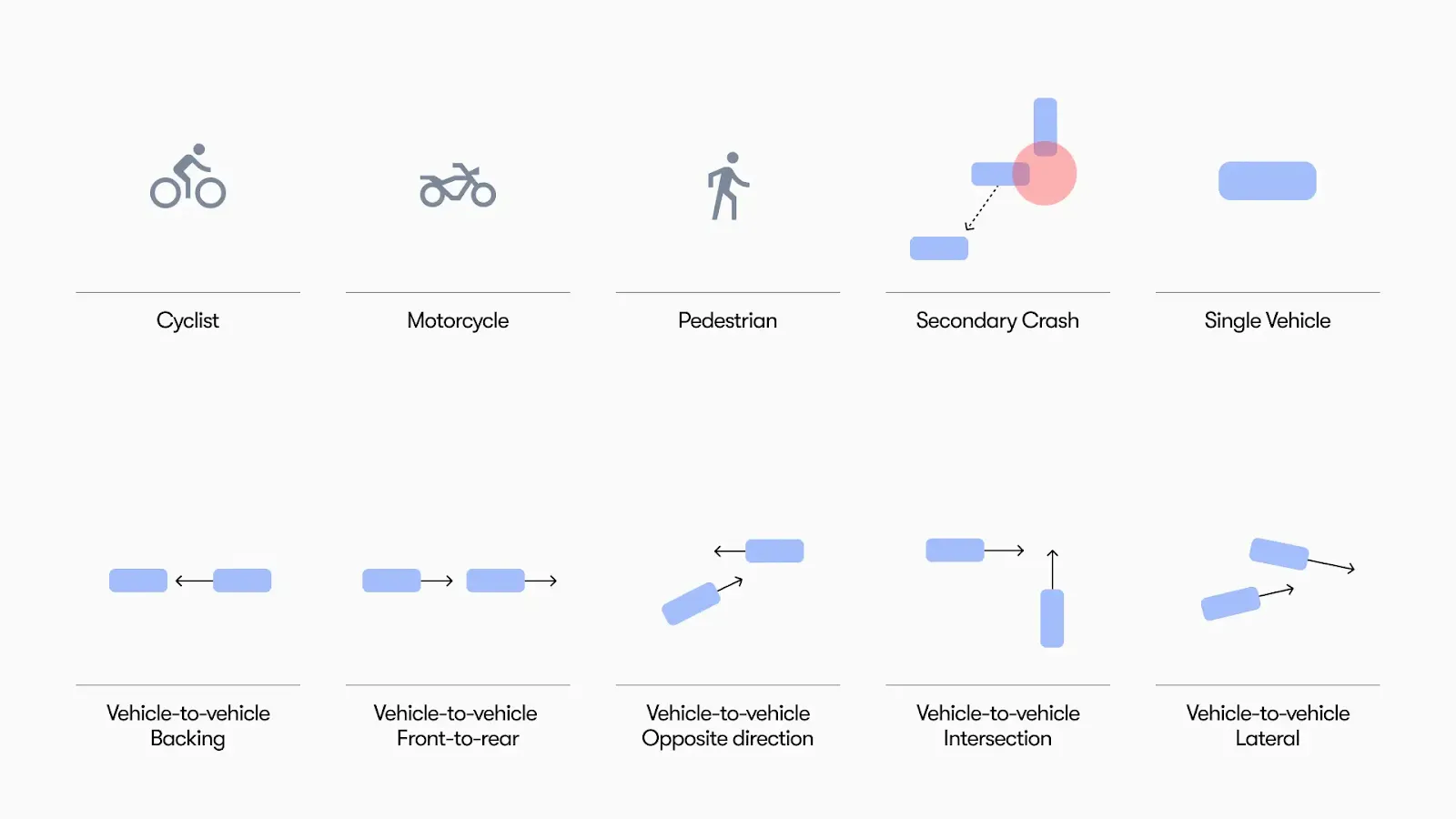
Ask any urban planner or crash investigator where the danger lies, and they will point to the intersection. It is the chaos point, where turning cars, rushing pedestrians, and through-traffic cyclists collide. It is where human drivers, overwhelmed by sensory input, often make fatal errors.
This is where the robot driver makes the biggest difference. The study recorded a 96% reduction in vehicle-to-vehicle intersection injury crashes compared to human drivers.
The massive drop at intersections points to the fundamental differences between human and machine drivers. Human drivers can misjudge the speed of an approaching e-bike or get distracted by a phone notification, well-known causes of crashes. In contrast, the autonomous system's sensors (lidar, radar, and cameras) are designed specifically to overcome these limitations. They maintain a constant 360-degree vigil, and as a machine, the system doesn't get tired, impatient, or distracted. It is engineered to follow the rules with a level of consistency that humans struggle to maintain.
Protecting the Vulnerable
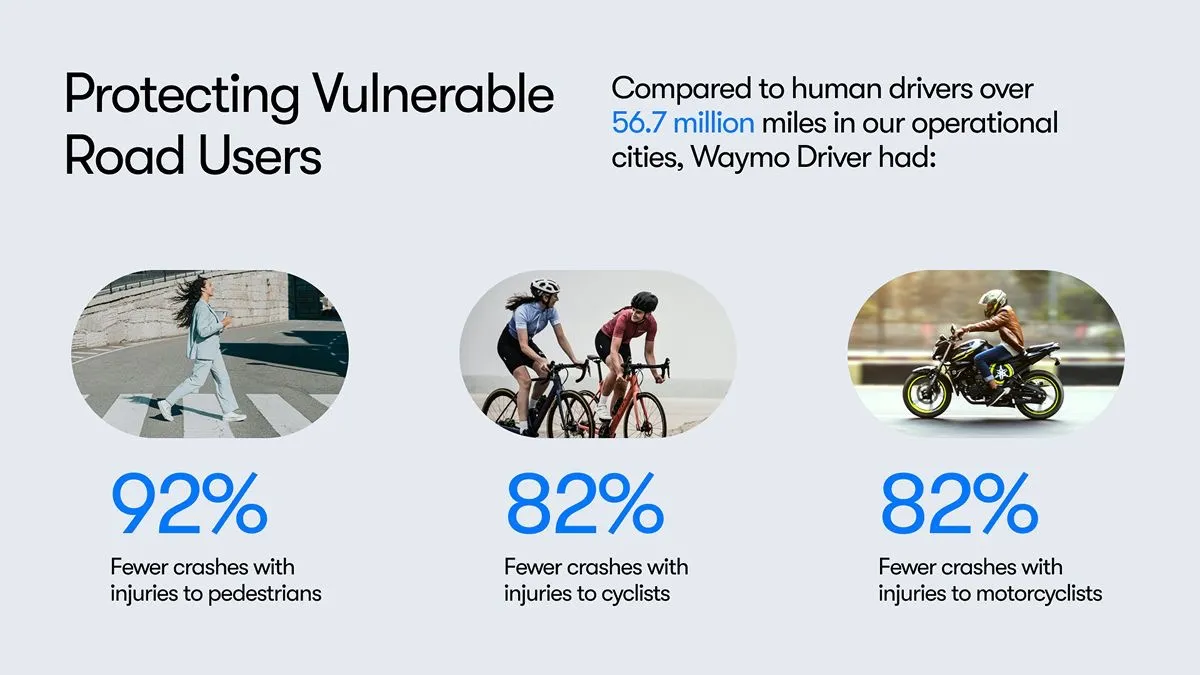
The study groups cyclists, motorcyclists, and pedestrians into a category known as "Vulnerable Road Users." The data shows that the safety benefits extend across this entire group.
Alongside the drop in cyclist crashes, the study found a 92% reduction in injury crashes involving pedestrians. The vehicle appears effectively tuned to recognize and yield to the people who are most exposed on the street.
For a scooter rider or cyclist, the biggest danger is often unpredictability, a driver swerving or drifting. The Waymo data points to a system that behaves conservatively. For instance, in "single-vehicle" crashes (like running off the road or hitting a stationary object), the AV showed a 100% reduction in airbag-deployment events. It stays in its lane and stays on the road.
Going Global
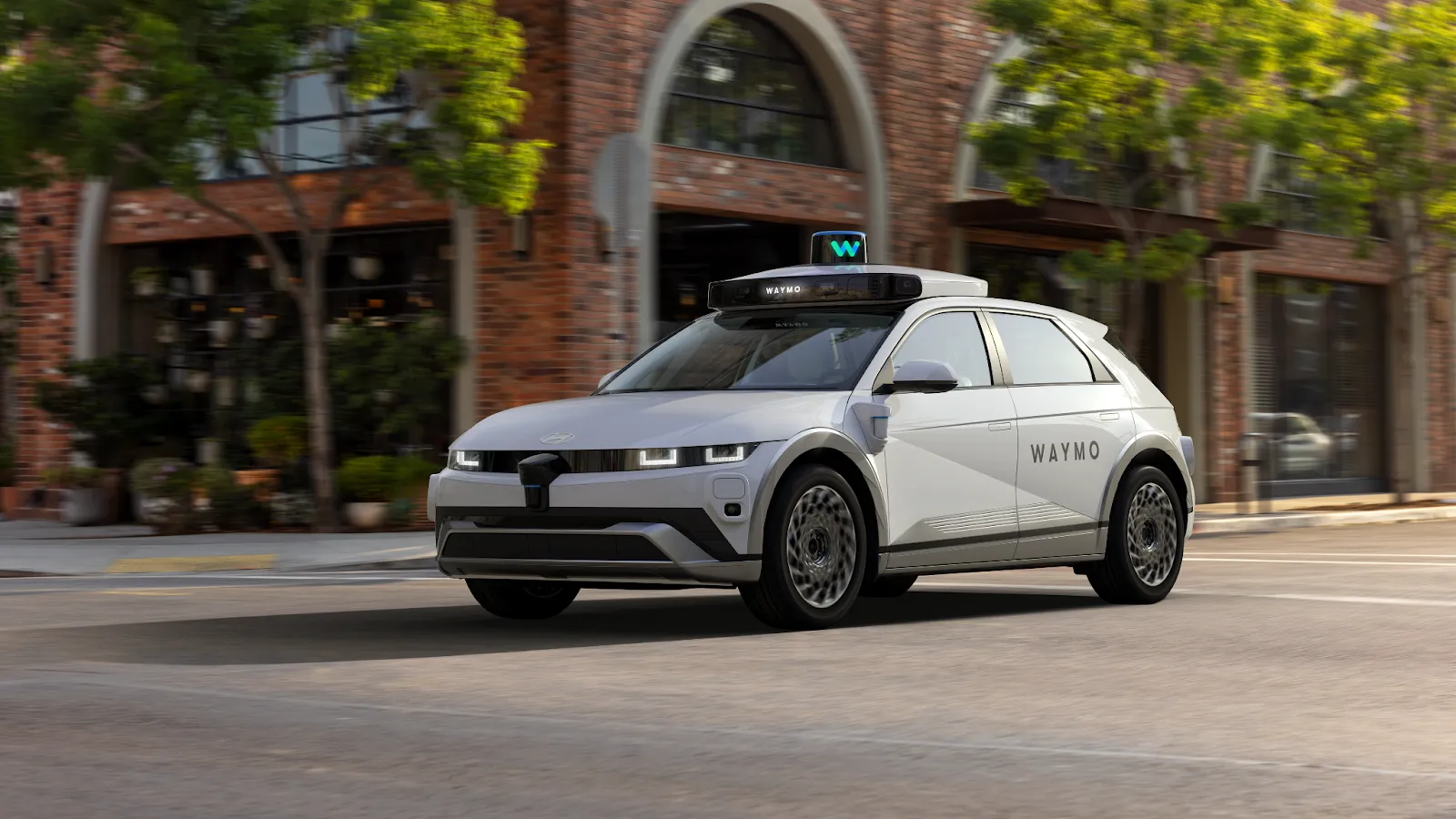
This safety record is no longer just a curiosity for a few American cities. The technology is actively preparing to cross oceans. Waymo hopes to operate a robotaxi service in London as soon as September, with a pilot service launching this April. The UK government is supporting this timeline with plans to update regulations in the second half of 2026, explicitly citing the safety benefits of vehicles that don't get tired or distracted.
Simultaneously, Waymo confirmed it is in talks with transport officials in Australia to potentially launch services there, with reports indicating potential testing on public roads as early as 2026. As these vehicles move into new markets with different road rules and cycling cultures, these safety benchmarks will likely set the standard for how automated transport integrates with micromobility globally.
Industry Context
While this safety data is promising, widespread adoption of AVs remains a future prospect. A 2026 report from McKinsey, "Insights from autonomous-vehicle experts," notes that the global rollout of Level 4 robo-taxis at a large scale is now expected around 2030. The report also identifies high development costs as the single largest challenge facing the AV industry.
Waymo's ability to accumulate such a vast amount of real-world mileage and demonstrate a strong safety record highlights its position in the industry as the company explores expansion into new markets.
A Decades-Long Journey to This Moment
The dream of a self-driving car is not new, but for decades, it was confined to university labs. Early projects in the 1970s and 80s showed what was theoretically possible, but also highlighted the immense technological hurdles. For instance, a project at Stanford University involved a wheeled cart that could navigate a room on its own by using two cameras to build a 3D map and avoid chairs. However, the computers of the time were so slow that it took the cart five hours just to move 20 meters.
The turning point came in the early 2000s when the Defense Advanced Research Projects Agency (DARPA) launched a series of competitions to accelerate progress. In the first challenge in 2004, a 142-mile desert race, no vehicle finished. Yet, just 18 months later, an explosion of progress in software and sensors saw five teams complete the course. This success directly sparked the modern era of autonomous driving. In 2009, Google recruited key leaders from the winning university teams to start its own self-driving car project in secret. That project, born from the lessons of those early academic and competitive challenges, is now Waymo.
A New Kind of Coexistence: Sharing Roads and Trust
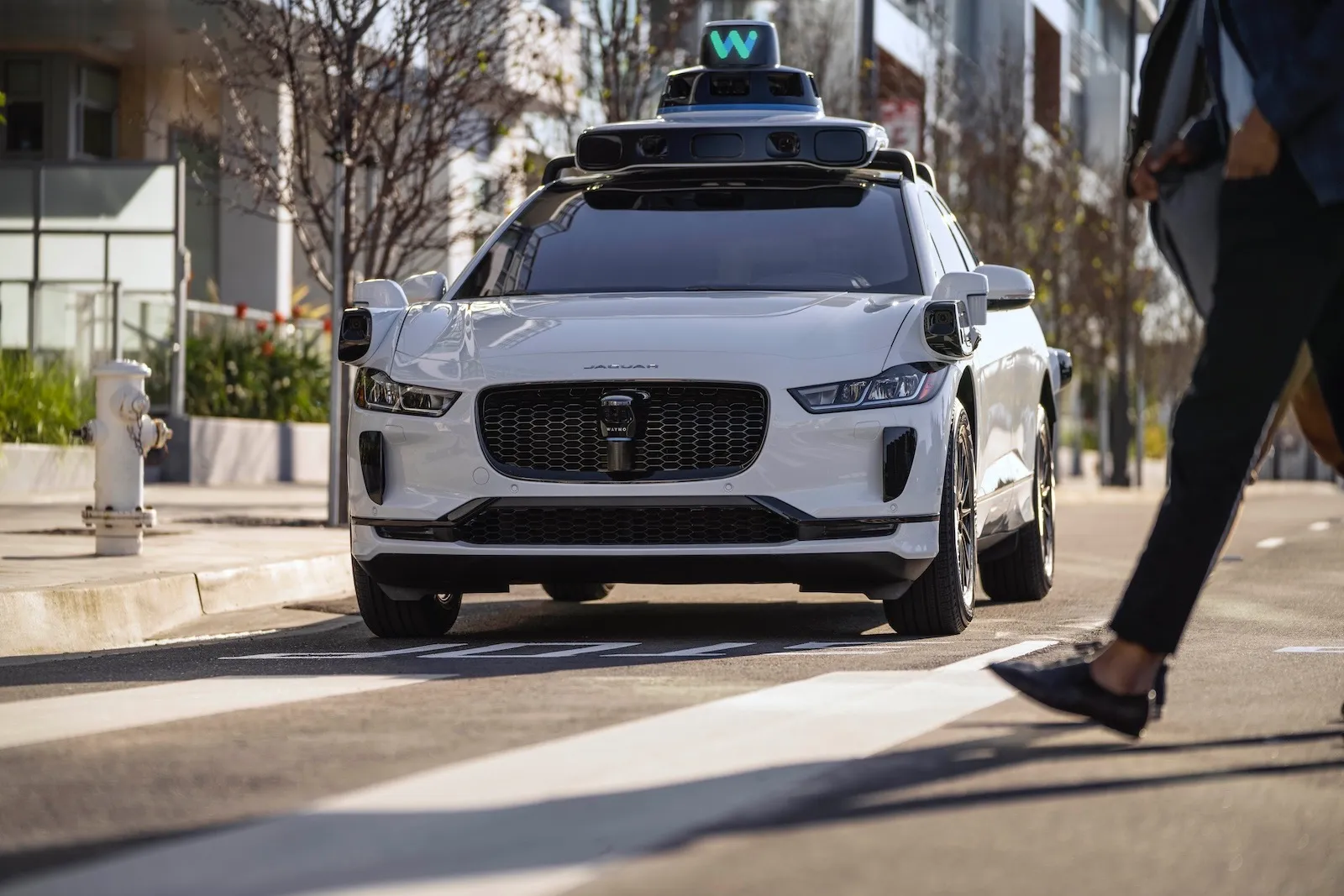
For decades, the narrative of urban cycling has been a battle for space and survival against heavy, fast-moving metal boxes piloted by fallible humans.
We still need protected bike lanes. We still need better infrastructure. But the data from these first 56 million miles suggests something hopeful, the cars of the future might finally stop crashing into us.
Image Source: Waymo