.svg)
%2Bcopy.avif)


.svg)


%20(1).jpg)



.webp)


For much of the past decade, Rad Power Bikes stood as one of the defining names in North America’s e-bike boom. Built on a direct-to-consumer model and affordable pricing, the company became one of the most visible e-bike brands.
That long growth story has now reached a new phase. On December 15, 2025, Rad Power Bikes filed for Chapter 11 bankruptcy protection in the United States, according to court documents filed in the Eastern District of Washington.
The filing places Rad under court supervision while it works through its financial position.
What Chapter 11 Means for Rad Power Bikes
Chapter 11 allows a company to continue operating while it restructures its debts and obligations under court oversight. It is not a liquidation process. Instead, it gives the company time to reorganize its balance sheet, renegotiate contracts, and explore strategic options.
Rad Power Bikes filed voluntarily as a corporate debtor. According to the petition, the company listed total assets of approximately $32.1m and total liabilities of about $72.8m at the time of filing.
The company reported no real estate assets, with the bulk of its assets tied to operations. Inventory, primarily e-bikes, accessories, and spare parts, accounted for roughly $14.2m, while cash and cash-equivalent holdings totaled around $6.7m.
Liabilities included a mix of secured and unsecured claims, with total unsecured claims exceeding $31.8m. Secured claims amounted to approximately $40.9m, according to court schedules.
The filing estimates between 100 and 199 creditors. The company also stated that, after administrative expenses, no funds are expected to be available for unsecured creditors at this stage.
Revenue
As part of its Statement of Financial Affairs, Rad Power Bikes disclosed gross revenue from operating its business over the past three years:
- 2023: $129.8m
- 2024: $103.8m
- 2025 (year-to-date): $63.3m
These figures are reported as gross revenue from operations.
Creditors and suppliers
The Chapter 11 filing includes a court-mandated list of Rad Power Bikes’ 20 largest unsecured creditors, alongside a comprehensive schedule of all unsecured claims. These disclosures provide visibility into the company’s supplier and counterparty exposure.
Unsecured creditors listed in the filing include:
- Overseas manufacturing partners producing frames, batteries, and electronic components
- Freight and logistics providers supporting international shipping and warehousing
- Insurance companies connected to product-related and subrogation claims
- Government entities, including U.S. Customs and Border Protection, reflecting tariff-related obligations
- Software, marketing, and e-commerce vendors supporting Rad’s direct-to-consumer operations
Equity ownership and capital structure
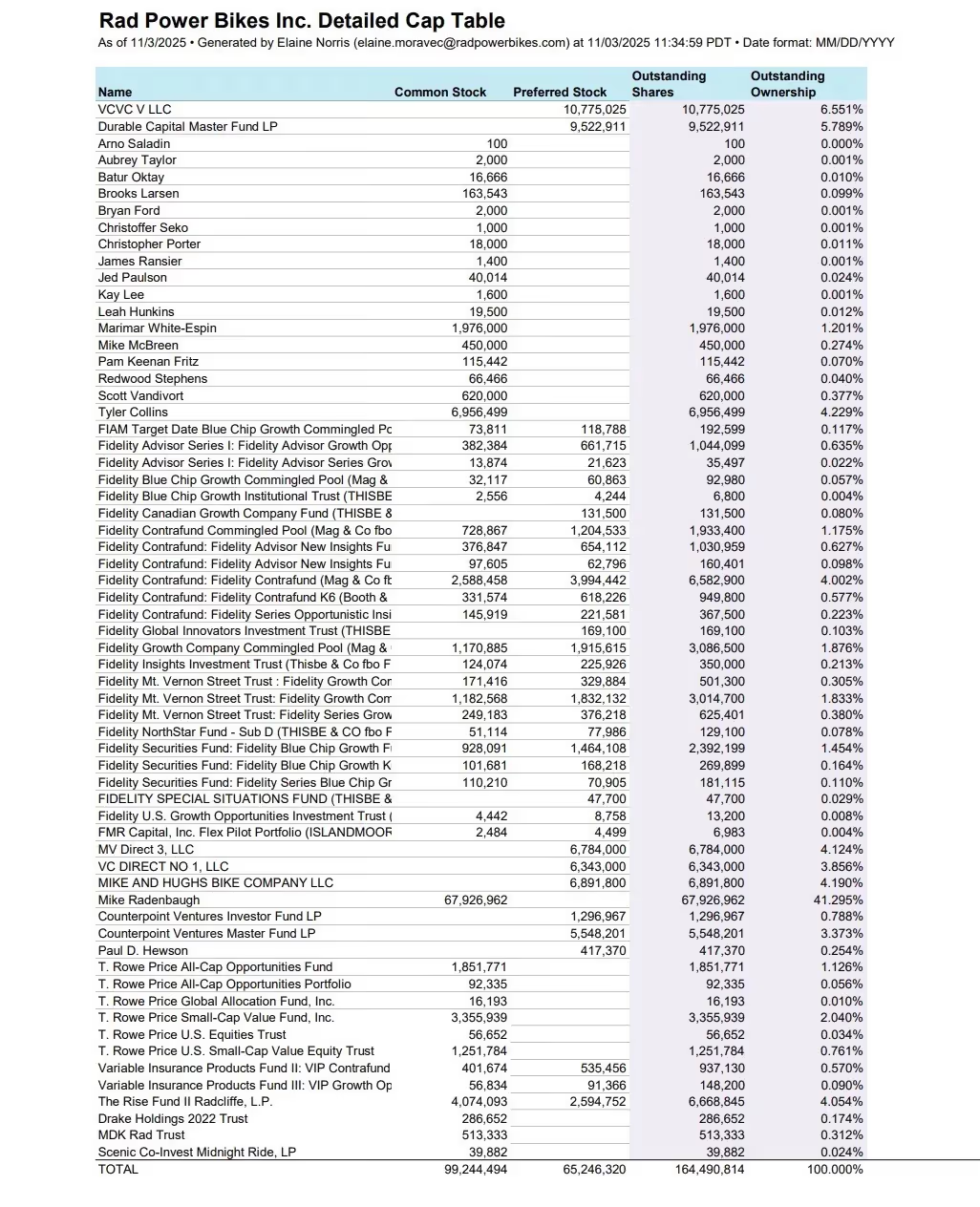
The table lists ownership across common stock and preferred stock, along with outstanding share counts and percentage ownership.
Largest disclosed shareholders
Based on the cap table:
- Mike Radenbaugh holds 67,926,962 shares, representing 41.295% ownership
- VCVC V LLC holds 10,775,025 preferred shares (6.551%)
- Durable Capital Master Fund LP holds 9,522,911 preferred shares (5.789%)
- Mike and Hughs Bike Company LLC holds 6,891,800 shares (4.190%)
- VC Direct 3, LLC holds 6,784,000 shares (4.124%)
- VC Direct No 1, LLC holds 6,343,000 shares (3.856%)
- Counterpoint Ventures Master Fund LP holds 5,548,201 shares (3.373%)
The cap table also lists holdings by multiple institutional investment funds, including Fidelity, T. Rowe Price, Counterpoint Ventures, Durable Capital, FMV Capital, and various commingled and special-situations funds. Individual fund ownership stakes generally represent less than 2% each.
The table discloses, for each holder, common stock, preferred stock, total outstanding shares, and percentage ownership as of the stated date.
Operations and Corporate Structure
Rad Power Bikes Inc. is headquartered in Seattle, Washington, and operates as a corporation. The filing lists Summit Collective Incorporated as an affiliate, which also has a related bankruptcy case in the same district.
The petition was signed by Chief Executive Officer Angelina M. Smith, who certified the accuracy of the filing under penalty of perjury. Legal representation is being provided by Bush Kornfeld LLP, based in Seattle.
At the time of filing, the company did not report any property requiring immediate court attention, such as perishable assets or public safety risks.
A longer build-up to Chapter 11
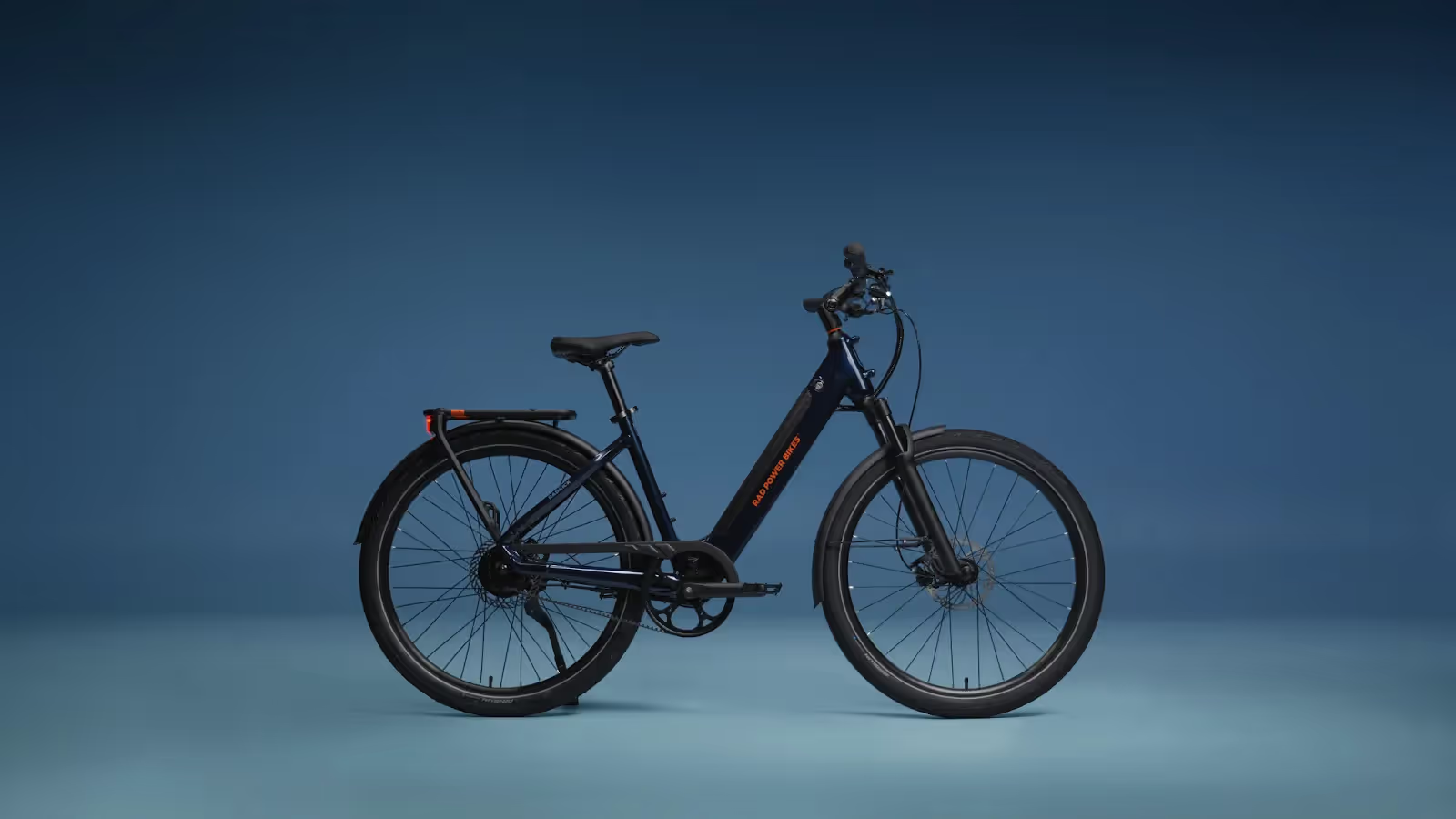
The Chapter 11 filing follows several years of mounting pressure for Rad Power Bikes. As previously covered in our earlier feature on the company’s trajectory, Rad expanded rapidly during the pandemic-driven e-bike surge, reaching a $1.65 billion valuation in 2021 and raising more than $329m in funding. That period reshaped the company’s scale, staffing, and supply chain expectations.
As demand cooled, the same scale became harder to sustain. Inventory accumulated, tariffs increased costs on China-made e-bikes, and the broader micromobility market entered a correction. Rad responded through pricing adjustments, new product launches, safety-focused battery development, and a shift toward physical retail via a nationwide partnership with Best Buy.
Despite those moves, financial pressure remained. In November 2025, the company issued WARN notices to 64 employees in Seattle, citing the possibility of a closure in early 2026 while noting that no final decisions had been made at the time. That disclosure marked one of the clearest public signals of the strain preceding the bankruptcy filing.
A Familiar Path in Micromobility: The Bird Comparison
In late 2023, shared scooter giant Bird Global followed a similar trajectory, filing for Chapter 11 bankruptcy protection. Bird’s filing represented a pivotal "reset" for the first generation of micromobility, following years of venture-capital-backed expansion that resulted in a total cash burn of more than $650 million between 2020 and 2022.
To maintain operations during the restructuring, Bird secured roughly $39 million in "new money" debtor-in-possession (DIP) financing. This was led by MidCap Financial (an affiliate of Apollo Global Management) and Obelysk Inc., the latter led by Canadian businessman John Bitove. Like Rad Power Bikes' current situation, Bird’s filing was strategic; its international operations in Europe and Canada were excluded from the proceedings, allowing the core brand to stabilize its North American footprint.
However, Bird’s path ultimately led to a full transition from a public company to a private one. In April 2024, Bird successfully emerged from bankruptcy after a court-supervised sale of its assets to its lenders for approximately $145 million. The company was reorganized under a new private parent entity called Third Lane Mobility Inc., which now operates both the Bird and Spin brands (the latter of which Bird acquired just months before its bankruptcy).
For Rad Power Bikes, Bird offers a clear case study in how Chapter 11 can function not as a shutdown, but as a mechanism to shed debt and restructure operations.
Listen to this podcast episode with James Gross and Prabin Joel Jones where Prabin explains more about Bird's Chapter 11 filing and what's next
A Broader Industry Reset
Rad Power Bikes’ Chapter 11 filing reflects a broader recalibration underway across micromobility and electric mobility markets. Companies built during a period of rapid growth are now adjusting to slower demand, higher costs, and more constrained capital.
Bird’s earlier restructuring, alongside other industry bankruptcies and consolidations, shows how Chapter 11 has become a common tool for companies seeking time to reset their balance sheets.
For Rad Power Bikes, this now sets the framework for what happens next.
What Comes Next
At this stage, the court filing outlines Rad Power Bikes’ financial position but does not include a confirmed restructuring plan or asset sale timeline. Those details typically emerge through subsequent motions, hearings, and creditor discussions.
The filing marks a transition rather than a conclusion.