.svg)
%2Bcopy.avif)


.svg)

.jpg)
%20(1).jpeg)
.jpg)


.webp)

Welcome to Micromobility Pro, a bi-weekly publication which is part of The Micromobility Newsletter, where we deep-dive into the financials of micromobility companies and share exclusive insights tailored for professionals and members.
Micromobility Europe 2026

Micromobility Europe returns to Berlin, the city where it all began.
Join us June 2–3, 2026 at Arena Berlin for two days of high-energy keynotes, panels, demos, and hands-on networking with the brightest minds in mobility.
Get Super Early Tickets for Just €299 before they sell out!
🏢 Early Bird Rates for Exhibitors: Limited Time Offer Ends on 31st December! Book your spot today!
🎙️Note to speakers: Applications will close earlier than usual this year due to high demand. We encourage you to submit yours soon.
[Sponsor/Exhibit] | [Speak at the Event] | [Exhibit as a Startup]
Spots are filling fast! secure yours today and be part of Europe’s bespoke event for all things micromobility.
Contents
- About Beryl
- History and Background
- Product and Technology Developments
- Table: Beryl Contract Type, By Region
- Chart: Beryl Bikes Fleet Split - 2024
- Funding
- Ownership Structure
- 2024 Financial Performance
- Revenue Breakdown
- Chart: Revenue & Net Result (2021-2024)
- Cost Structure
- Table: P&L
- Cash Position & Balance Sheet
- Table: Balance Sheet
- 2025 Outlook and Post-Year-End Developments
- How Riders Are Using Beryl’s Services
- Conclusion
About Beryl

Beryl is a UK-based micromobility company that designs, manufactures and operates shared bikes, e-bikes, e-scooters and e-cargo bikes. Over time, Beryl has become known for owning most of its technology stack, from vehicle hardware to the software platform that runs bookings, billing, fleet management and city-facing data services.
As of March 2024, it operated 14 schemes across the UK. These include bike-share, e-bike and e-scooter systems delivered through a mix of revenue-share, managed-service and SaaS-style agreements with local authorities. Rather than positioning itself as a purely consumer app, Beryl presents itself as a long-term transport partner to UK councils, supporting their active travel and sustainability goals.
History and Background
Beryl began as Blaze, founded by Emily Brooke in 2011. Its first product, the Laserlight, originated as her university project and launched on Kickstarter in 2012. Designed to project a green bicycle symbol onto the road ahead, it aimed to improve cyclist visibility in blind spots and at night. The innovation attracted early backing from Index Ventures, Pembroke VCT and members of the Branson family, enabling Blaze to scale manufacturing and secure major contracts, most notably supplying Laserlights to London’s Santander Cycles.
In 2018, Blaze rebranded to Beryl, reflecting a shift from a hardware-focused business to a full micromobility operator. The new identity paid tribute to legendary British cyclist Beryl Burton and signalled a more transport-oriented mission.
The company launched its first large-scale bike-share scheme in Bournemouth and Poole in 2019. Over the following years, it expanded to cities including Norwich, Hereford, Watford and the Isle of Wight, gradually adding e-bikes, e-scooters and e-cargo bikes and building the operational and software systems needed for city-wide deployments.
Product and Technology Developments
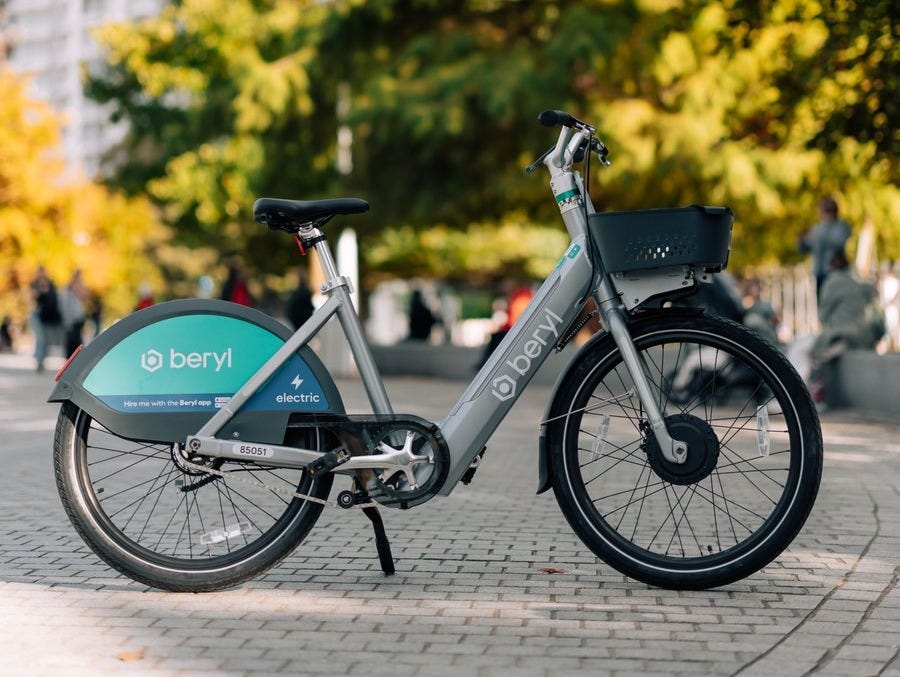
Beryl’s product strategy revolves around running multi-modal fleets on a single platform. Norwich became the company’s first city to host a fully mixed deployment of pedal bikes, e-bikes and e-scooters as part of the UK e-scooter trial programme. Other large mixed-fleet networks include Bournemouth-Christchurch-Poole, the Solent region, and more recent expansions in areas such as Cornwall and Leeds.
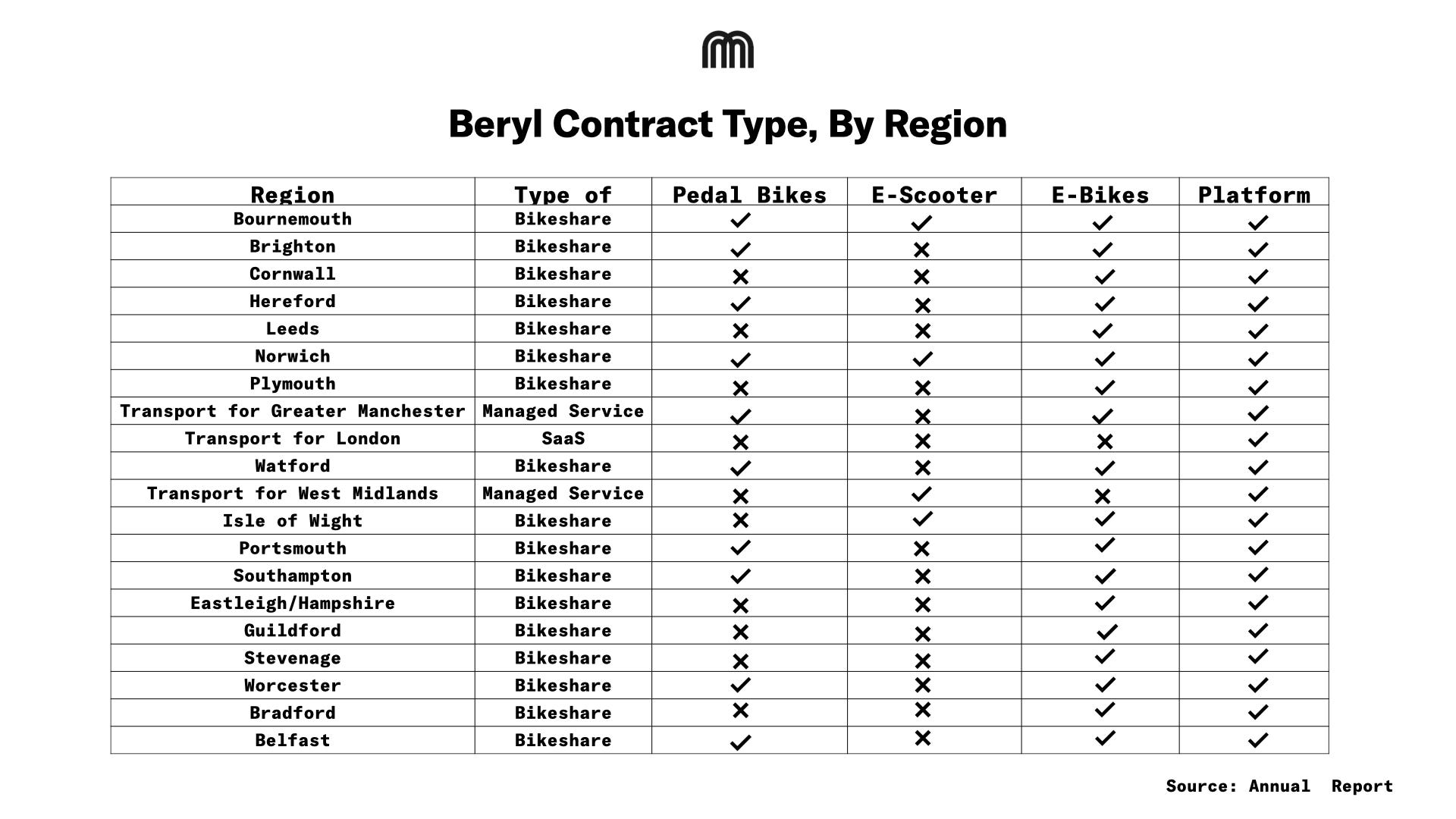
To understand how these deployments vary across the UK, Beryl’s 2024 annual report includes a breakdown of contract types and vehicle modes by region:
In 2024, Beryl introduced the BBE2, its latest shared e-bike. The model is significantly lighter than its predecessor and features a swappable battery system rated for around 80 km of range, a low step-through frame and upgraded components intended to improve durability and reduce maintenance.
Operationally, usage grew strongly, with the 2024 accounts reporting a 33% increase in rides versus the prior year.
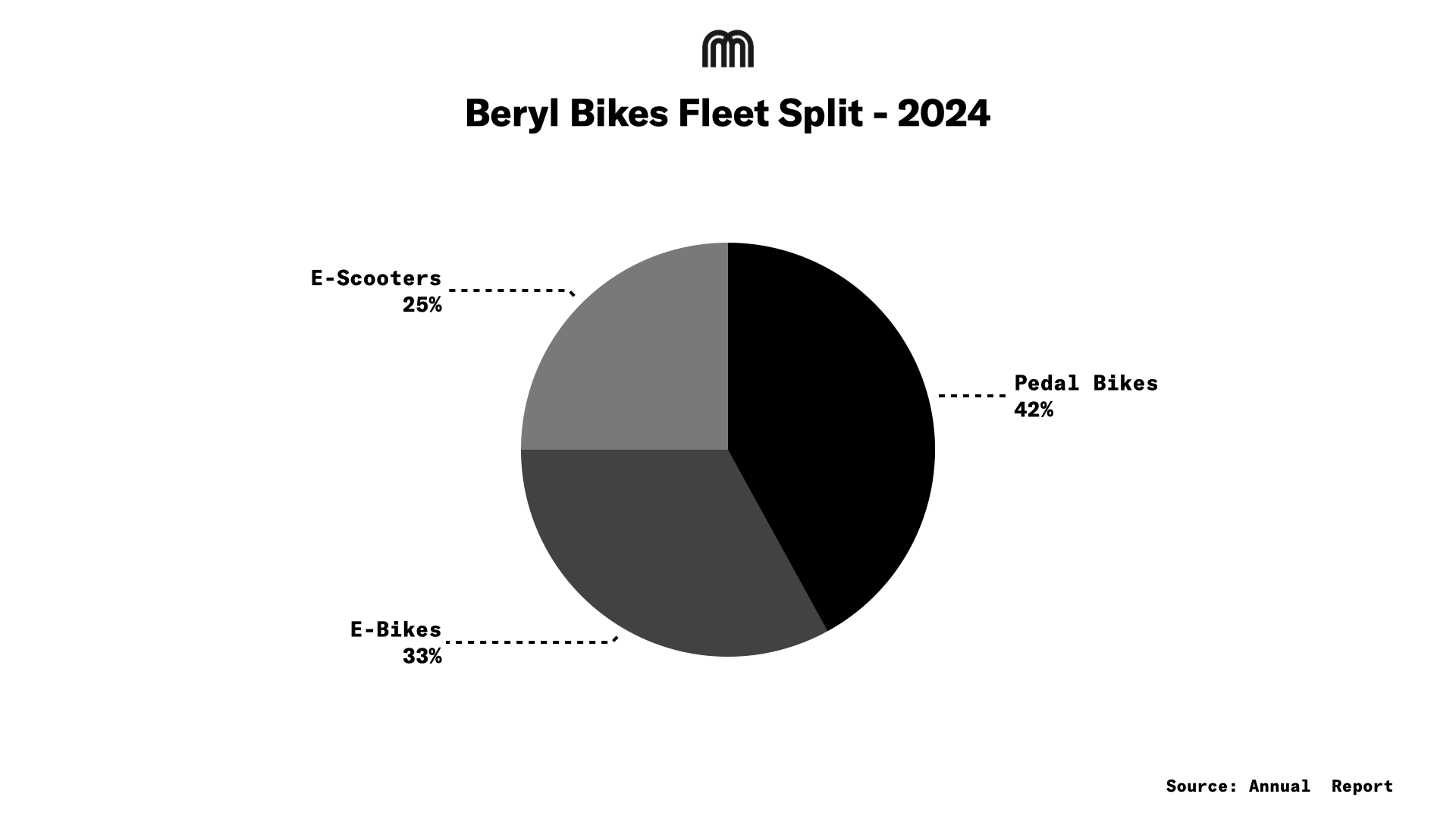
Beryl also reported its 2024 fleet mix, which consisted of 42% pedal bikes, 33% e-bikes and 25% e-scooters.
Underlying the vehicles is Beryl’s data platform, built around onboard telemetry, real-time fleet monitoring, and cloud-based tools used by both Beryl and its council partners. The company has also experimented with simulation-led planning. In Norwich, a digital-twin trial with Fujitsu used modelling tools to test bay locations before installation. Bays selected through this process went on to deliver roughly double the ridership and revenue of sites chosen conventionally, showing how planning tools can materially improve shared-vehicle performance.
Funding
Beryl’s funding history combines early venture investment, manufacturing-focused support and structured financing.
In its Blaze years, the company raised a $500k seed round in 2014 from Index Ventures and the Branson family, as reported by TechCrunch. Additional early funding came later from a Pembroke VCT-led consortium and other private investors, with public profiles placing Blaze’s total early investment at over £1.5m. This capital supported the production and global rollout of the Laserlight.
As Beryl, the company has continued to attract both private and public-sector investments. In 2023, it secured £2m from Frontier Development Capital’s AMSCI Recycled Fund to build a UK manufacturing hub in Poole and expand R&D for new vehicle models. Institutional investors, including Pembroke VCT and the Greater Manchester Combined Authority, list holdings in SMIDSY Ltd, the company behind Beryl.
Alongside equity, Beryl has also used structured instruments such as convertible loan notes, including a recorded round of around $2.78m in 2020.
Ownership Structure
As of 31 March 2024, the ultimate controlling party was A P Clarke, by virtue of his shareholding in ACG Limited. ACG had been the largest single shareholder for years and provided significant financial backing.
Post-year-end development:
On 24 December 2024, Beryl was acquired in a 100% share capital acquisition by Ocean Infinity Group Limited, a marine robotics company owned by ACG Limited. This move integrates Beryl into a larger group structure, providing a stronger footing for long-term growth.
2024 Financial Performance
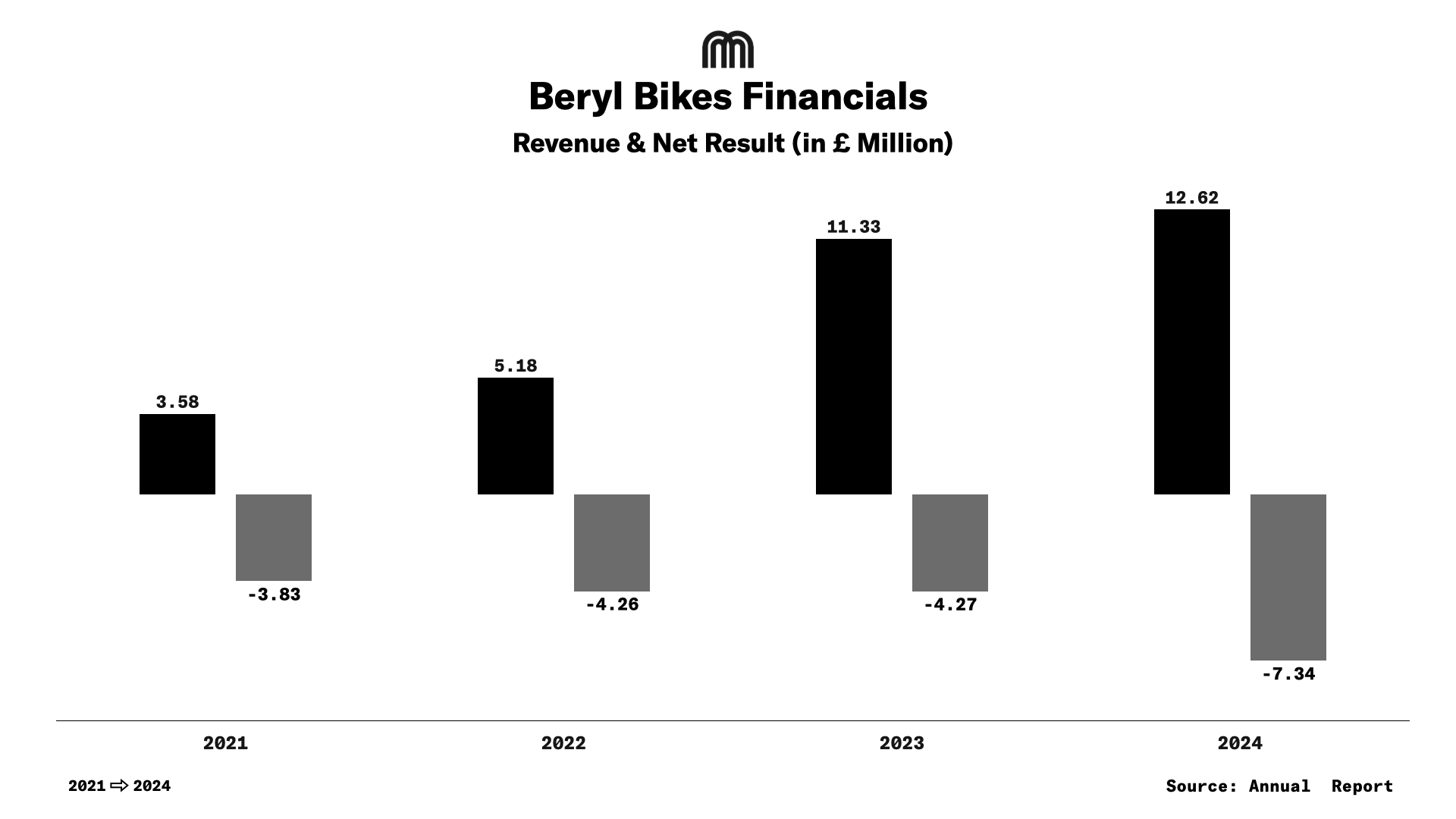
For the year ending 31 March 2024, Beryl reported revenue of £12.6m, up 11.3% from £11.3m in 2023 and £5.2m in 2022. Gross profit came in at just under £5.0m.
Administrative expenses remained the company’s largest cost category at around £10.9m, reflecting staff costs, technology development and overheads.
Overall, Beryl recorded an operating loss of £5.8m and a net loss for the financial year of £7.3m, underscoring the capital-intensive nature of scaling hardware-based transport systems.
Revenue Breakdown
By business segment:
- Bikeshare schemes: £12.61M
- Consumer products: £10,357
By geography:
- United Kingdom: £12.69M
- Europe: £494
- Rest of World: £63
Beryl’s revenue is almost entirely UK-based, derived from local authority contracts and SaaS/platform fees.
Cost Structure
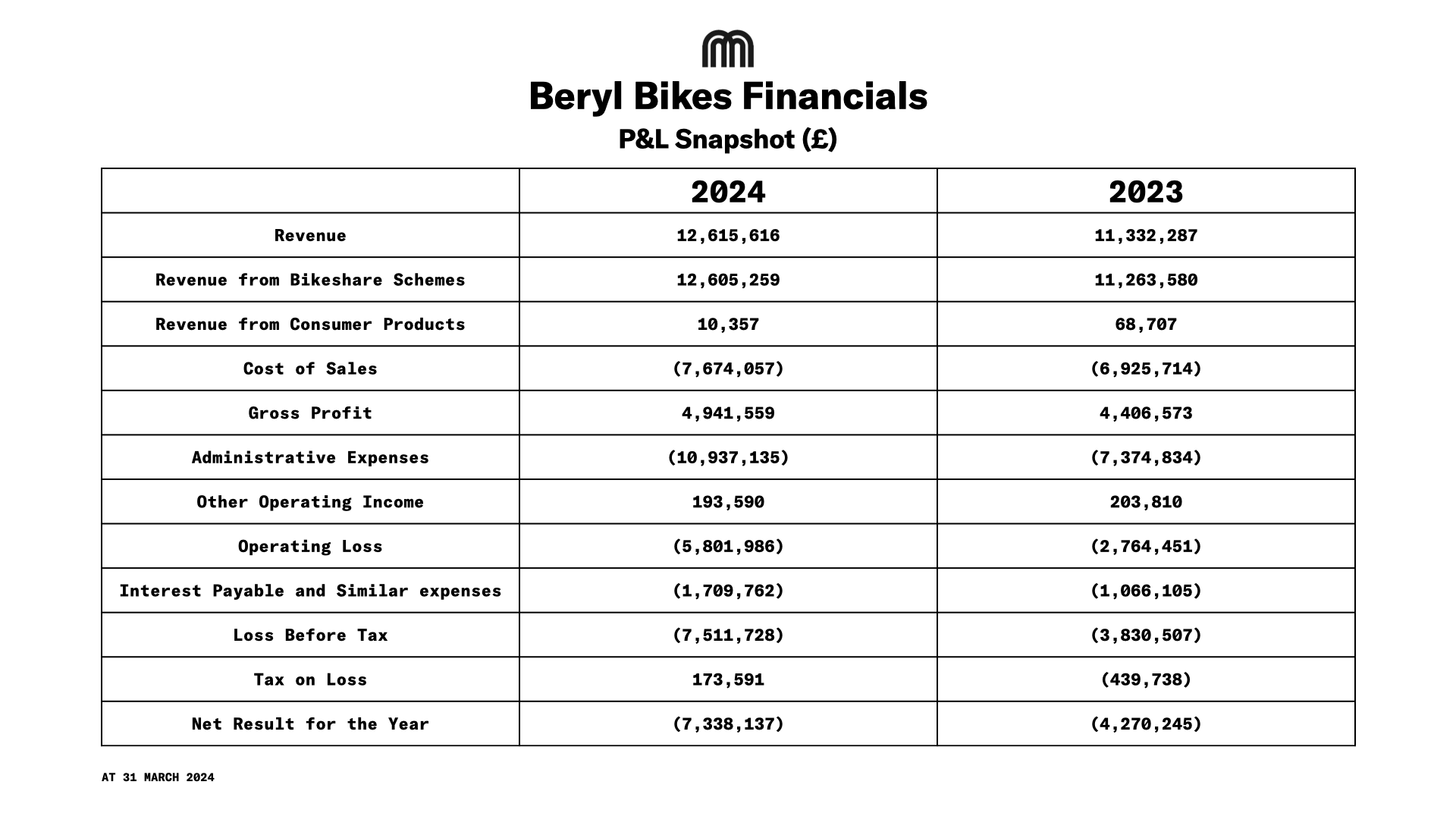
Beryl’s cost base continues to be dominated by fleet operations and technology. In 2024, cost of sales rose to £7.67m, or 60.8% of revenue, broadly in line with the prior year. Administrative expenses increased to £10.94m, driven by higher depreciation and impairment charges (£3.38m), amortisation of software and development costs (£2.30m), staff costs, and operating lease expenses (£0.48m).
Finance costs also rose, with interest expense increasing to £1.71m from £1.07m in 2023, reflecting higher borrowings and charges linked to the company’s debt structure.
Gross margin remained stable at around 39%, but the operating margin declined to -46% (from - 24% in 2023).
Cash Position & Balance Sheet
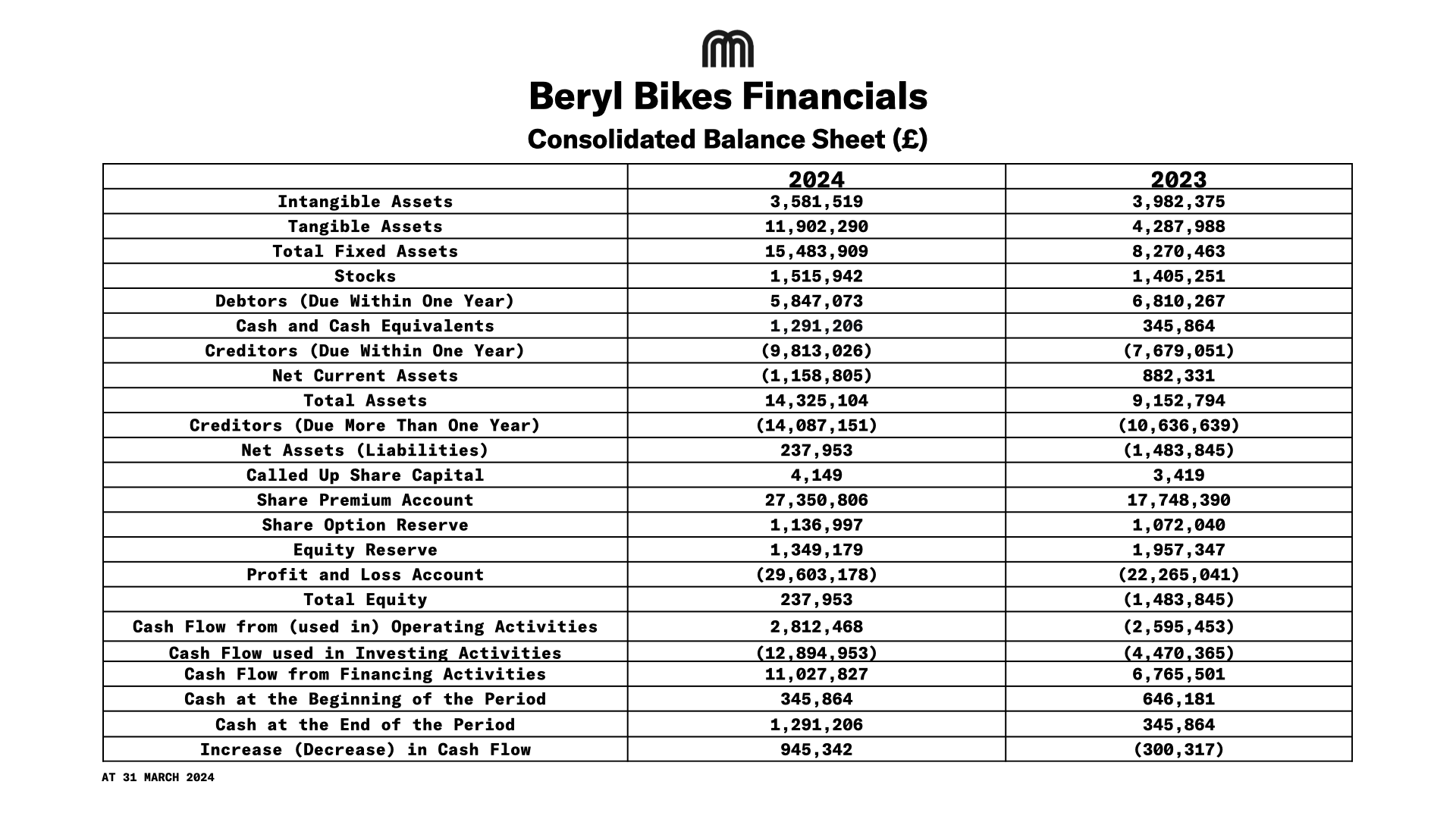
Beryl ended FY2024 with a stronger cash position, holding £1.29m compared with £0.35m the previous year. Despite reporting a £7.34m accounting loss, the company generated £2.81m in operating cash flow, helped by large non-cash charges and movements in working capital. Investment activity remained high: Beryl spent £10.99m on fleet and infrastructure and £1.90m on software and platform development.
Total assets increased to £24.14m, reflecting this ongoing investment, while liquidity remained tight with net current liabilities of £1.16m. Total liabilities reached £23.90m, with long-term funding dominated by £14.09m in convertible loan notes. Short-term borrowings amounted to £2.65m, including bank loans and a £0.75m shareholder loan from ACG Limited. The company had no long-term bank loans remaining at year-end.
2025 Outlook and Post-Year-End Developments
Following the end of the 2024 financial year, Beryl expanded its footprint with several new UK schemes scheduled to launch after March 2024, including locations such as Guildford Hospitals, Guildford, Bromsgrove, Barnsley and Bradford. The company is also continuing its fleet transformation programme, replacing older vehicles and updating equipment across existing schemes. In early 2025, Beryl strengthened its capital position by issuing £5 million of new ordinary shares on 15 February 2025. Together, these updates show that Beryl entered 2025 with additional contract wins, an upgraded fleet plan, and fresh equity raised to support its ongoing operations.
How Riders Are Using Beryl’s Services
Alongside its financial results, Beryl’s annual Rider Report offers a useful view into how people are actually using the system on the ground. The 2024 edition, based on more than 13k responses across 16 schemes, shows the service shifting from occasional leisure use toward more routine, purpose-driven travel.
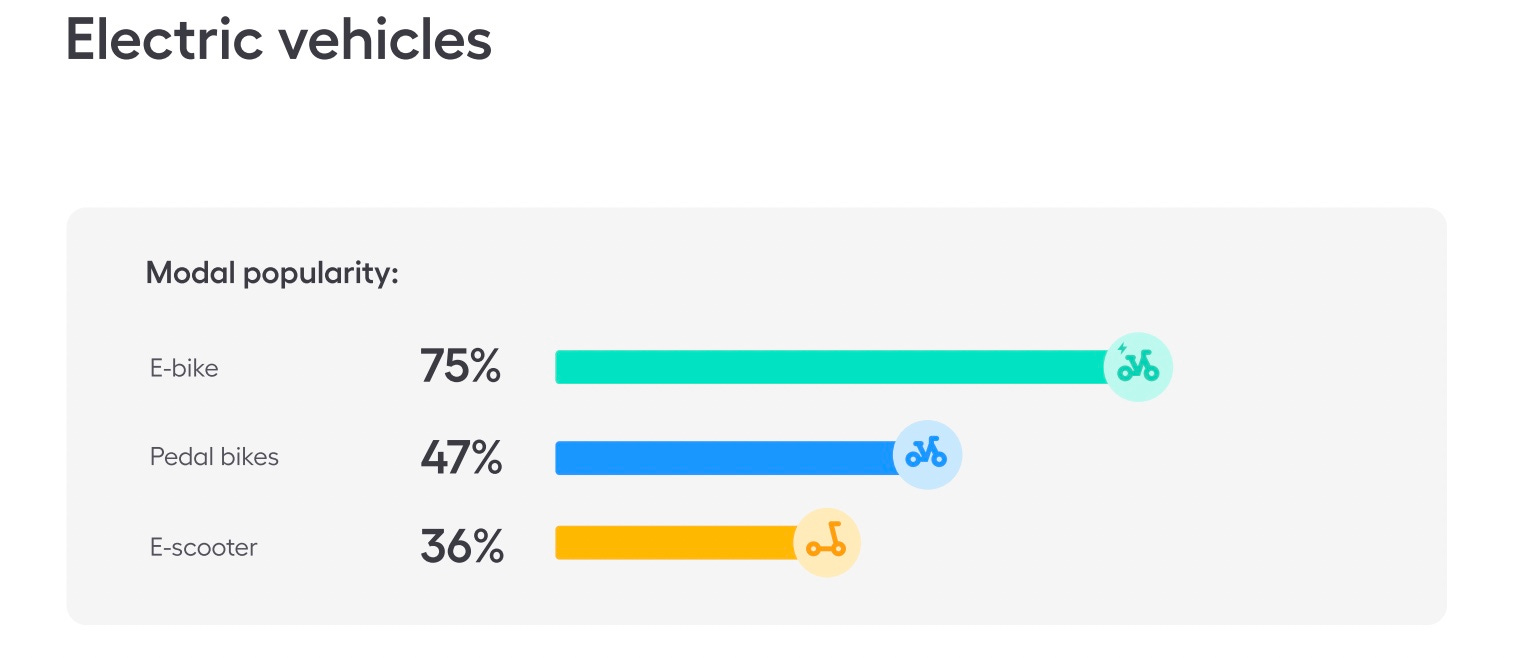
Commuting now accounts for 34% of all rides, while 70% of riders use Beryl at least monthly, indicating growing dependence on the service for everyday mobility. E-bikes remain central to this pattern: 75% of riders used an e-bike in the past six months, and they continue to be the mode most likely to replace short car journeys. Accessibility improvements are also being reflected in adoption, with 12% of riders identifying as having a disability, a proportion that has risen year-on-year.
The report highlights Beryl’s role in reducing car trips, 62% of riders said their most recent journey replaced a car, taxi or motorbike trip, an impact that aligns with the sustainability priorities of the councils Beryl contracts with. At the same time, 41% of riders cited cost as the main barrier to increasing their usage, a consideration that will influence pricing and access programmes as schemes expand.
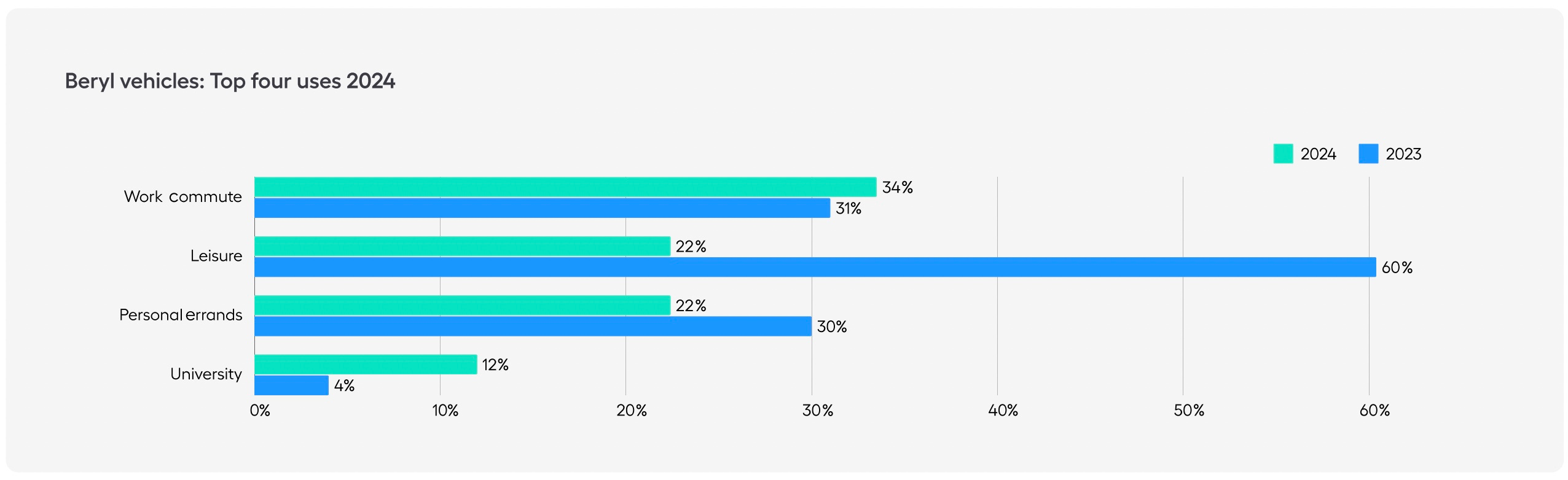
Work commutes have overtaken leisure as the top use case, with commuting rising to 34% of all rides while leisure use drops sharply year-on-year. This shift reflects how Beryl is becoming part of daily travel rather than an occasional activity, as the report also notes a 16% fall in “novelty” sign-ups, a sign that riders now use the service for routine, purpose-driven trips rather than curiosity or one-off leisure rides.
Taken together, these behavioural trends give further context to Beryl’s operational performance and help shape expectations for how demand may evolve in 2025.
Conclusion
Beryl has grown from a cycling safety startup into a UK-wide micromobility operator with its own fleet, platform and manufacturing capability.
The company now operates a broad network of micromobility schemes and continues to build out its contract pipeline. Its financials reflect both the progress made and the typical pressures of operating capital-heavy fleets. As Beryl moves through 2025, its focus remains on expanding its schemes, improving operational performance and managing the balance between investment and sustainability.
The result is a business that has become a consistent presence in the UK’s transport landscape, one shaped by practical expansion rather than rapid leaps, and by long-term city partnerships rather than short-term deployment cycles.


.png)