Voi-là, a Record Year on Every Metric

Team M
News
April 23, 2026

Subscribe

Welcome to Micromobility Pro, a bi-weekly publication which is part of The Micromobility Newsletter, where we deep-dive into the financials of micromobility companies and share exclusive insights tailored for professionals and members.

Last Day to Save on Micromobility Europe 2026. Sale Ends Today!🚨

Today is your final chance to secure your spot at Micromobility Europe 2026 for €525.

Join the leaders, operators, and innovators shaping the future of micromobility and urban transport in Berlin.

General Admission is €525, down from €1500. Prices increase after today or when tickets sell out.

Secure your ticket now.

[Get Your Ticket]

Join McKinsey, Rivian’s ALSO, LYFT, RYDE, Dott, NextBike, POLIS, Urban Sharing, Navee, CityFi, Valeo, XYTE, Vmax, Microlino, Standab, Atom and many others!

[Sponsor/Exhibit] | [Speak at the Event] | [Exhibit as a Startup] | [Get A Free Pass]

And to find all about Micromobility America | Nov 11-12 | Palace of Fine Arts, SFO - HERE!

Contents

  • About Voi Technology
  • The Beginning: Four People, One Thesis
  • Voi’s Timeline
  • Operations
    • Chart: Revenue Split by Category & Geography
  • Fleet and Hardware
  • FY2025 Financial Performance
    • Chart: Yearly Net Revenue vs EBIT And Quarterly Net Revenue vs EBIT
    • Chart: Number of Trips And Vehicles Deployed
    • Chart: Trips Per Vehicle Per Day And Revenue Per Vehicle Per Day
    • Chart: Vehicle Profit % And Market EBITDA %
    • Table: P&L Snapshot - 2025
    • Table: Consolidated Balance Sheet - 2025
  • Ownership Structure
    • Chart: Voi’s Valuation
  • Into 2026
  • Voi vs Dott

About Voi

Image credits: Voi

Somewhere in Stockholm, four people decided that European cities deserved better than what they were getting from the first wave of shared scooters. That idea became Voi.

Today, Voi Technology is one of Europe’s leading shared micromobility operators. The company runs electric scooters and e-bikes across more than 130 cities in 12 countries, with a fleet of roughly 160k vehicles.

Voi’s stated vision is “Cities made for living, free from noise and pollution.” The company’s mission is to offer safe, sustainable, and reliable micromobility for everyone, with the goal of giving urban residents a practical, affordable alternative that reduces car dependency, congestion, and air pollution.

In 2025, the company posted €178.2m in net revenue and it marked the strongest year in Voi’s history.

The Beginning: Four People, One Thesis
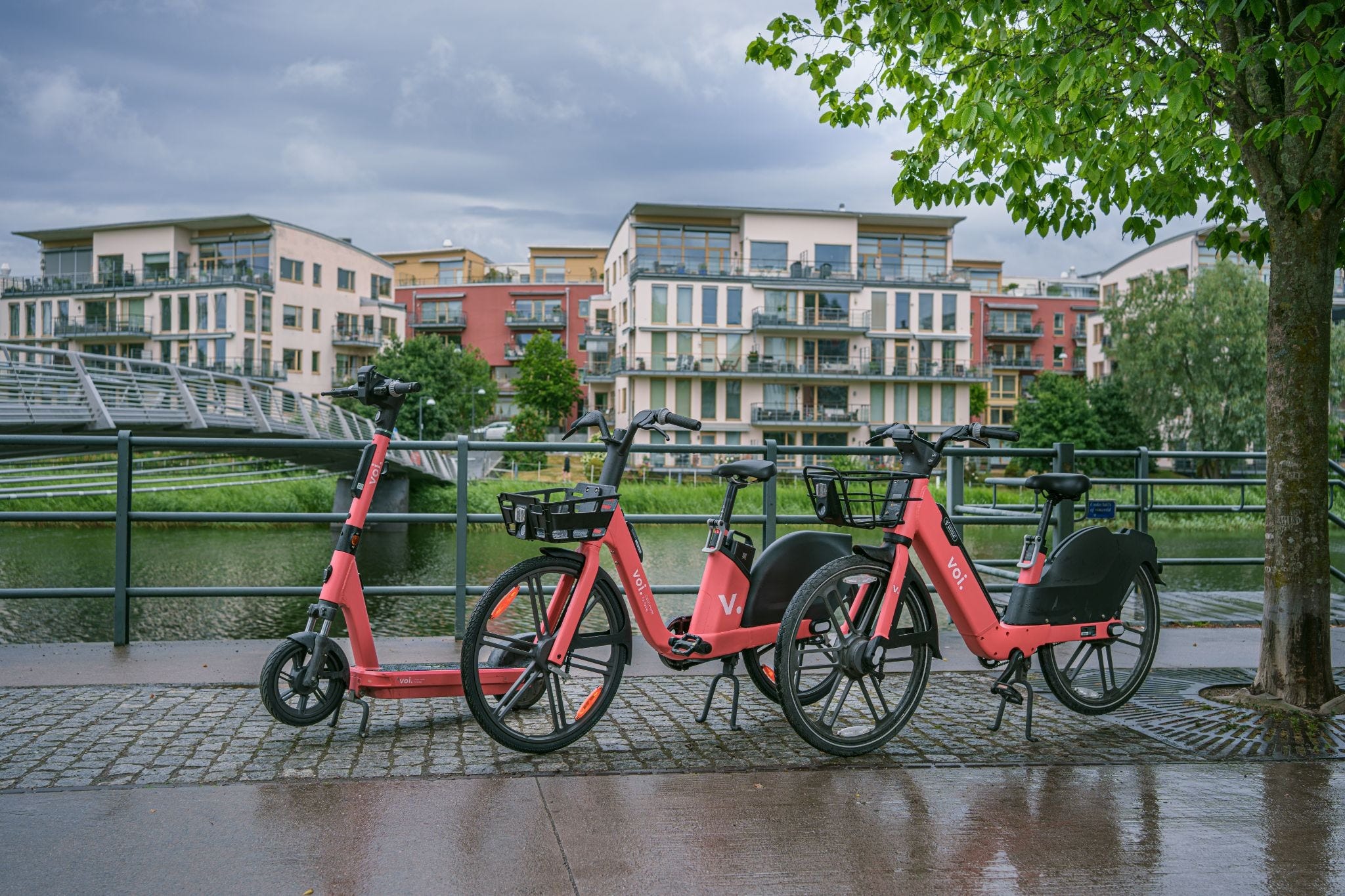
Image credits: Voi

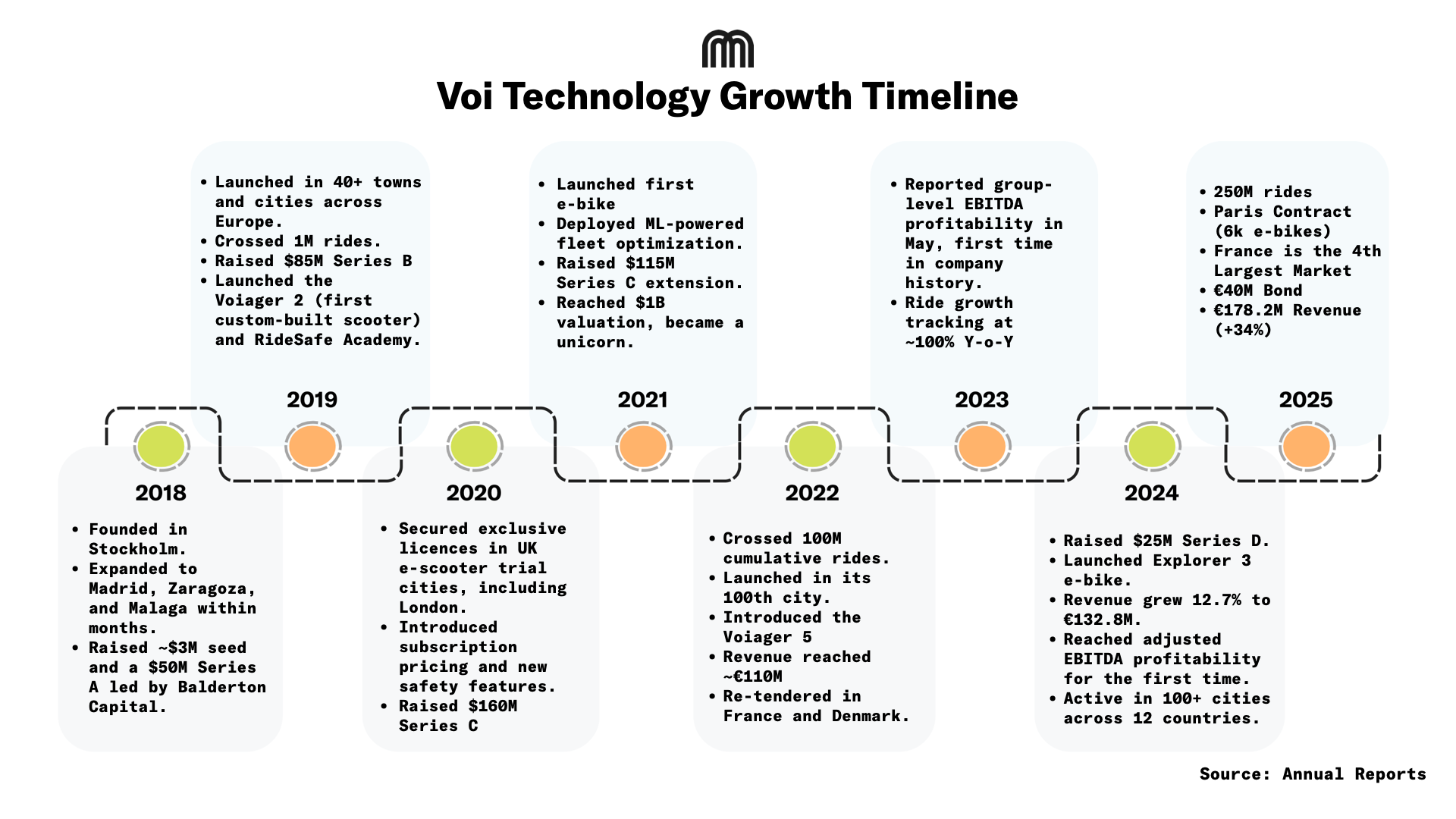
Voi was founded in Stockholm in August 2018 by four co-founders: Fredrik Hjelm (who became CEO), Douglas Stark, Adam Jafer, and Filip Lindvall. Hjelm had a background that was unusual for a tech founder, he was part of the Swedish Armed Forces and a serial entrepreneur. The founding team shared a specific conviction: European cities had different needs than American ones. Denser streets, stronger public transit, more collaborative regulatory environments.

The model was straightforward, dockless electric scooters rented by the minute through a mobile app, no docking stations, GPS-tracked, unlocked by QR code. Within months of launching, Voi had already expanded to Spain, operating in Madrid, Zaragoza, and Malaga. The speed was there. But so was the intentionality about how they were doing it.

Before the year was out, Voi had raised around $3m in an initial round, then closed a $50m Series A in November 2018, led by Balderton Capital, with Vostok New Ventures, LocalGlobe, and Raine Ventures participating. Angel investors included Justin Mateen (the Tinder co-founder) and Nicolas Brusson, CEO of BlaBlaCar. For a company that was less than four months old, this was a remarkable vote of confidence.

But money alone doesn’t explain what made Voi different. The clearest signal of what Voi was trying to build came in how it thought about cities.

Voi’s Timeline

A lot happened between 2018 and today. Here’s the condensed version:
Operations

Voi operates shared e-scooter and e-bike services under tender agreements, licenses and permits with municipalities and city authorities across Europe. The service model is app-based and dockless, vehicles are deployed within defined operational zones and can be picked up and dropped off freely by riders within those areas. The company partners with cities rather than operating unilaterally. A significant portion of Voi’s markets are governed by formal public procurement processes, where operators compete for licenses and tenders typically lasting several years. This model creates more stable, predictable revenue than free-floating permit structures but also requires a continuous track record of operational performance and regulatory compliance to retain and renew contracts.

Alongside pay-as-you-go service, Voi offers daily and monthly pass known as Voi Pass, which give riders unlimited access to vehicles up to defined trip caps. In 2025, pass and subscription products grew 65% YoY and represented 39% of total net revenue, up from 31% in 2024. Pay-as-you-go rides remained the largest revenue stream, accounting for €109.2m in leasing income (services recognized at a point in time), while subscriptions (Services recognized over a period of time) accounted for €69.1m.
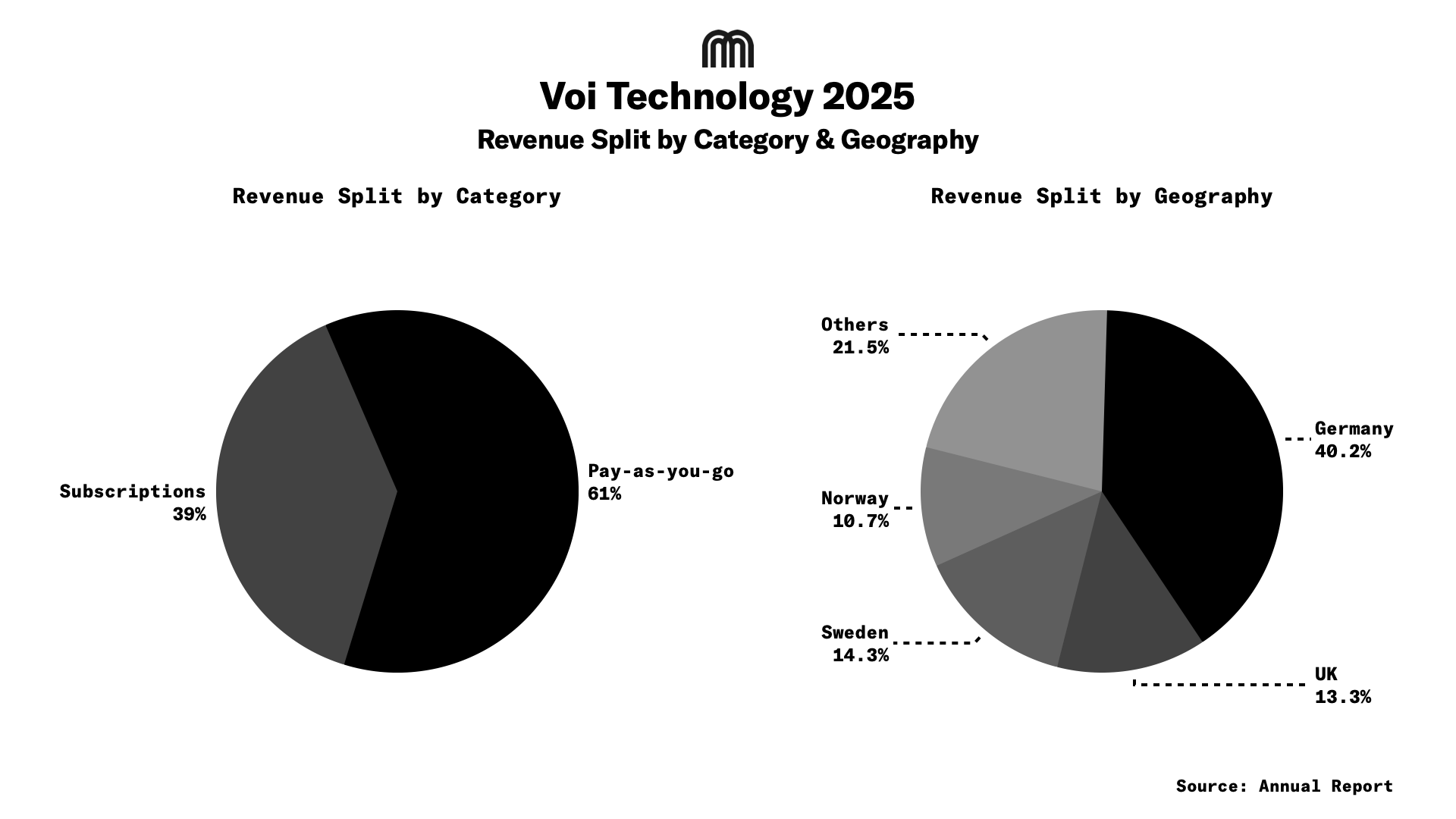
At the end of the 2025 reporting period, Voi employed 913 people. During the year, the average headcount was 813, distributed across Sweden (223), Germany (281), the UK (124), and other markets (185).

Fleet and Hardware
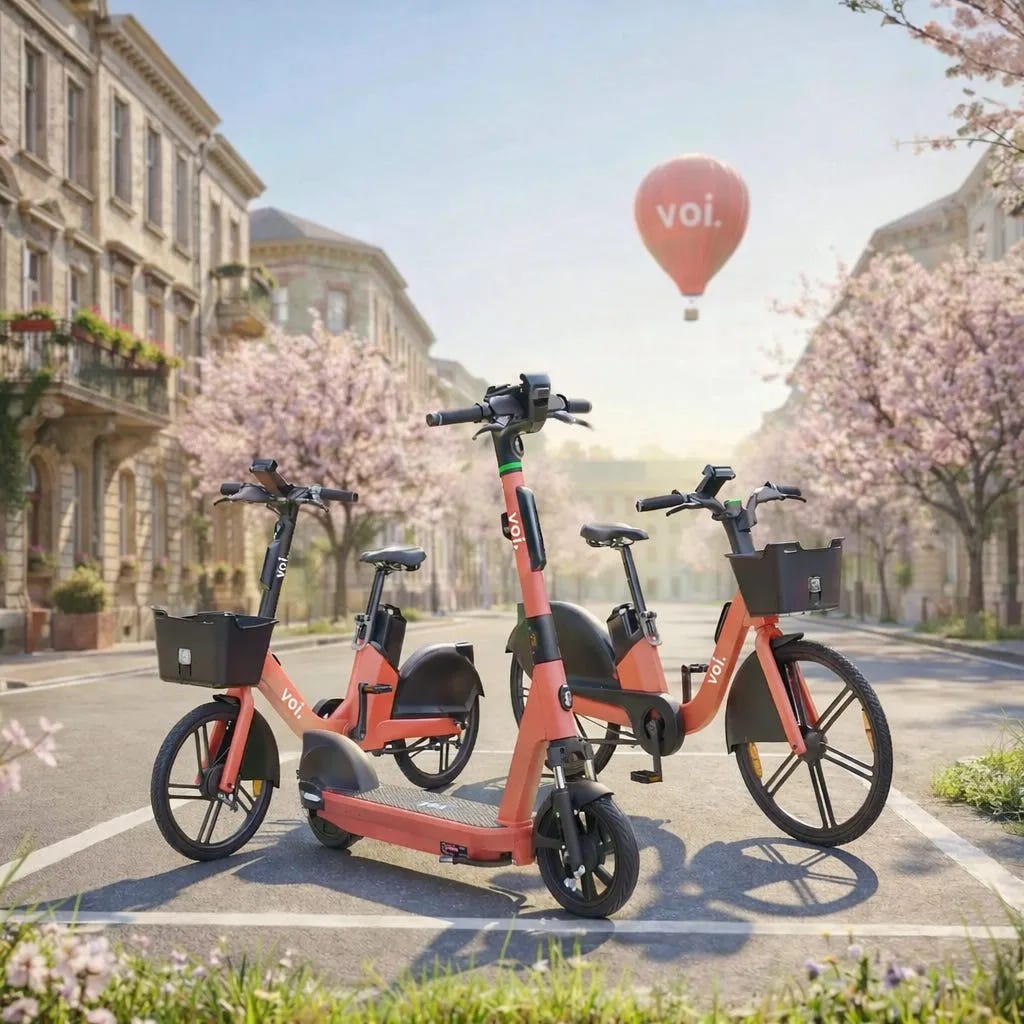
Image credits: Voi

Voi owns its vehicle fleet outright and treats hardware development as a core operational lever. Each generation of the Voiager scooter line and Explorer e-bike line has been designed to Voi’s own specifications, with a focus on lowering the cost of operating each vehicle while extending its working life. Voi works with a limited number of external manufacturers to produce its vehicles, while developing key systems such as its IoT platform and firmware internally.

The Voiager 2, launched in 2019, introduced swappable batteries, a design that cut per-vehicle operational costs by nearly 50% by eliminating full vehicle retrieval for charging. The Voiager 5, introduced in 2022, brought a modular architecture that simplified repairs and enabled component reuse across the fleet.
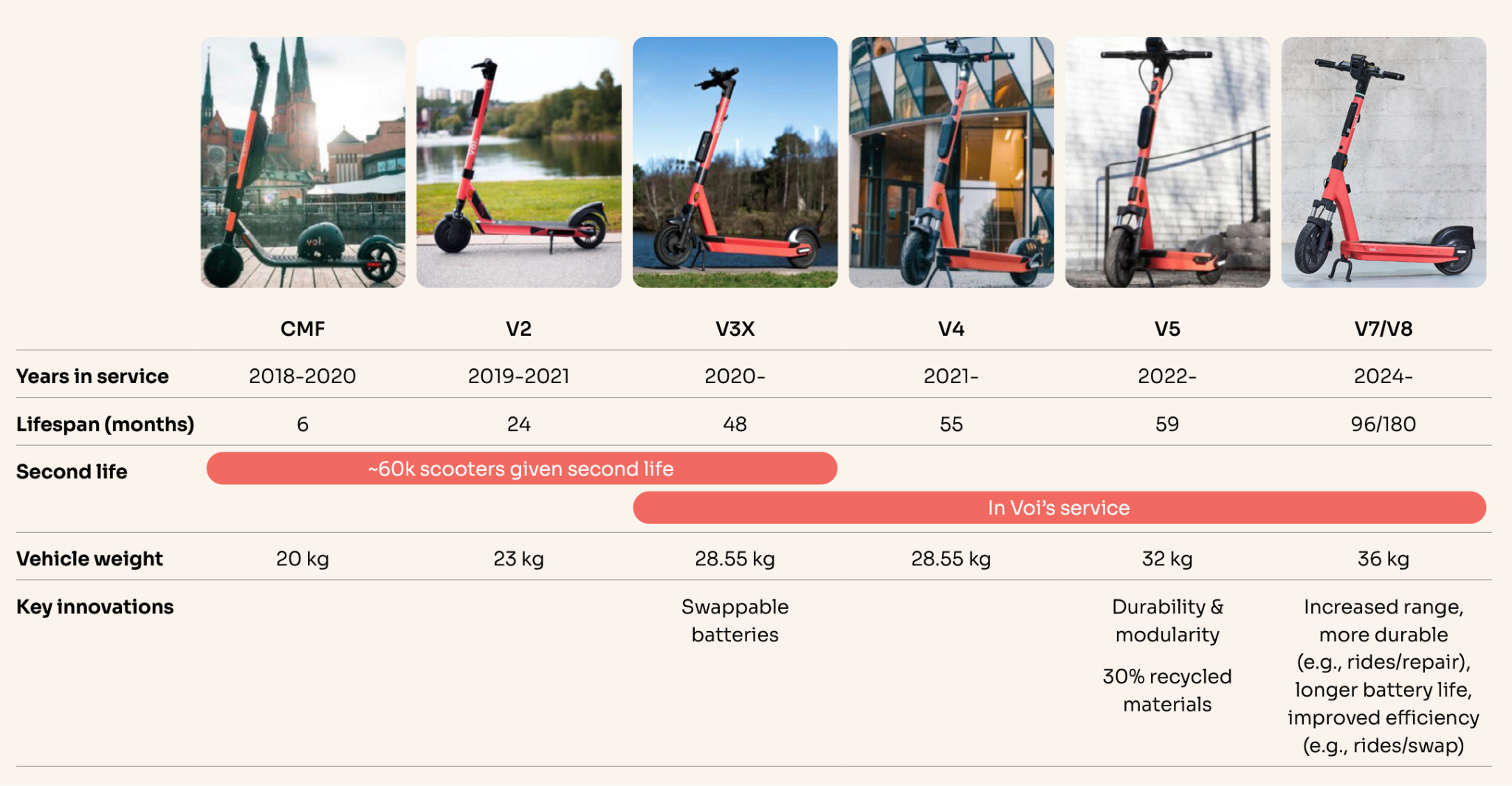
Image Credit: Voi Sustainability Report 2024

During 2025, Voi developed its next generation of vehicles, the Voiager 9 scooter, the Explorer 5 e-bike, and the Explorer Light 2 e-bike, all launched in early 2026. The 2026 generation was built around two priorities: durability and circularity. The Voiager 9 uses 15% more recycled materials than its predecessor. The new e-bikes go further, incorporating more than seven times the recycled content of earlier models. The Explorer Light 2 weighs approximately 15% less than the Explorer 5, which means less raw material used in production and less energy consumed over its operational lifetime.

The 2026 vehicle family runs on Voi’s fully in-house developed IoT platform. The system provides highly accurate GPS positioning enhanced with advanced location technology, enabling more precise vehicle tracking even in dense urban environments. Built-in geofencing allows vehicles to automatically adjust behaviour when entering specific zones, reducing speed in pedestrian areas or flagging no-parking locations directly through the vehicle. Because Voi develops the firmware internally, the company can rapidly adapt vehicle behaviour to new local regulations without requiring hardware changes.

Safety features built into the new generation include topple detection and accident detection, both of which enable faster response when incidents occur.

FY2025 Financial Performance

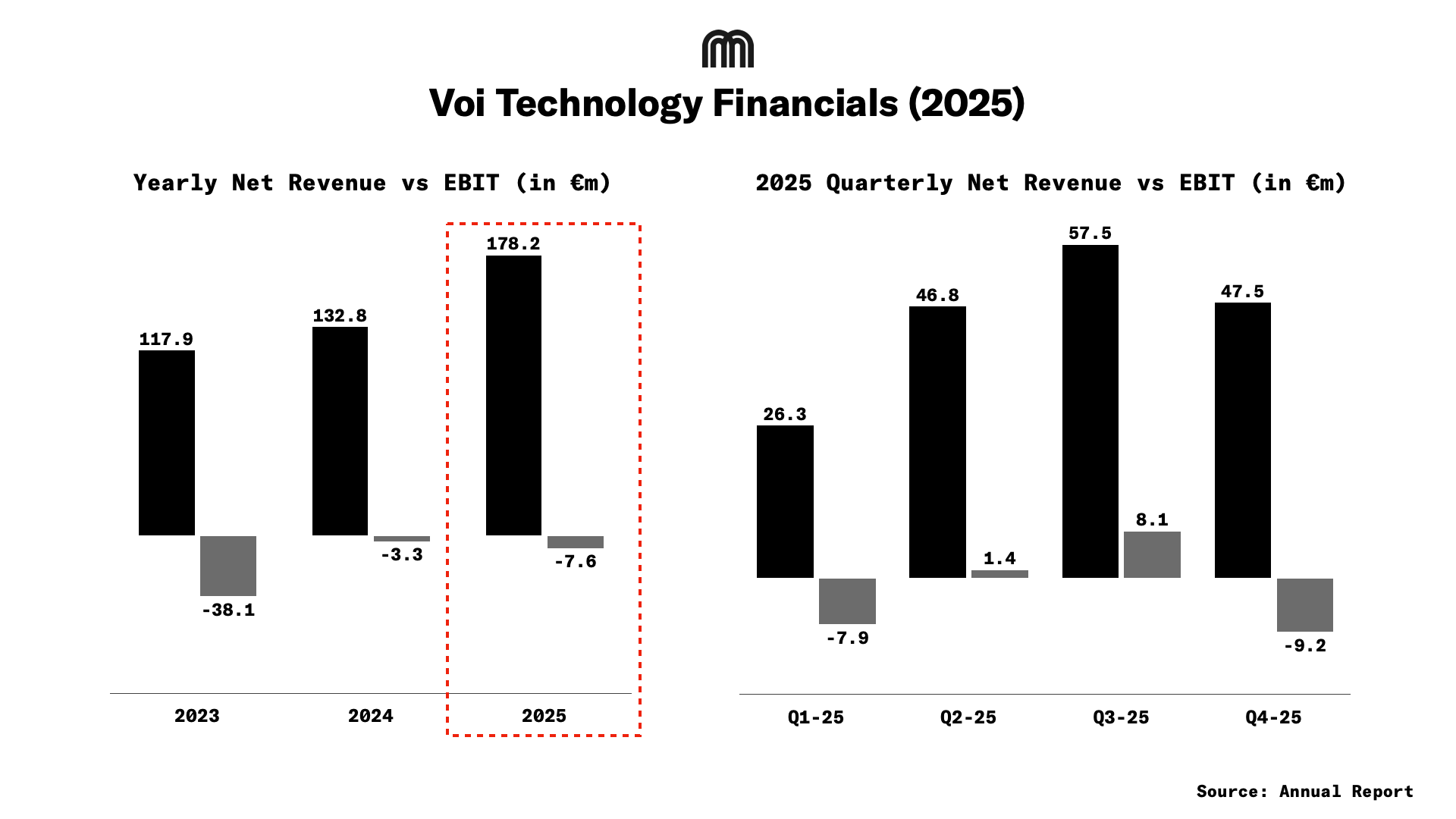
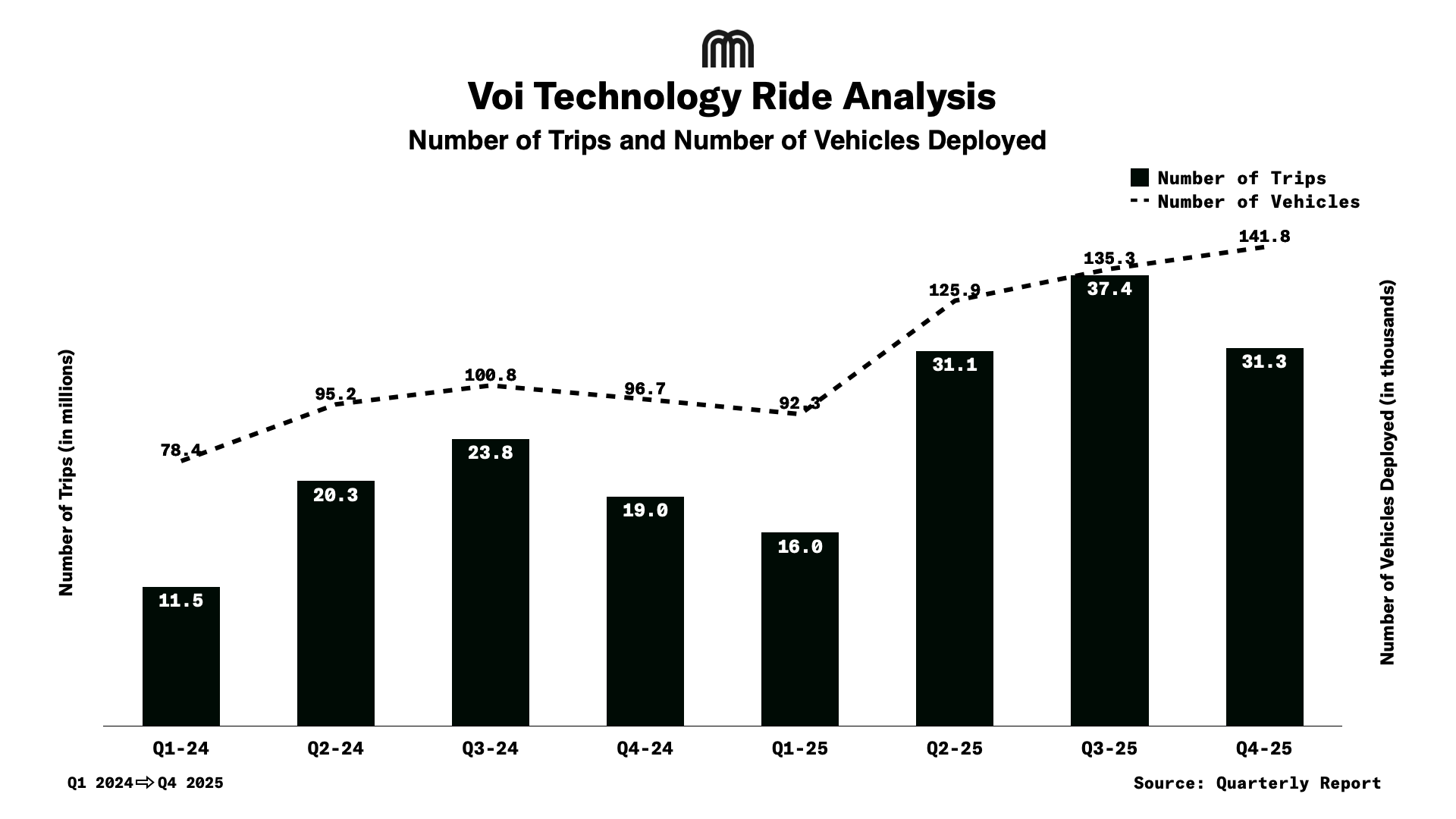
FY2025 was Voi’s strongest year on record across almost every financial metric. Net revenue reached €178.2m, up 34% from €132.8m in 2024, the highest growth rate in the company’s history. The number of rides grew 55% YoY to 116m.
Revenue

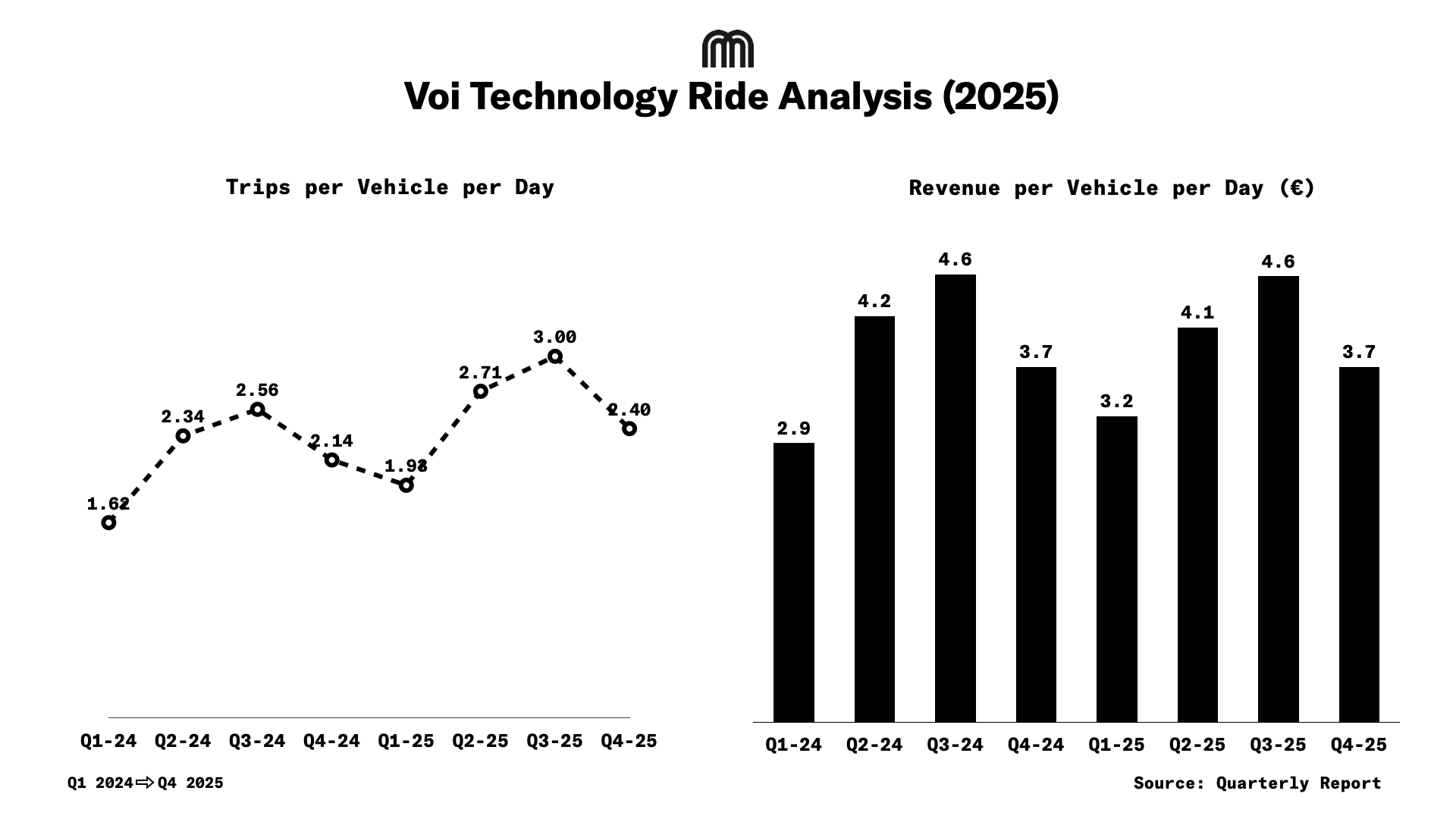
The 34% revenue growth was driven primarily by fleet expansion. Average deployed vehicles grew 34% to 124k, while Net Revenue per Vehicle per Day held steady at €3.94 (vs €3.91 in 2024), despite the fleet expanding into newer, less mature markets where utilisation starts lower.
All major established markets delivered solid Net Revenue growth of between 26% and 29%. Newer and historically smaller markets grew faster and became key contributors during the year. France in particular, going from a presence in Marseille only at the start of the year to the company’s fourth-largest country by Q4 2025.
Vehicle Profit and Market EBITDA

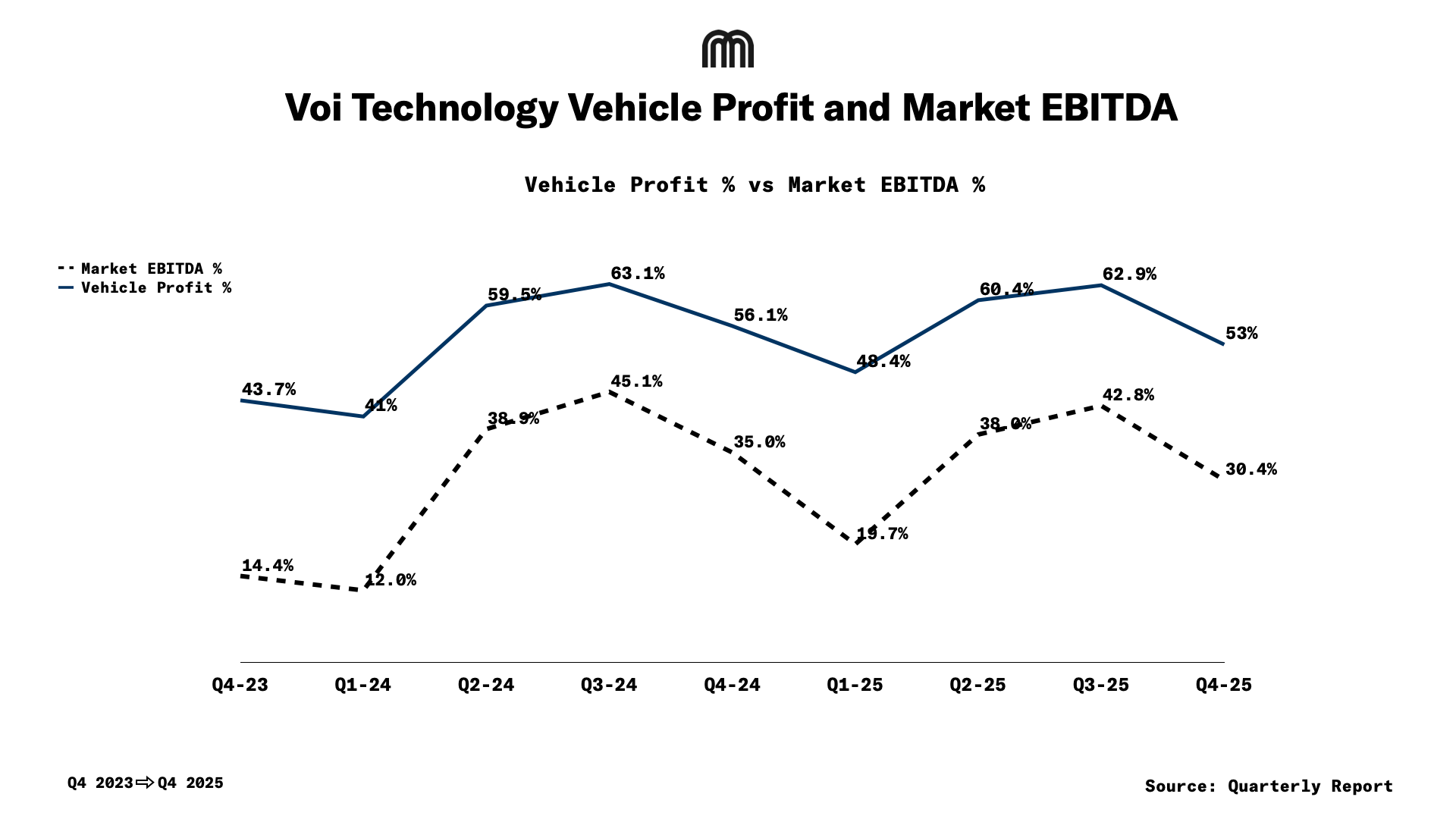
Vehicle profit, what Voi earns per vehicle after the direct costs of operating it, reached €102.4m, a 35% increase from €75.7m in 2024. The vehicle profit margin held steady at 57.5% (vs 57.0%), showing that per-vehicle economics remained consistent even as the fleet scaled.

In FY 2025, market EBITDA grew 31% from €47.5m to €62.1m, with the margin at 34.8% (vs 35.8%). The slight margin compression reflects temporary costs from fleet scaling during the low season, and a moderately lower average ride charge as the fleet expanded into newer territories.
Adjusted EBITDA and Adjusted EBIT

Adjusted EBITDA grew 70% YoY, from €17.2m to €29.3m. The adjusted EBITDA margin expanded by 3.5 percentage points to 16.4%, up from 13.0% in 2024.

Depreciation for the year rose 47% to €26.2m, driven by the larger fleet and the expansion of the e-bike fleet in particular. E-bikes carry a higher purchase price than scooters and, given shorter operating history, are depreciated over a shorter period. The Paris contract, e-bikes added in Q4, pulled depreciation higher in the second half of the year.

After depreciation, Adjusted EBIT reached €3.2m, a 1.8% margin, up from €0.1m and 0.1% in 2024. On an adjusted basis, Voi is now an operating-profitable business.

Reported EBIT and Net Loss

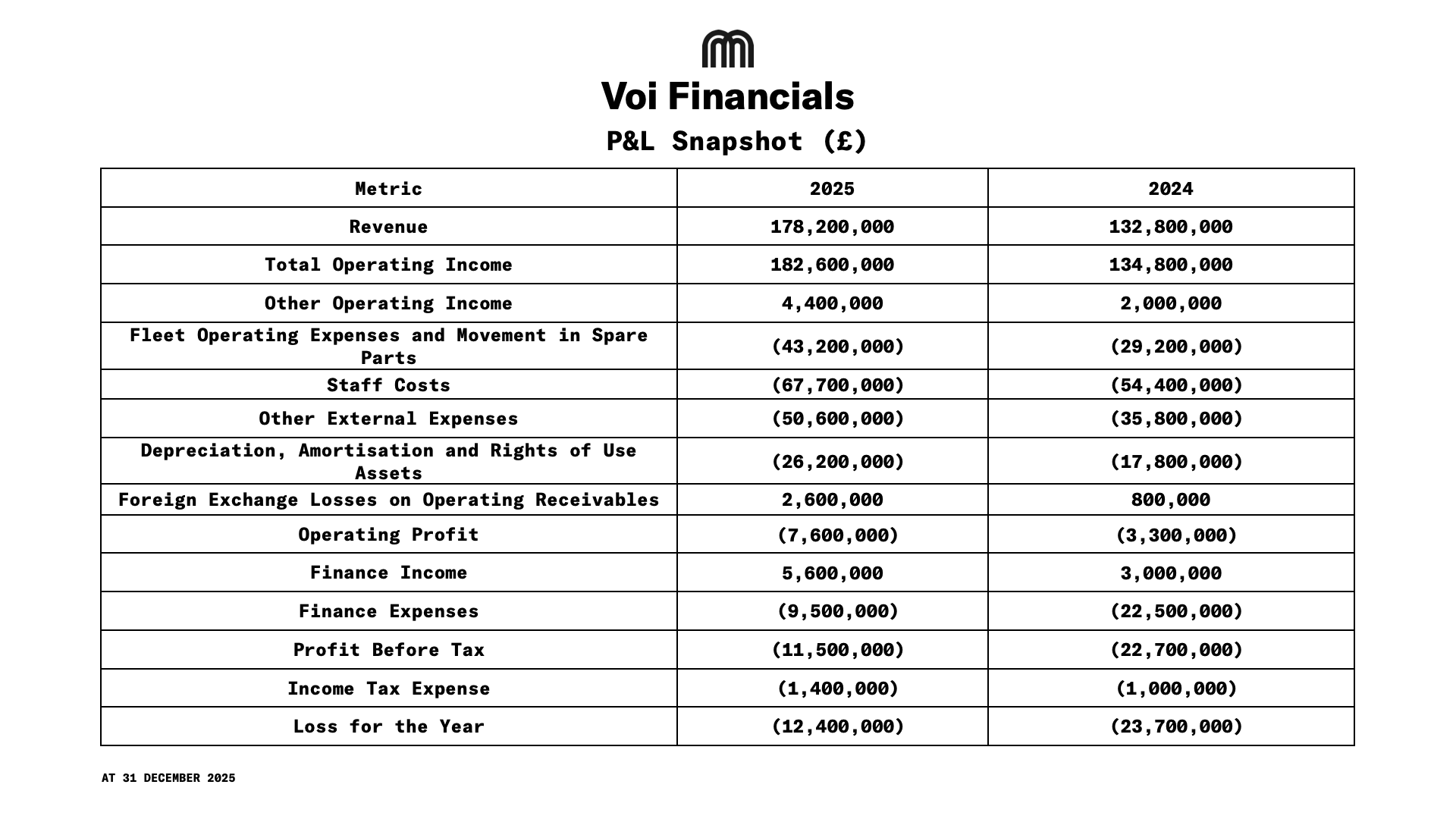
Reported EBIT came in at -€7.6m (vs -€3.3m in 2024). The difference versus adjusted EBIT of €3.2m comes down to €10.7m in one-time costs, of which €10.2m were employee incentive charges. These charges grew because Voi’s valuation rose during 2025 and higher valuation means higher accounting charges on incentive programmes.

Net financial items improved significantly, from -€19.5m in 2024 to -€3.9m in 2025. In 2024, that line included €14.7m in interest costs related to the conversion of convertible notes, which were converted in March 2024 and no longer a recurring item. Interest costs in 2025 related primarily to the outstanding bond portfolio (€4.7m) and right-of-use assets (€0.9m), partly offset by interest income on the company’s cash balance.

Net loss for the year was €12.4m, an improvement from €23.7m in 2024.
Balance Sheet

Total assets grew from €112.7m to €165.6m during the year. Non-current assets increased by €55.3m to €90.5m, driven almost entirely by a €51.3m increase in tangible assets from fleet expansion. Current assets remained broadly stable at €75.1m.

Voi ended the year with a cash balance of €56.1m, down slightly from €60.1m at the start of the year after absorbing significant fleet investment.

Total equity decreased from €31.5m to €24.7m. Total non-current liabilities grew from €60.4m to €104.7m, primarily due to the €40m bond tap issue in Q4. Total current liabilities increased from €20.8m to €36.1m, driven by the overall expansion of operations.
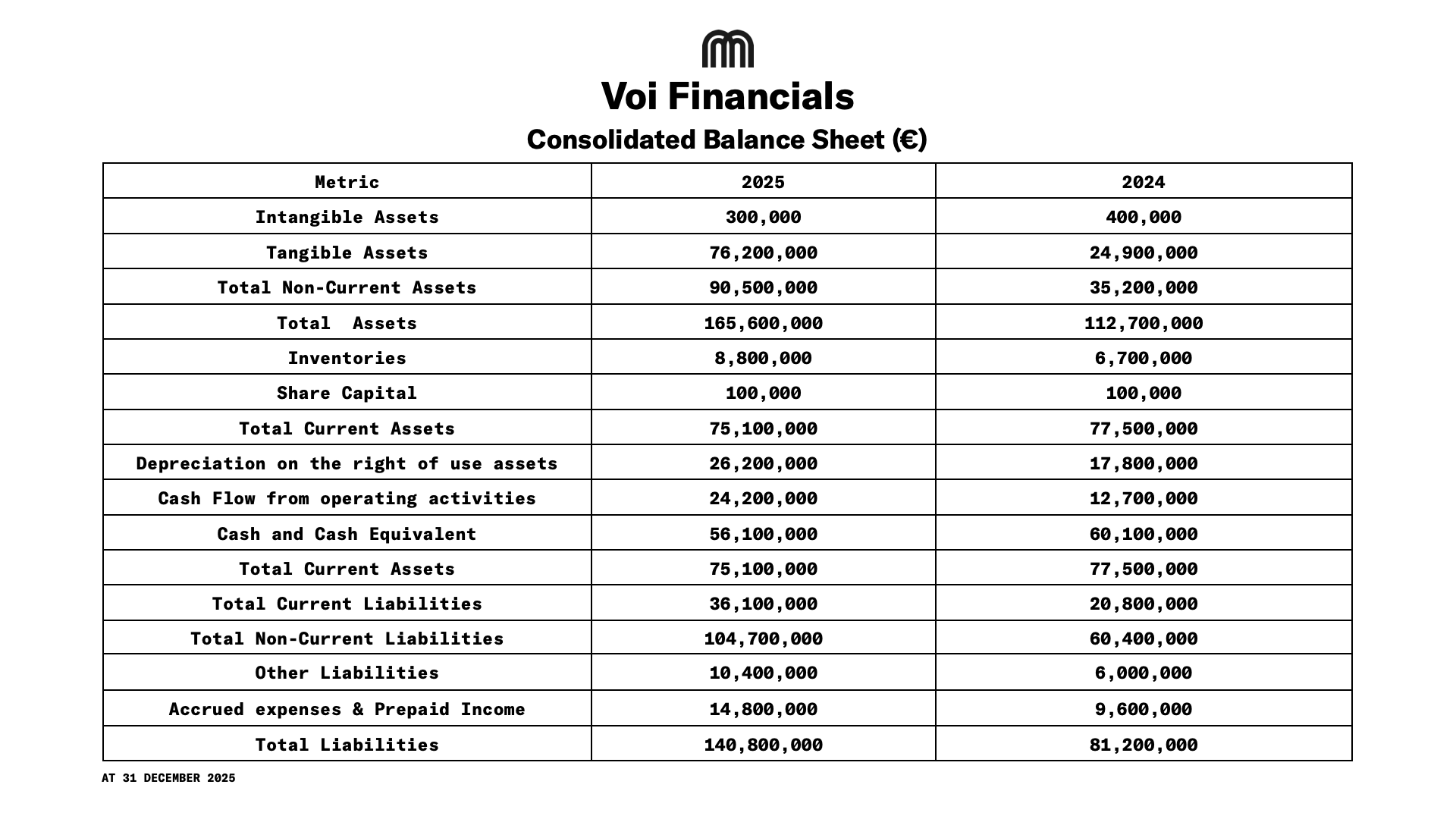
Operating cash flow for the year was €24.2m, up from €12.7m in 2024. Investing activities used €64.4m, predominantly for fleet acquisitions (€63.6m in tangible asset purchases). Financing activities brought in €37.2m. Overall, cash decreased by €3.1m during the year to €56.1m.

Ownership Structure

As of December 31, 2025, Voi had 118 shareholders and 197,991,555 shares issued across 11 share classes, including common shares and several series of preference shares linked to employee incentive programmes and external investment.

VNV Global AB (publ) is the largest shareholder, holding 25.66% of the votes in Voi through its subsidiaries VNV (Cyprus) Limited and VNV Sweden AB, and an economic ownership of 20.9%.
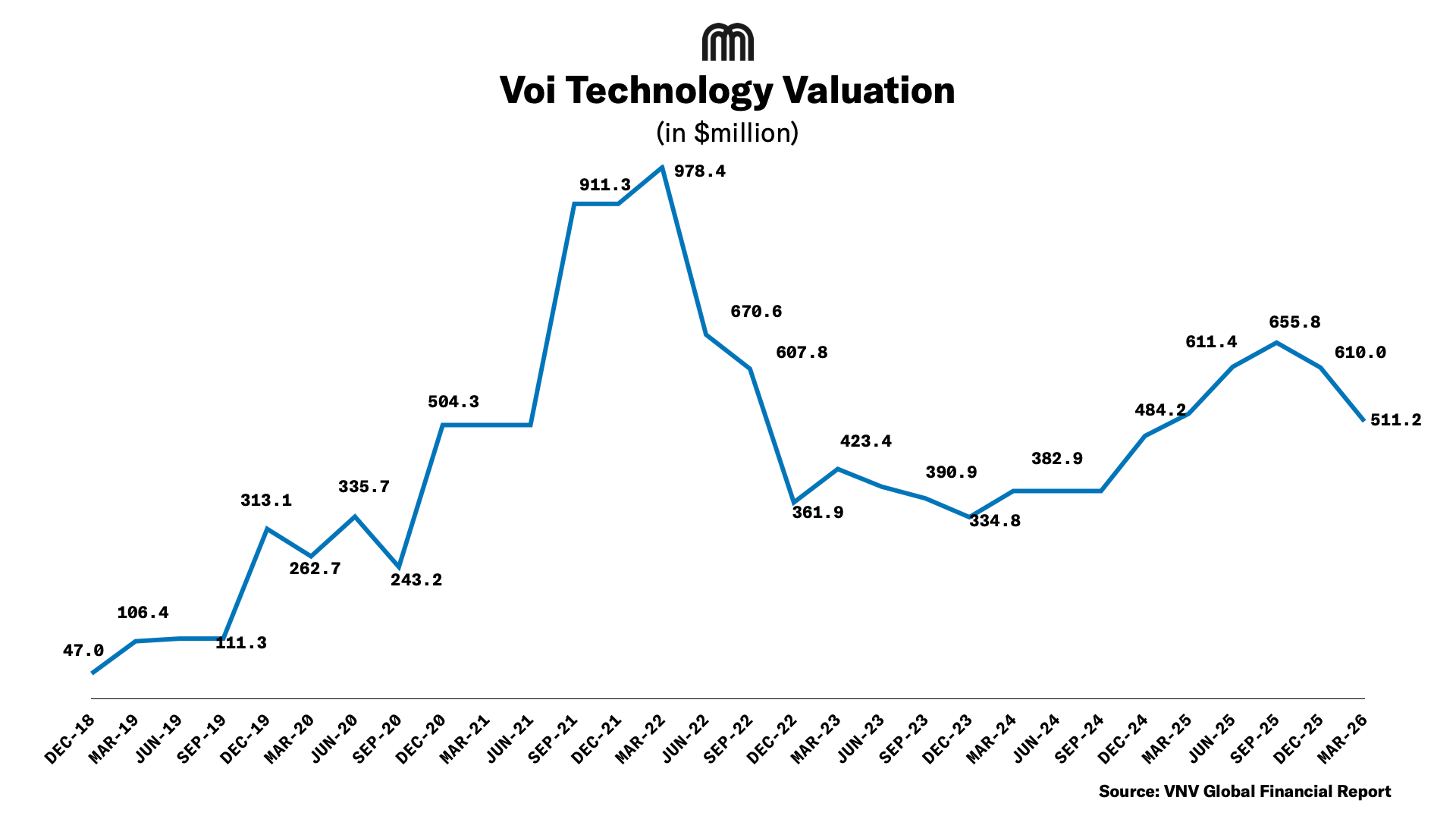
VNV Global valued Voi at $511m at the end of March 2026, down 16% from $610m at end of December 2025. The drop was purely because the stock prices of similar listed companies fell sharply, and the Euro weakened against the Dollar.

Into 2026
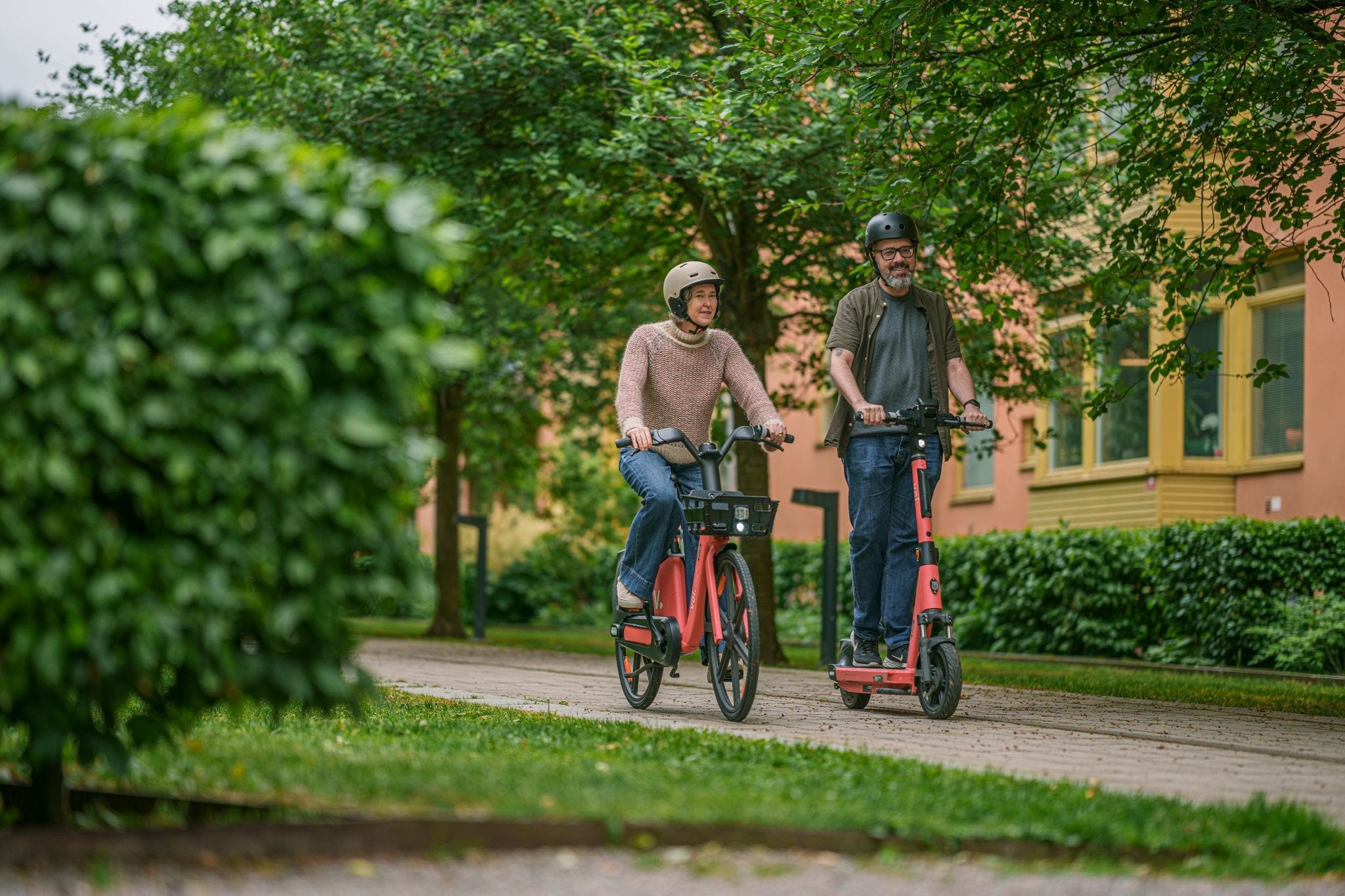
Image credits: Voi

The company entered 2026 with positive operating cash flow, a substantially larger and newer fleet, and its biggest contract, Paris. The Voiager 9, Explorer 5, and Explorer Light 2 have launched and are in deployment.

Voi expects operating cash flow and profits to continue growing through 2026. Fleet investment levels increased in the latter half of 2025 and will continue into 2026, meaning the first half of the year, the seasonally weakest period, will carry the highest investment burden and the greatest drag on near-term profitability. Full-year performance is expected to reflect stronger second-half results as the new fleet comes online and builds utilisation.

France is expected to continue its growth trajectory as a relatively underpenetrated market with significant room to expand. London is scaling. The e-bike fleet, which grew substantially in 2025, is expected to continue growing as Voi deepens its multi-modal capability across its network.

The business heading into 2026 looks more like a daily transport service than it ever has.

The Broader Ecosystem

Voi wasn’t the only European operator making progress in 2025. The broader ecosystem saw multiple players advancing in parallel, with companies like Dott taking a distinctly different route.
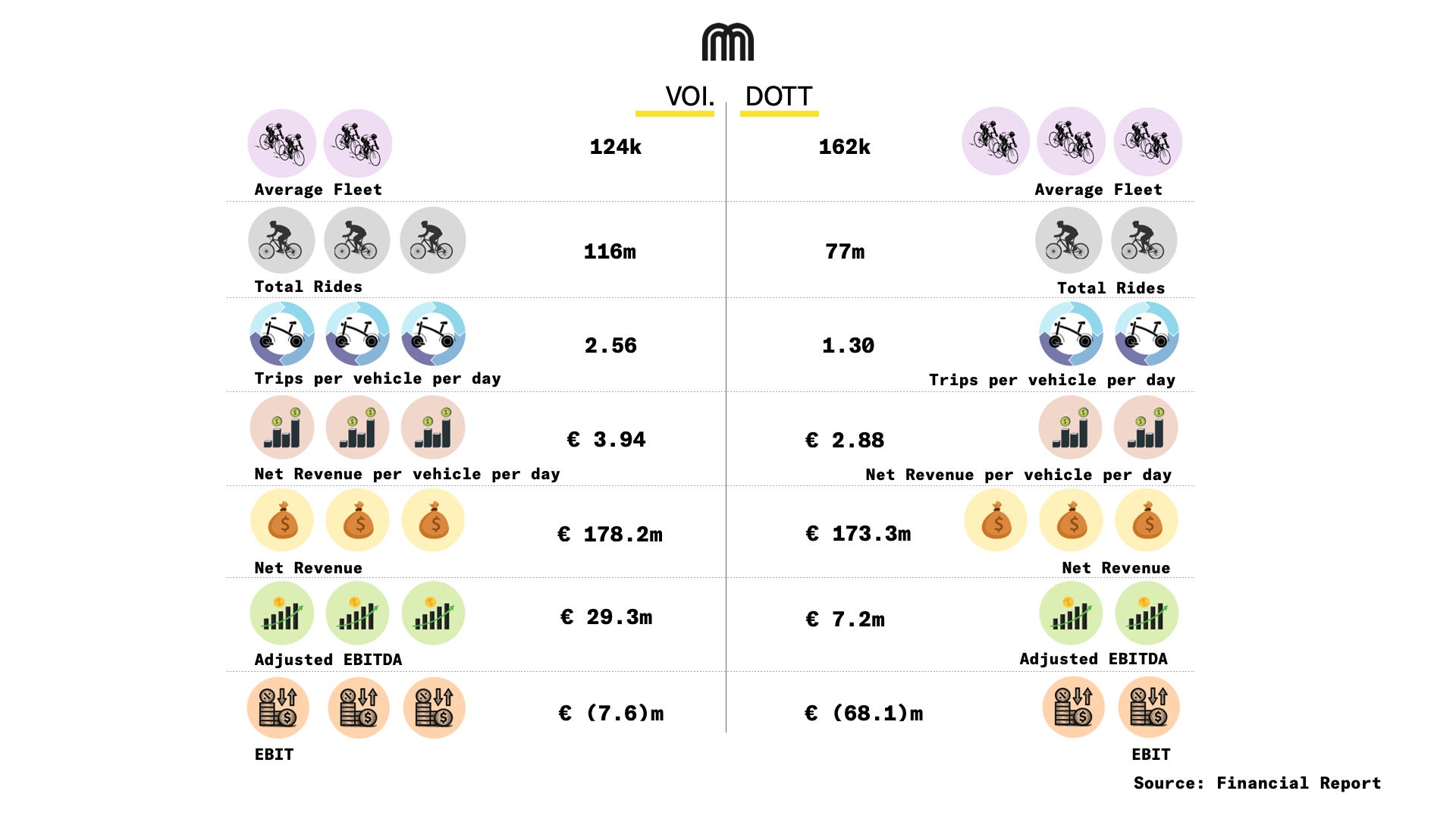
The contrast is worth noting briefly. Voi scaled and improved unit economics. Dott deliberately exited markets and is still coming out of a merger and restructuring phase. Different journeys, but both show the industry is maturing.

Got your micromobility moment to share? Email us at press@micromobility.io

Loving the vibe? Hop on and ride with us! Subscribe!

Twitter | YouTube | LinkedIn | Instagram | Blog | Podcast

Cover image credits: Voi

Sign up for free for the Micromobility Newsletter - the world’s largest newsletter about small vehicles - and receive best-in-class insights, analysis, and commentary. Trusted by over 75,000 riders, insiders, builders and enthusiasts.

Welcome to Micromobility Pro, a bi-weekly publication which is part of The Micromobility Newsletter, where we deep-dive into the financials of micromobility companies and share exclusive insights tailored for professionals and members.

Last Day to Save on Micromobility Europe 2026. Sale Ends Today!🚨

Today is your final chance to secure your spot at Micromobility Europe 2026 for €525.

Join the leaders, operators, and innovators shaping the future of micromobility and urban transport in Berlin.

General Admission is €525, down from €1500. Prices increase after today or when tickets sell out.

Secure your ticket now.

[Get Your Ticket]

Join McKinsey, Rivian’s ALSO, LYFT, RYDE, Dott, NextBike, POLIS, Urban Sharing, Navee, CityFi, Valeo, XYTE, Vmax, Microlino, Standab, Atom and many others!

[Sponsor/Exhibit] | [Speak at the Event] | [Exhibit as a Startup] | [Get A Free Pass]

And to find all about Micromobility America | Nov 11-12 | Palace of Fine Arts, SFO - HERE!

Contents

  • About Voi Technology
  • The Beginning: Four People, One Thesis
  • Voi’s Timeline
  • Operations
    • Chart: Revenue Split by Category & Geography
  • Fleet and Hardware
  • FY2025 Financial Performance
    • Chart: Yearly Net Revenue vs EBIT And Quarterly Net Revenue vs EBIT
    • Chart: Number of Trips And Vehicles Deployed
    • Chart: Trips Per Vehicle Per Day And Revenue Per Vehicle Per Day
    • Chart: Vehicle Profit % And Market EBITDA %
    • Table: P&L Snapshot - 2025
    • Table: Consolidated Balance Sheet - 2025
  • Ownership Structure
    • Chart: Voi’s Valuation
  • Into 2026
  • Voi vs Dott

About Voi

Image credits: Voi

Somewhere in Stockholm, four people decided that European cities deserved better than what they were getting from the first wave of shared scooters. That idea became Voi.

Today, Voi Technology is one of Europe’s leading shared micromobility operators. The company runs electric scooters and e-bikes across more than 130 cities in 12 countries, with a fleet of roughly 160k vehicles.

Voi’s stated vision is “Cities made for living, free from noise and pollution.” The company’s mission is to offer safe, sustainable, and reliable micromobility for everyone, with the goal of giving urban residents a practical, affordable alternative that reduces car dependency, congestion, and air pollution.

In 2025, the company posted €178.2m in net revenue and it marked the strongest year in Voi’s history.

The Beginning: Four People, One Thesis

Image credits: Voi

Voi was founded in Stockholm in August 2018 by four co-founders: Fredrik Hjelm (who became CEO), Douglas Stark, Adam Jafer, and Filip Lindvall. Hjelm had a background that was unusual for a tech founder, he was part of the Swedish Armed Forces and a serial entrepreneur. The founding team shared a specific conviction: European cities had different needs than American ones. Denser streets, stronger public transit, more collaborative regulatory environments.

The model was straightforward, dockless electric scooters rented by the minute through a mobile app, no docking stations, GPS-tracked, unlocked by QR code. Within months of launching, Voi had already expanded to Spain, operating in Madrid, Zaragoza, and Malaga. The speed was there. But so was the intentionality about how they were doing it.

Before the year was out, Voi had raised around $3m in an initial round, then closed a $50m Series A in November 2018, led by Balderton Capital, with Vostok New Ventures, LocalGlobe, and Raine Ventures participating. Angel investors included Justin Mateen (the Tinder co-founder) and Nicolas Brusson, CEO of BlaBlaCar. For a company that was less than four months old, this was a remarkable vote of confidence.

But money alone doesn’t explain what made Voi different. The clearest signal of what Voi was trying to build came in how it thought about cities.

Voi’s Timeline

A lot happened between 2018 and today. Here’s the condensed version:

Operations

Voi operates shared e-scooter and e-bike services under tender agreements, licenses and permits with municipalities and city authorities across Europe. The service model is app-based and dockless, vehicles are deployed within defined operational zones and can be picked up and dropped off freely by riders within those areas. The company partners with cities rather than operating unilaterally. A significant portion of Voi’s markets are governed by formal public procurement processes, where operators compete for licenses and tenders typically lasting several years. This model creates more stable, predictable revenue than free-floating permit structures but also requires a continuous track record of operational performance and regulatory compliance to retain and renew contracts.

Alongside pay-as-you-go service, Voi offers daily and monthly pass known as Voi Pass, which give riders unlimited access to vehicles up to defined trip caps. In 2025, pass and subscription products grew 65% YoY and represented 39% of total net revenue, up from 31% in 2024. Pay-as-you-go rides remained the largest revenue stream, accounting for €109.2m in leasing income (services recognized at a point in time), while subscriptions (Services recognized over a period of time) accounted for €69.1m.

At the end of the 2025 reporting period, Voi employed 913 people. During the year, the average headcount was 813, distributed across Sweden (223), Germany (281), the UK (124), and other markets (185).

Fleet and Hardware

Image credits: Voi

Voi owns its vehicle fleet outright and treats hardware development as a core operational lever. Each generation of the Voiager scooter line and Explorer e-bike line has been designed to Voi’s own specifications, with a focus on lowering the cost of operating each vehicle while extending its working life. Voi works with a limited number of external manufacturers to produce its vehicles, while developing key systems such as its IoT platform and firmware internally.

The Voiager 2, launched in 2019, introduced swappable batteries, a design that cut per-vehicle operational costs by nearly 50% by eliminating full vehicle retrieval for charging. The Voiager 5, introduced in 2022, brought a modular architecture that simplified repairs and enabled component reuse across the fleet.

Image Credit: Voi Sustainability Report 2024

During 2025, Voi developed its next generation of vehicles, the Voiager 9 scooter, the Explorer 5 e-bike, and the Explorer Light 2 e-bike, all launched in early 2026. The 2026 generation was built around two priorities: durability and circularity. The Voiager 9 uses 15% more recycled materials than its predecessor. The new e-bikes go further, incorporating more than seven times the recycled content of earlier models. The Explorer Light 2 weighs approximately 15% less than the Explorer 5, which means less raw material used in production and less energy consumed over its operational lifetime.

The 2026 vehicle family runs on Voi’s fully in-house developed IoT platform. The system provides highly accurate GPS positioning enhanced with advanced location technology, enabling more precise vehicle tracking even in dense urban environments. Built-in geofencing allows vehicles to automatically adjust behaviour when entering specific zones, reducing speed in pedestrian areas or flagging no-parking locations directly through the vehicle. Because Voi develops the firmware internally, the company can rapidly adapt vehicle behaviour to new local regulations without requiring hardware changes.

Safety features built into the new generation include topple detection and accident detection, both of which enable faster response when incidents occur.

FY2025 Financial Performance

FY2025 was Voi’s strongest year on record across almost every financial metric. Net revenue reached €178.2m, up 34% from €132.8m in 2024, the highest growth rate in the company’s history. The number of rides grew 55% YoY to 116m.

Revenue

The 34% revenue growth was driven primarily by fleet expansion. Average deployed vehicles grew 34% to 124k, while Net Revenue per Vehicle per Day held steady at €3.94 (vs €3.91 in 2024), despite the fleet expanding into newer, less mature markets where utilisation starts lower.

All major established markets delivered solid Net Revenue growth of between 26% and 29%. Newer and historically smaller markets grew faster and became key contributors during the year. France in particular, going from a presence in Marseille only at the start of the year to the company’s fourth-largest country by Q4 2025.

Vehicle Profit and Market EBITDA

Vehicle profit, what Voi earns per vehicle after the direct costs of operating it, reached €102.4m, a 35% increase from €75.7m in 2024. The vehicle profit margin held steady at 57.5% (vs 57.0%), showing that per-vehicle economics remained consistent even as the fleet scaled.

In FY 2025, market EBITDA grew 31% from €47.5m to €62.1m, with the margin at 34.8% (vs 35.8%). The slight margin compression reflects temporary costs from fleet scaling during the low season, and a moderately lower average ride charge as the fleet expanded into newer territories.

Adjusted EBITDA and Adjusted EBIT

Adjusted EBITDA grew 70% YoY, from €17.2m to €29.3m. The adjusted EBITDA margin expanded by 3.5 percentage points to 16.4%, up from 13.0% in 2024.

Depreciation for the year rose 47% to €26.2m, driven by the larger fleet and the expansion of the e-bike fleet in particular. E-bikes carry a higher purchase price than scooters and, given shorter operating history, are depreciated over a shorter period. The Paris contract, e-bikes added in Q4, pulled depreciation higher in the second half of the year.

After depreciation, Adjusted EBIT reached €3.2m, a 1.8% margin, up from €0.1m and 0.1% in 2024. On an adjusted basis, Voi is now an operating-profitable business.

Reported EBIT and Net Loss

Reported EBIT came in at -€7.6m (vs -€3.3m in 2024). The difference versus adjusted EBIT of €3.2m comes down to €10.7m in one-time costs, of which €10.2m were employee incentive charges. These charges grew because Voi’s valuation rose during 2025 and higher valuation means higher accounting charges on incentive programmes.

Net financial items improved significantly, from -€19.5m in 2024 to -€3.9m in 2025. In 2024, that line included €14.7m in interest costs related to the conversion of convertible notes, which were converted in March 2024 and no longer a recurring item. Interest costs in 2025 related primarily to the outstanding bond portfolio (€4.7m) and right-of-use assets (€0.9m), partly offset by interest income on the company’s cash balance.

Net loss for the year was €12.4m, an improvement from €23.7m in 2024.

Balance Sheet

Total assets grew from €112.7m to €165.6m during the year. Non-current assets increased by €55.3m to €90.5m, driven almost entirely by a €51.3m increase in tangible assets from fleet expansion. Current assets remained broadly stable at €75.1m.

Voi ended the year with a cash balance of €56.1m, down slightly from €60.1m at the start of the year after absorbing significant fleet investment.

Total equity decreased from €31.5m to €24.7m. Total non-current liabilities grew from €60.4m to €104.7m, primarily due to the €40m bond tap issue in Q4. Total current liabilities increased from €20.8m to €36.1m, driven by the overall expansion of operations.

Operating cash flow for the year was €24.2m, up from €12.7m in 2024. Investing activities used €64.4m, predominantly for fleet acquisitions (€63.6m in tangible asset purchases). Financing activities brought in €37.2m. Overall, cash decreased by €3.1m during the year to €56.1m.

Ownership Structure

As of December 31, 2025, Voi had 118 shareholders and 197,991,555 shares issued across 11 share classes, including common shares and several series of preference shares linked to employee incentive programmes and external investment.

VNV Global AB (publ) is the largest shareholder, holding 25.66% of the votes in Voi through its subsidiaries VNV (Cyprus) Limited and VNV Sweden AB, and an economic ownership of 20.9%.

VNV Global valued Voi at $511m at the end of March 2026, down 16% from $610m at end of December 2025. The drop was purely because the stock prices of similar listed companies fell sharply, and the Euro weakened against the Dollar.

Into 2026

Image credits: Voi

The company entered 2026 with positive operating cash flow, a substantially larger and newer fleet, and its biggest contract, Paris. The Voiager 9, Explorer 5, and Explorer Light 2 have launched and are in deployment.

Voi expects operating cash flow and profits to continue growing through 2026. Fleet investment levels increased in the latter half of 2025 and will continue into 2026, meaning the first half of the year, the seasonally weakest period, will carry the highest investment burden and the greatest drag on near-term profitability. Full-year performance is expected to reflect stronger second-half results as the new fleet comes online and builds utilisation.

France is expected to continue its growth trajectory as a relatively underpenetrated market with significant room to expand. London is scaling. The e-bike fleet, which grew substantially in 2025, is expected to continue growing as Voi deepens its multi-modal capability across its network.

The business heading into 2026 looks more like a daily transport service than it ever has.

The Broader Ecosystem

Voi wasn’t the only European operator making progress in 2025. The broader ecosystem saw multiple players advancing in parallel, with companies like Dott taking a distinctly different route.

The contrast is worth noting briefly. Voi scaled and improved unit economics. Dott deliberately exited markets and is still coming out of a merger and restructuring phase. Different journeys, but both show the industry is maturing.

Got your micromobility moment to share? Email us at press@micromobility.io

Loving the vibe? Hop on and ride with us! Subscribe!

Twitter | YouTube | LinkedIn | Instagram | Blog | Podcast

Cover image credits: Voi

Sign up for free for the Micromobility Newsletter - the world’s largest newsletter about small vehicles - and receive best-in-class insights, analysis, and commentary. Trusted by over 75,000 riders, insiders, builders and enthusiasts.

Become a Pro member to gain access to this content plus the entire Micromobility Pro archive.

Micromobility Pro

Starter
for up to 2,500 contacts
and up to 37,500 emails/month
$48
/month
What's included:
Email Designer
Campaign Creator
Web Forms
Analytics
Pro
for up to 5,500 contacts
and up to 57,500 emails/month
$78
/month
What's included:
Email Automations
Custom rDNS
User Management
Form with reCAPTCHA
Best Value
Monthy
Join the leaders in the industry and become a Micromobility Pro Member today!
25
/month
What's included:
Micromobility Pro Articles
Micromobility Pro Newsletter
Member Exclusive Content
Yearly
Get the most popular yearly plan at just €20.80/month with extra perks
250
/year
What's included:
Micromobility Pro Articles
Micromobility Pro Newsletter
Access to Members Only Slack
Discounts on Event Tickets
Fast Track Landscape Application
Best Value
Already a member? Login

Become a Pro member to gain access to this content plus the entire Micromobility Pro archive.

Micromobility Pro

Starter
for up to 2,500 contacts
and up to 37,500 emails/month
$48
/month
What's included:
Email Designer
Campaign Creator
Web Forms
Analytics
Pro
for up to 5,500 contacts
and up to 57,500 emails/month
$78
/month
What's included:
Email Automations
Custom rDNS
User Management
Form with reCAPTCHA
Best Value
Monthy
Join the leaders in the industry and become a Micromobility Pro Member today!
25
/month
What's included:
Micromobility Pro Articles
Micromobility Pro Newsletter
Member Exclusive Content
Yearly
Get the most popular yearly plan at just €20.80/month with extra perks
250
/year
What's included:
Micromobility Pro Articles
Micromobility Pro Newsletter
Access to Members Only Slack
Discounts on Event Tickets
Fast Track Landscape Application
Best Value
Already a member? Login