.svg)
%2Bcopy.avif)

.svg)


.webp)

.webp)
.avif)
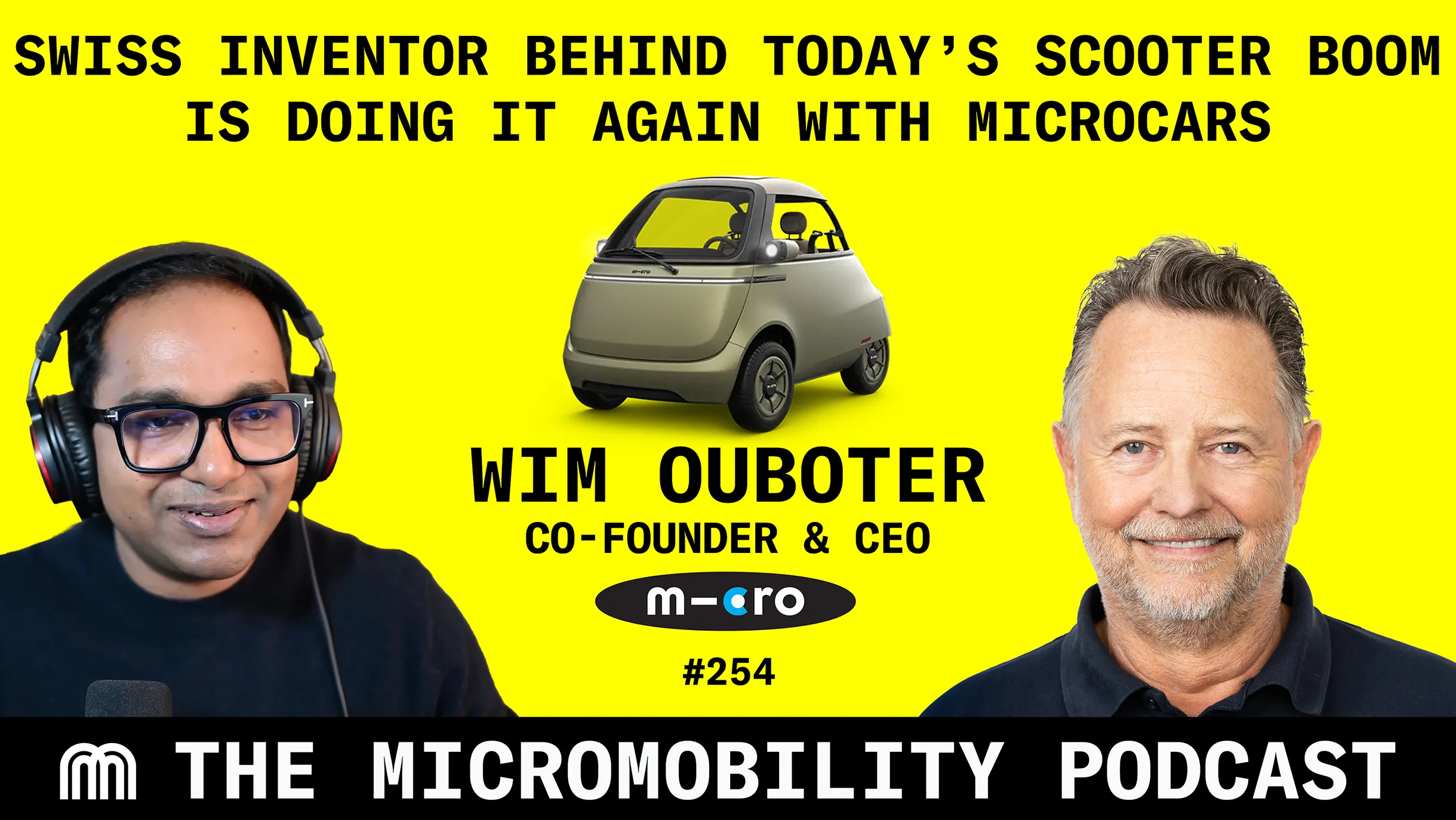
Wim Ouboter occupies a position in micromobility that almost nobody else can claim.
He invented the modern kick scooter in 1997, gave the industry its name, and then watched his creation sell at a rate of 80k units a day at its peak. The Razor scooter, built from the same factory under a separate distribution arrangement, moved five million units in six months in the United States alone. Retail chains saw their share prices move on the back of scooter sales. Hoffie Bicycle, Sharper Image, all of them got a lift from this small foldable object that had appeared from nowhere.
Then, when the kick scooter boom collapsed under the weight of more than 300 copycat manufacturers, Ouboter did not follow the industry into a slow decline. He started building microcars.
The Microlino, his modern reinterpretation of the postwar bubble car, has become the reference point for any serious conversation about urban microcars. It appears on the cover of virtually every article written on the subject. It shows up at Micromobility events as both exhibit and argument. Its first customer in Italy was the CEO of Gucci.
In this episode, Prabin Joel Jones sits down with Ouboter, Founder & CEO, Micro Mobility Systems to trace the full arc. From a late-night bratwurst run in Zurich that sparked an idea, through the brutal dynamics of a hardware boom-and-bust, and into the regulatory and commercial battles that now define the microcar frontier.
The Bratwurst That Started Everything
The origin story has a charming specificity to it.
Zurich in the 1990s. Hot food after nine o'clock was difficult to find. A favourite sausage stall existed somewhere in the city centre, too far to walk comfortably but too short to justify taking a car or retrieving a bicycle from the cellar. Ouboter describes this gap as a micro distance. He built a prototype scooter with inline skate wheels to solve it.
The first ride attracted stares. At one metre eighty-five, riding a low-slung scooter with small wheels through the streets was not a common sight. The embarrassment of it prompted the solution. If you could fold it, carry it into a bar inside a bag, and pretend you had simply walked there, the social friction disappeared entirely.
That thinking, portable mobility designed to be invisible when not in use, became the philosophical foundation for the entire product line. In 1997 he registered the company as Micro Mobility Systems, and the phrase entered the vocabulary of an industry he was quietly building from scratch.
The route to market had a fortuitous twist. Ouboter made a presentation to the board of Smart, proposing the scooter as a last-mile solution that could be stored inside the car. The board was interested but declined to acquire the patent. They were not scooter manufacturers, they said. He would have to produce it himself. That refusal sent him to Taiwan, then to China, where a manufacturer named Chino Tsai understood the volume potential immediately and insisted production begin there from the outset.
The logic proved sound. Chinese factories at the time could scale with a speed that no European manufacturer could match. Ouboter describes arriving at a factory with five hundred workers and watching it expand to fifteen thousand people across three facilities. Twenty forty-foot shipping containers left every day, seven days a week. The scooter had become a global product before most of the world had even seen one.
The Boom, the Copies, and What Came After
The product spread almost entirely through observation. There was no advertising budget to speak of. It sold because it was used outside, where other people could see it. Observation led to trial, trial led to purchase. Japan stacked them in every T-shirt shop. In the United States, the Razor version moved through retail so quickly that it briefly became the fastest-selling product in Sharper Image's entire history.
The collapse came just as fast.
Within a short period, more than 300 factories were producing scooters. The tooling cost for a new model sat under five thousand dollars, meaning the barrier to copying was essentially nothing. The market flooded. Some manufacturers counterfeited the Micro brand directly, which created a safety problem serious enough to require a notary-certified marking system just to distinguish genuine products from imitations. By 2001, the market had effectively fallen apart. Containers of scooters could be bought for a thousand dollars at the Hamburg docks.
Ouboter's response was to invest in development rather than fight for margin in a commoditised market. The Mini Micro, the Maxi Micro, and a range of other mobility products followed. The company diversified across seven categories and eighty countries, creating a revenue base stable enough, in his words, to finance a crazy project.
That project was the Microlino.
From Scooters to Microcars
The transition from scooters to cars was not purely strategic. It was personal.
Ouboter had two sons, Oliver and Merlin. He wanted a project that might draw them into the company while they were still young. A demo car for the Nuremberg toy fair, something that looked like a toy but was actually a vehicle, became the seed of the idea. Research led to the bubble cars of the 1950s. The Isetta, originally designed by Iso Rivolta in Italy and later manufactured by BMW under licence, had the right combination. A front door that swings open toward you, two seats side by side, and a shape that communicates something unmistakably alive and playful.
He is clear about why side-by-side seating matters. On a motorbike you sit one behind the other. In a car, even a very small one, you sit next to each other. That distinction carries more social weight than it might seem.
The choice of L7 rather than L6 as the vehicle class was deliberate and remains central to his argument. An L7 vehicle can travel at up to 90 kilometres per hour, making it capable of replacing a conventional car for the vast majority of daily trips. He is precise about this. Ninety-five percent of trips in his own household are now taken in a Microlino. His wife has one, he has one. The only exception is skiing on weekends, when the equipment requires something larger.
The L6-to-L7 flexibility was also engineered into the platform itself. A Microlino sold as an L6 can be converted to L7 specification through a software update and a new number plate. A car bought for a teenager becomes a full-speed vehicle when they turn eighteen. The logic of long-lasting, upgradeable hardware rather than disposable product cycles is one Ouboter has carried across both businesses.
Why the Microlino Costs What It Costs
The question of price comes up directly in the conversation, and Ouboter addresses it without defensiveness.
The Microlino uses a unibody stamped steel construction, the same method used in conventional cars. Its nearest competitors in the L6 segment, the Citroën Ami and the Opel Rocks-e, use tubular frames with plastic bodywork typically manufactured in lower-cost locations. The cost difference in the base structure alone runs to roughly 2,500 euros before a single battery or electronic component is considered. Battery options across three different sizes add more. A full in-house painting line, capable of producing any colour a customer requests, carries operational costs that a one-colour plastic shell simply does not.
The analogy Ouboter reaches for is the first Tesla Roadster. Expensive, deliberately so, a proof of concept aimed at a customer willing to pay for what it represented rather than just what it did. The Microlino's first Italian customer chose it knowing the price. Getting out of one and making a good impression, what he calls a bella figura, was part of what he was buying.
He is equally candid about what changes next. A new version developed from the outset in China is already in progress. Component costs there, for motors, gearboxes, and drivetrain elements, run at roughly half the European equivalent. The vision going forward is a hybrid model. Limited editions and co-branded versions produced in the Turin factory, with a more affordable Chinese-manufactured version sold alongside them. Assembly in target markets, including potentially the United States, would allow local final assembly to manage tariff exposure.
The co-branding programme with European automotive names continues in parallel. Products developed with BMW, Peugeot, Mazda, and Mercedes have already shipped. A Porsche collaboration is in development. The appeal for these partners is partly aesthetic and partly about data sovereignty. Chinese software platforms, Ouboter notes pointedly, send usage data somewhere.
The Regulatory Maze and the Lawsuit Against the Swiss Government
The microcar sits inside vehicle categories that were written for two-wheeled mopeds and heavy quadricycles. The fit is poor, and the consequences play out in practical, commercially damaging ways every day.
In Brussels, L6-category vehicles are banned from tunnels because mopeds are banned from tunnels. The microcar is classified alongside the moped regardless of how different the two objects actually are. Cities that have moved to reward low-emission vehicles have done so through frameworks that recognise conventional passenger cars and simply fail to include the Microlino.
Switzerland is now the site of an active legal challenge. The Swiss CO2 law refers to passenger cars as a category eligible for emissions credits. Ouboter's argument is that the Microlino is a passenger car. Two occupants, weather protection, full enclosure, a steering wheel. He argues that only a judge can resolve the question, not a government official applying a rule written before the product existed. A thirty-page submission prepared by a senior Swiss lawyer, the same person who represented the landmark Swiss climate case in Brussels, has already been filed.
The underlying frustration is structural. Innovation arrives before the rules written to govern it. That is what innovation means. The solution he proposes to city officials is direct. Introduce regulatory changes on a five-year trial basis. If problems emerge, revise or withdraw. Waiting for the full legislative cycle to accommodate new vehicle categories means the market moves without the clarity that would actually accelerate it.
The Chinese throwaway car problem, now appearing in European markets, adds urgency to all of this. Vehicles that cannot be repaired because parts are unavailable, or because the manufacturer has already failed, create consumer protection failures and discourage buyers from moving to smaller vehicles at all. Ouboter is clear on this. Homologation standards need to be enforced, not selectively applied. He draws no distinction between domestic manufacturers and imported vehicles when it comes to compliance.
The Global Picture and What Comes Next
The current footprint is primarily European, with approximately eighty countries for the scooter business and a growing cluster of microcar markets developing outside Europe. Ten vehicles are operating in the Middle East. A customer in Uruguay has recently been added. India is under active evaluation, with components already being tested there following the collapse of a potential investment from Bajaj that had nearly come together before the KTM bankruptcy pulled them back.
The next vehicle platform is designed to address a different consumer psychology. In Switzerland, ten of the fifteen best-selling cars are SUVs. The next Micro pod car will carry SUV visual references while remaining within the microcar size and weight envelope. The same platform is engineered to support variants from golf cart to delivery vehicle to short-range military use. The Turin factory, with eighty to ninety workers, is already operating as a contract manufacturer for other companies wanting production runs of five hundred to a thousand vehicles, a scale that no Chinese factory will entertain a conversation about.
Martin Eberhard, co-founder of Tesla, has been announced as joining the team. His view aligns with Ouboter's. The next significant vehicle category is not another iteration of the conventional car. It is the pod car.
The capital structure is also changing. The scooter business has self-funded the Microlino from the very beginning. The scale of what comes next requires external investment, and Ouboter says plainly that they are now open for it.
The broader vision, the one he returns to at the end of the conversation, is not primarily about business. It is about carbon. A microcar uses 60 percent less material in production than a standard vehicle. It consumes proportionally less energy per kilometre in use. When he and his wife plug their Microlinos into a normal household socket each evening before bed and find both fully charged each morning, he describes it as a no-brainer. The city infrastructure that would make this accessible to more people, small parking spaces, simple charging points, flat-fee annual charging passes, park-and-ride spaces at train stations, is not technically complicated. It requires political will, pricing signals on heavy vehicles, and governments willing to move faster than their existing rulebooks allow.
There is no Planet B, he says. And someone has to do it.