.svg)
%2Bcopy.avif)


.svg)


.webp)


.webp)
.avif)

Lime recorded more than 200m rides in 2024. That's 6 rides per second, every second, across roughly 30 countries. Voi went from 78.4k vehicles in Q1 2024 to 141.8k by Q4 2025. The North America Bikeshare and Scootershare Association (NABSA) found that trips in the region jumped 31% between 2023 and 2024, from 175m to 225m.
What these numbers share is that they all point in the same direction - more vehicles, more cities, more rides, year after year, and that trajectory brings a specific problem with it that doesn't get talked about as much as ridership figures do. Every vehicle added to a fleet is a vehicle that will eventually break down. And when you're managing tens of thousands of scooters and e-bikes across dozens of cities, how you handle that breakdown, before or after it happens, determines whether the economics of the whole thing work.
The Maintenance Problem
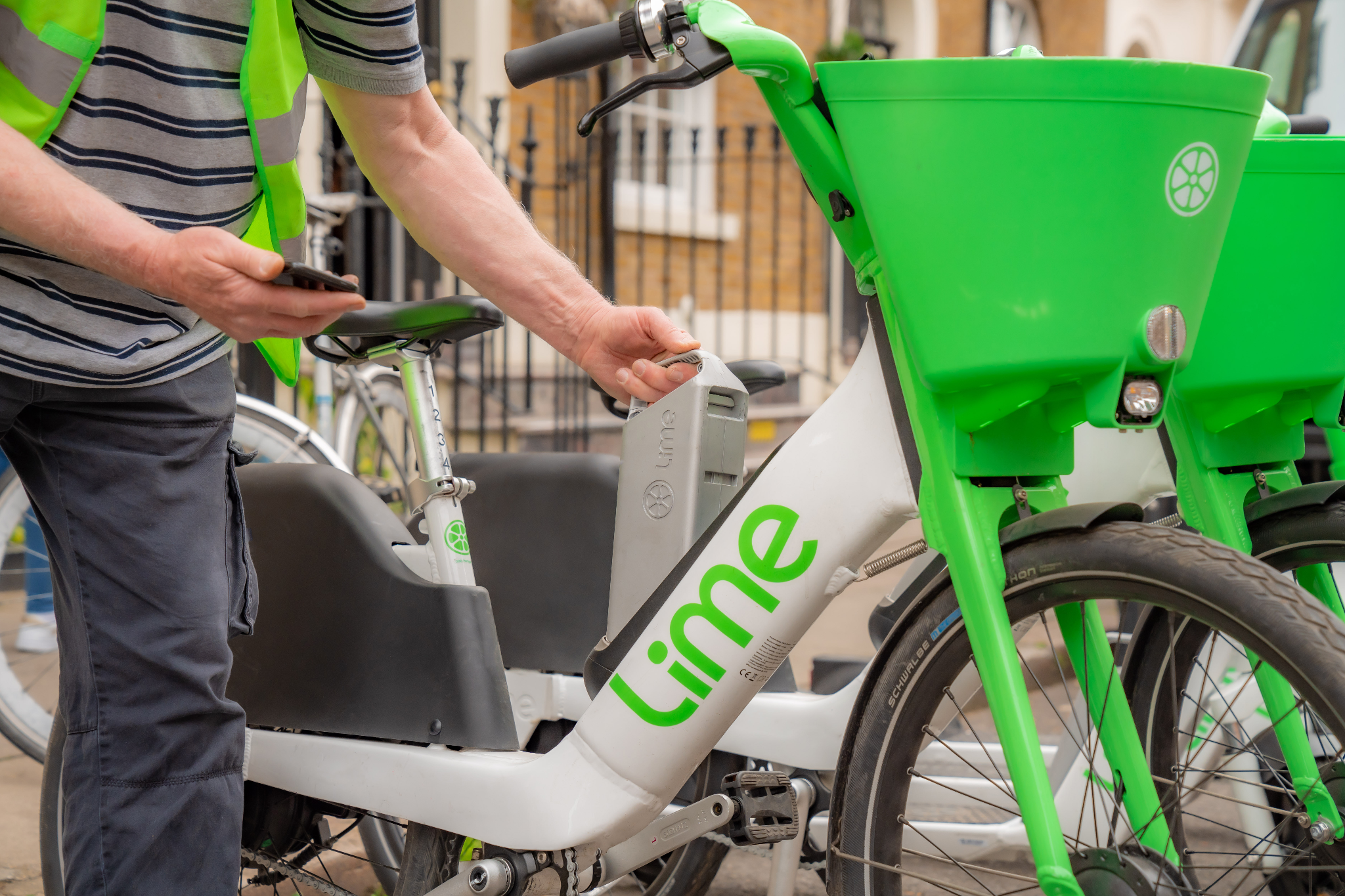
Fleet management is one of the biggest cost drivers in micromobility. Operators must track vehicle availability, manage charging, rebalance distribution across a city, and keep vehicles in working condition.
Most operators have historically handled this the same way. Vehicles go out on the street. Something breaks, a mechanic goes out to fix it. Or a scheduled servicing date arrives and the vehicle gets pulled regardless of whether anything is actually wrong.
Both approaches have real costs.
The first approach, reactive maintenance, is exactly what it sounds like. A vehicle fails. A rider complains, or a field team spots it, or a sensor flags it as offline. Someone comes to fix it. The problem is that by the time a failure is visible, damage has often already compounded. Parts that run too hot or vibrate out of alignment don't just fail quietly. They tend to take other components with them.
The second approach, preventive maintenance, tries to get ahead of that by scheduling servicing at regular intervals. Replace the brake pads every X rides. Check the battery every Y days. The logic is sound but the execution is wasteful. A component that's still functioning fine gets swapped out on schedule, while another one that's degrading faster than expected stays in service too long. You end up doing too much maintenance in some places and not enough in others.
Deloitte puts the cost of poor maintenance strategy at a 5-20% reduction in an asset's productive capacity. Unplanned downtime alone is estimated to cost industries $50B annually.
For a micromobility operator, a vehicle that's off the street is not earning. A vehicle that fails mid-ride is a safety liability. A reputation for unreliable scooters pushes riders toward alternatives. The maintenance problem isn't just operational, it flows directly into revenue, safety records, and city relationships.
What Predictive Maintenance Actually Is
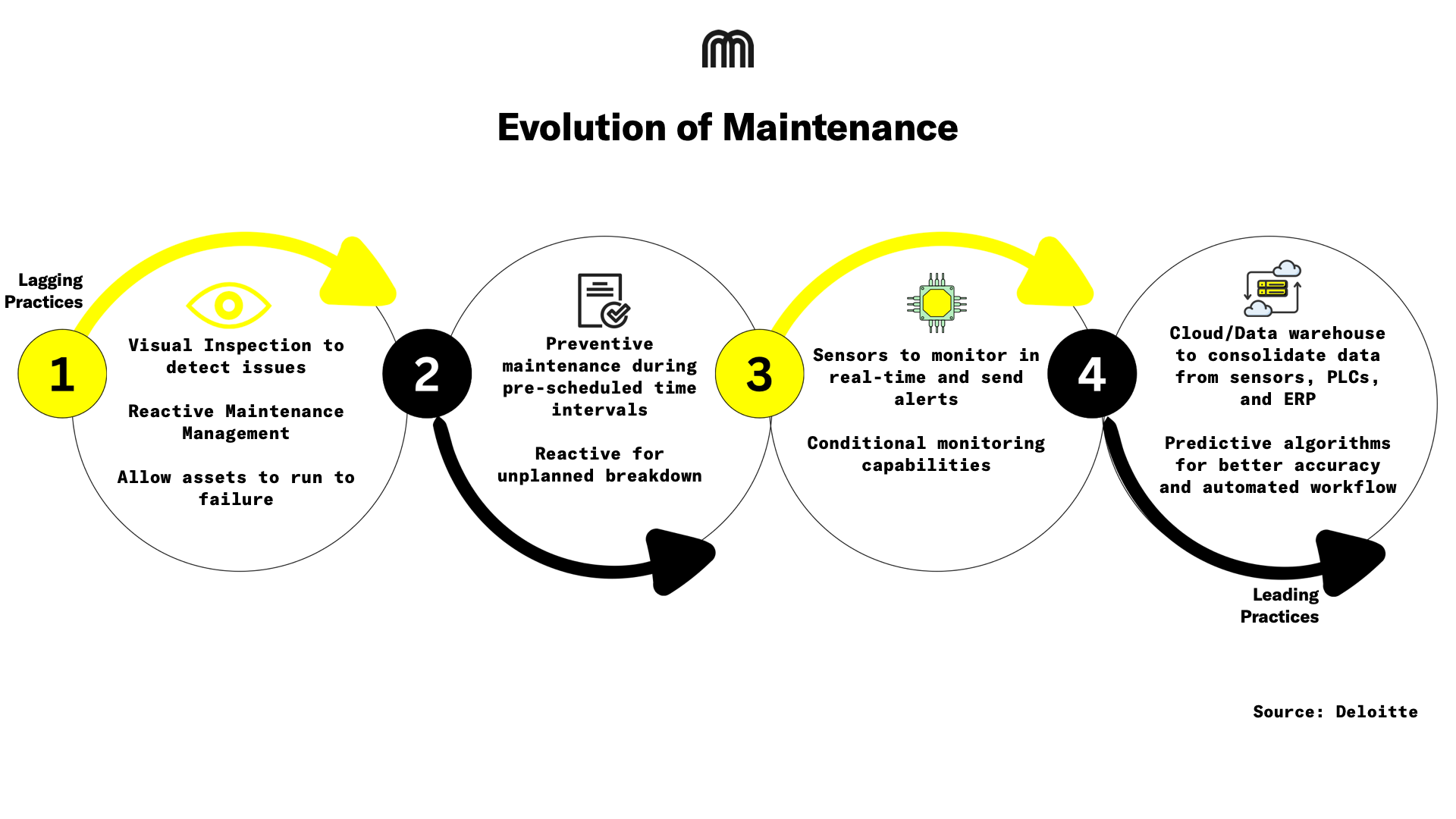
Predictive maintenance uses real-time data to decide when a specific vehicle, or a specific component on that vehicle, actually needs attention. Not after something has already gone wrong. When the data says it's time.
The underlying mechanism combines sensor data, historical records, and machine learning models that have been trained to recognize the early signatures of degradation. A battery cell showing unusual discharge patterns. A motor running slightly hotter than baseline. Vibration data on a brake assembly trending in the wrong direction. None of these are failures yet. But the model has seen enough examples of what comes next to flag them before they get there.
The concept isn't new. Manufacturing, aviation, and energy infrastructure have used condition-based monitoring for years. What's changed is that sensors got cheaper, cellular IoT became standard hardware on shared scooters and e-bikes, and cloud computing made it practical to run these models continuously across thousands of vehicles at once.
The IoT layer that makes it possible
Shared micromobility is, structurally, an IoT business. Every vehicle needs to communicate its location, its availability, and its battery state to support basic operations. That connectivity infrastructure, the sensors, the cellular connection, the data pipeline back to a cloud backend, is already there.
Predictive maintenance sits on top of it. The same system that tracks a scooter's GPS position can also stream motor temperature, battery voltage curves, accelerometer readings, and brake response data. Modern e-bikes sync this information in real time, either directly to fleet management platforms or via cloud storage that holds longitudinal performance records going back months.
What operators gain is a view of each vehicle's condition that isn't dependent on a field technician physically checking it. The vehicle is, in effect, self-reporting.
What operators are doing with it
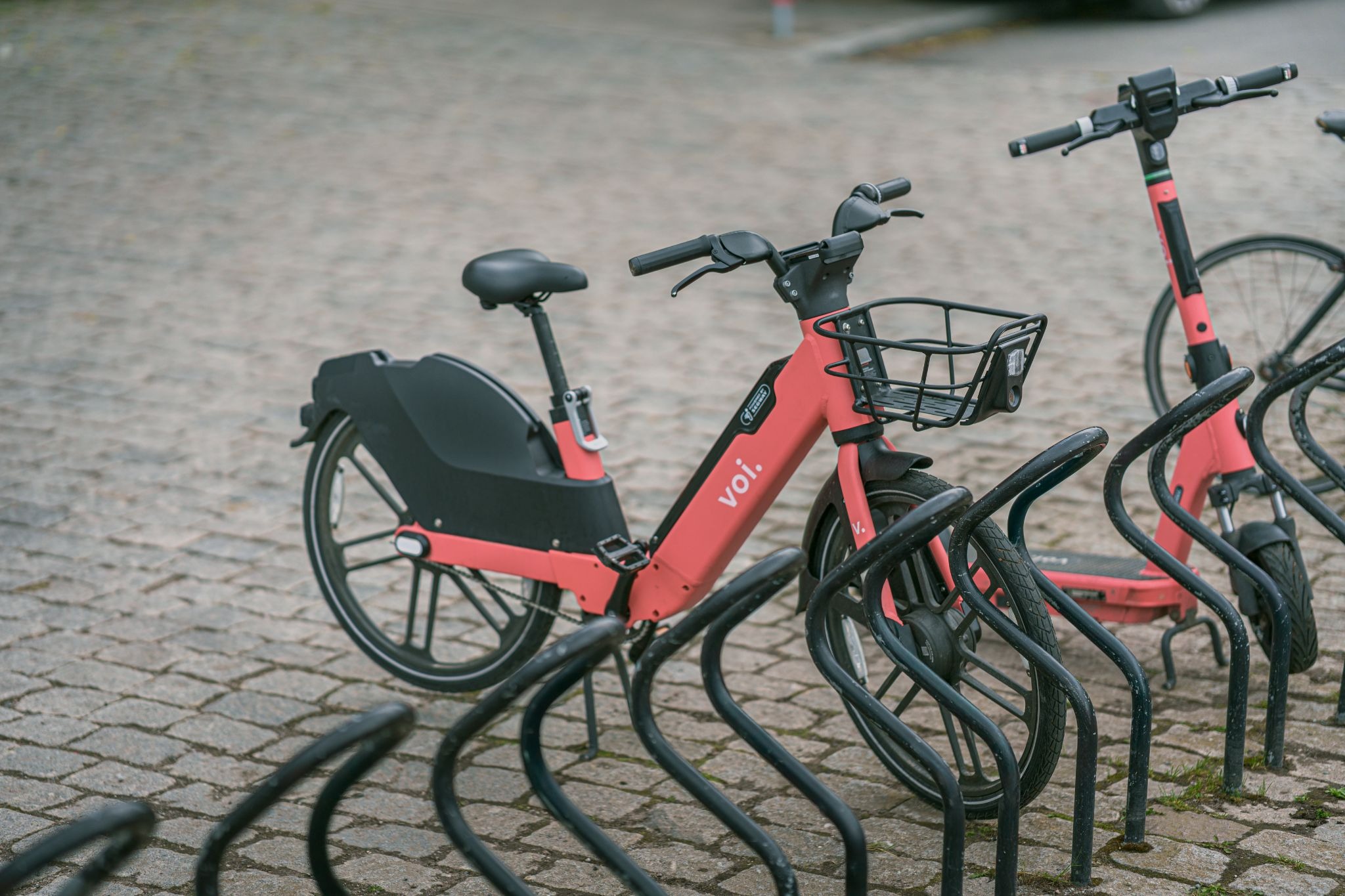
Voi publishes some of the most detailed public accounts of how this works in practice. Their vehicles carry sensors on safety-critical components, brakes, throttle, battery. The platform analyses sensor readings alongside time-since-repair data, ride behavior, and indicators of vandalism to build an ongoing picture of each vehicle's condition. Two specific tools sit on top of that foundation.
StreetScan identifies vehicles on the street that need maintenance without requiring a rider complaint or a scheduled inspection. By late 2024, it had enabled more than 111.6k in-field quality checks. ProParts models the probability that specific components need maintenance or replacement. The output feeds directly into Voi's component maintenance plan. More than 6k vehicle frames have been reinforced based on what ProParts flagged.
TIER-Dott reports a predictive maintenance algorithm that identifies potential vehicle issues before they arise, with 90% accuracy. When a safety-sensitive fault is flagged, the vehicle is taken offline immediately. Riders can also report issues through the app, which feeds back into the model.
TIER-Dott also rolled out a Smart Routing algorithm across 400 cities, giving field teams optimized routes for collections and maintenance tasks, cutting unnecessary kilometres driven and reducing the time between a fault being identified and a technician reaching the vehicle.
Where the value actually lands
The clearest gain is in vehicle uptime. A scooter that gets pulled for servicing before it fails is back on the street faster than one that has to be recovered mid-breakdown and diagnosed from scratch. Fewer unplanned failures means more vehicles available during peak demand hours.
There's also a direct effect on component lifespan. Preventive maintenance replaces parts on a schedule. Predictive maintenance replaces them when they actually need it, which, for components that are lasting longer than expected, means less spend on unnecessary replacements. Getting there requires knowing when and where to intervene, not just that a service cycle is due.
Safety is the less-discussed but arguably more important outcome. A brake assembly degrading toward failure is a different kind of problem than a flat tyre. The consequences of missing it fall on the rider. Early detection of safety-critical faults is, in this context, not just an operational efficiency story, it determines whether the vehicle should be on the street at all.
For operators trying to build long-term relationships with cities, demonstrated vehicle safety is also a regulatory asset. Cities that see operators proactively removing unsafe vehicles are easier to work with than cities managing complaint backlogs.
Why It's Still Hard
The technology works in controlled settings. Deploying it at fleet scale across dozens of cities introduces a different set of problems.
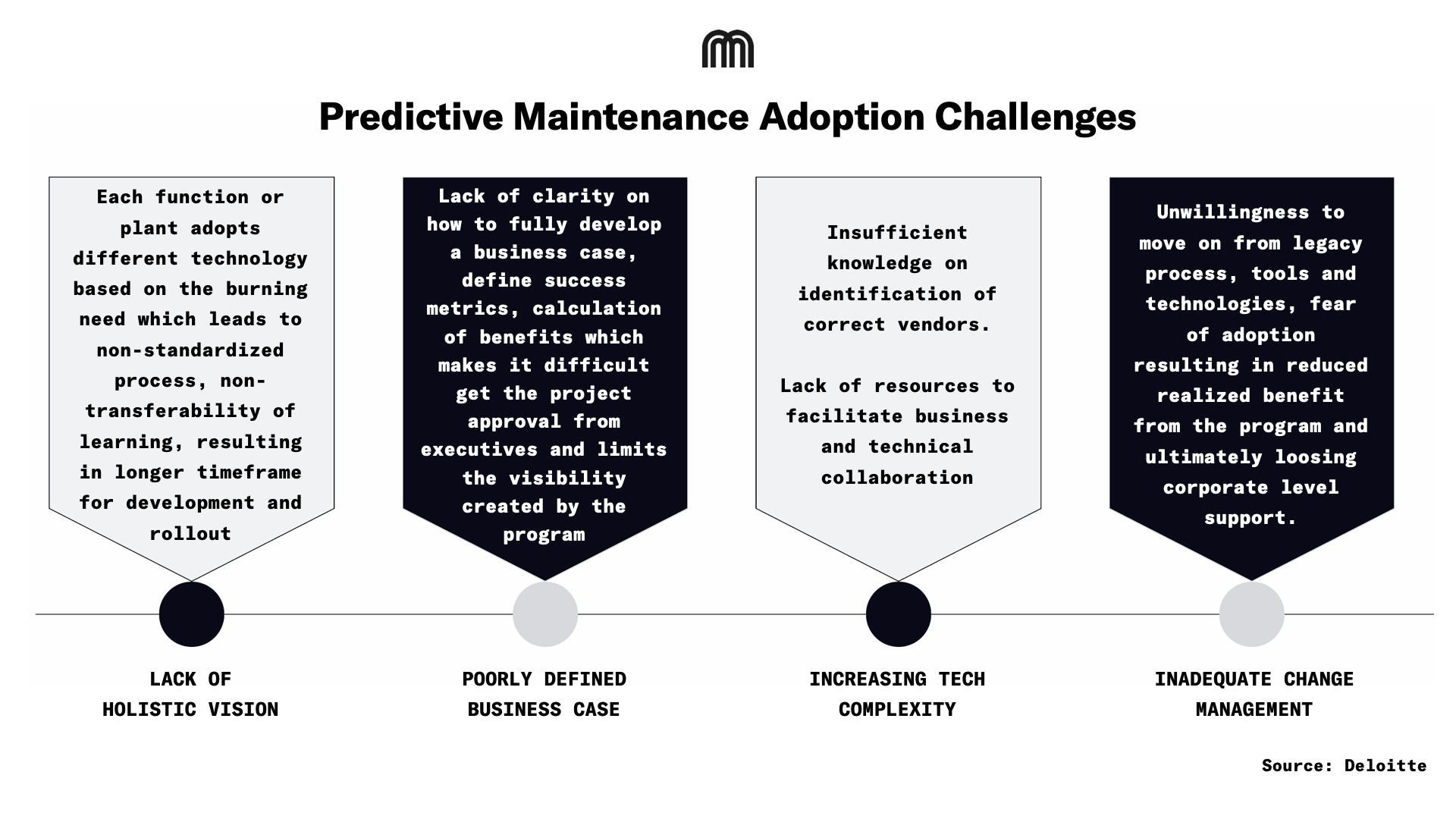
Deloitte's research on predictive maintenance adoption points to four recurring obstacles. The first is fragmentation: different teams within an operator often adopt different technology approaches based on local needs, resulting in non-standardized processes and data that can't be easily aggregated. The second is the business case problem, without clearly defined success metrics and a rigorous cost-benefit framework, getting executive buy-in for the initial investment is difficult.
The third is technical complexity: identifying the right vendors, building the data pipelines, and maintaining the cross-functional collaboration between engineering, operations, and data teams is a genuine organisational challenge. The fourth is change management, teams that have run on reactive maintenance for years don't automatically trust an algorithm telling them what to prioritise.
There's also a data quality problem that sits underneath all of this. Predictive models are only as good as the data they're trained on. A fleet that has run on reactive maintenance for its first few years has incomplete historical records, it knows when things broke catastrophically, but has limited signal on the gradual degradation patterns that preceded those failures. Building useful models requires time and sufficient labelled data to learn from.
The Operations Layer Has to Keep Up
The current state of the art is condition monitoring and failure prediction. The next step is tighter integration, between the predictive layer, the logistics layer, and the field operations layer.
An algorithm that predicts a component failure three days out is only useful if it automatically generates a work order, routes a technician efficiently, and confirms the vehicle is back in service before that window closes. TIER-Dott's Smart Routing work points in this direction. The value of prediction erodes quickly if the operational response can't keep pace.
The longer-term picture is a fleet that manages itself more actively, not just flagging problems but continuously optimizing maintenance schedules, component lifespans, and field team routing as a single integrated system. The micromobility market is projected to reach $300-500B globally by 2030. Getting the unit economics to work at that scale requires the operations layer to get significantly smarter. Predictive maintenance is a core part of how that happens.
Cover image credits: Lime