.svg)
%2Bcopy.avif)

.avif)
.svg)

.webp)
.webp)

.jpg)
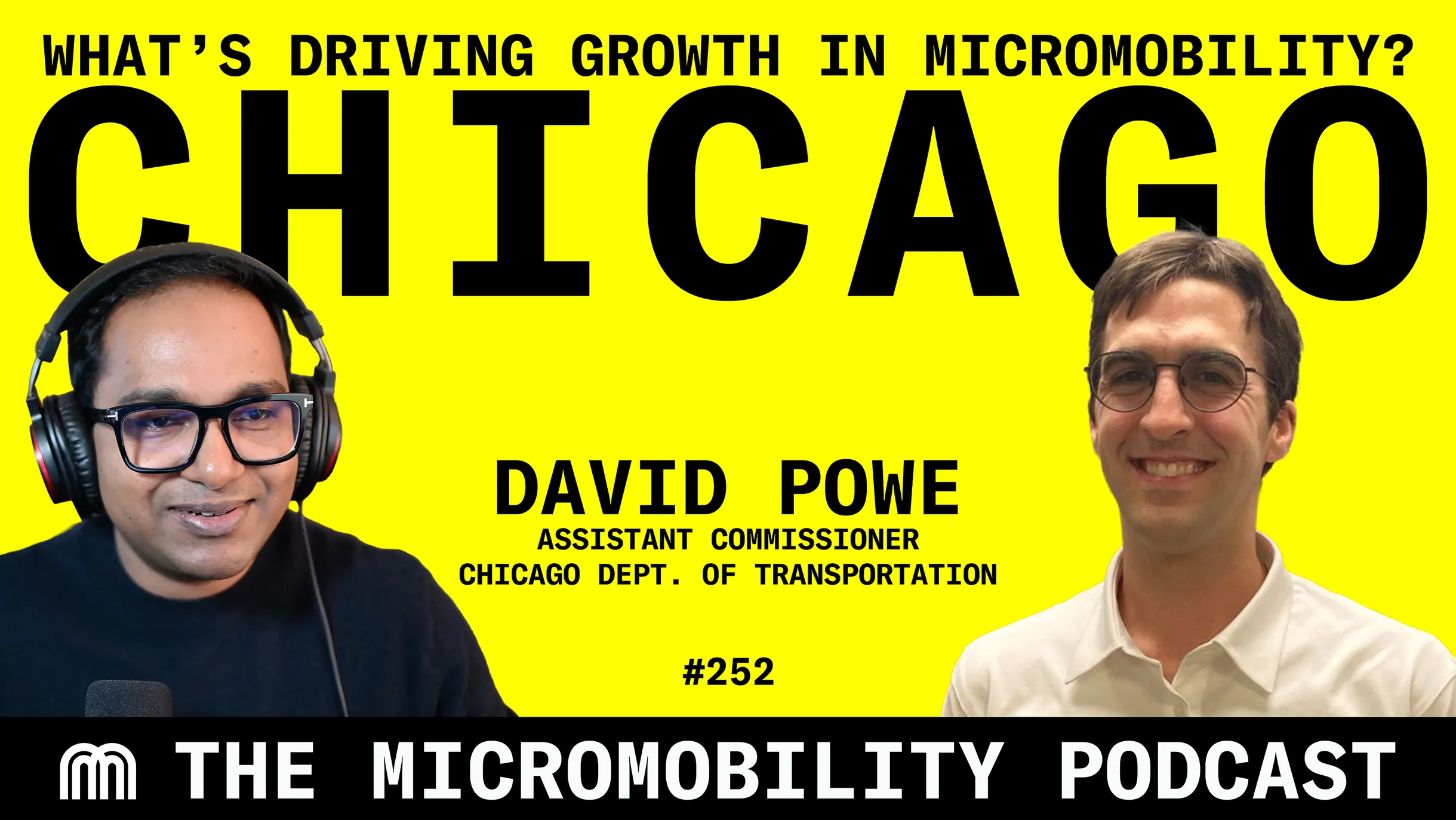
There are not many people who can talk about bike share the way Kristian Brink can.
He has been in the industry since 2015, moved through Nextbike, spent years consulting across Southeast Asia, and has been at Urban Sharing in Norway since late 2019. Over that time, he has watched cities build, stumble, ban, invest, and finally start to get it right.
If you missed his first appearance on the show, Bike Share 101, it is worth going back to.
In this episode of the Micromobility Podcast, host Prabin Joel Jones sits down with Brink for a wide-ranging conversation on the state of bike share globally, how different cities are approaching policy, and what operators should actually be focused on in the years ahead.
Rebuilding Urban Sharing From the Ground Up
When Prabin visited Urban Sharing in Oslo back in 2019, the company looked nothing like it does today.
It was a full-stack operation designing bikes, building IoT hardware, developing software, and running station-based systems. The bike share networks in Bergen and Trondheim that the team built are still operating today.
Then COVID hit. The company went from more than 50 people down to 11.
The choice that followed was to let go of hardware entirely and commit to being a software business. Part of that decision came from Brink's time in Singapore, where he had watched hardware startups anchor their entire seed rounds to manufacturing in Shanghai, Shenzhen, or Taipei. Trying to build a hardware company from Norway, he says, is a challenge you are choosing to take on before you have even started.
For two to three years, the team worked quietly on systems in Milan, Verona, and what Brink calls a little adventure in Edinburgh, with minimal backing and no fanfare.
By 2024 and 2025, the company began breaking its platform into more modular products. Some are lighter tools for free-floating operators. Others are fuller platforms for traditional bike share systems going through government tenders. Running both has brought Urban Sharing to break even and into profitability.
Should Operators Build Everything In-House?
Prabin pushed Brink on whether specializing in software, rather than doing everything internally, is a philosophy specific to bike share or something that applies more broadly across shared micro mobility.
Brink thinks it applies everywhere.
His read on the early years of the industry is that a lot of capital went into companies that treated micro mobility like a consumer app or a fintech play. What it turned out to be was something much closer to street logistics and urban service operations. Deeply local, shaped by city policy, and not particularly forgiving of shortcuts.
Companies like Voi, Dot, and Bolt built strong in-house software and it moved the whole industry forward. Features like slow-riding zones and end-of-trip photo checks are now standard across the board, with a lot of that influence coming from the free-floating scooter world and from ride-hailing companies like Uber and Bolt.
But Brink's view is that the next phase of the industry will not be won by putting more vehicles on the street. It will be won by improving the economics of every city you are already in. Making vehicles last longer. Reducing how often they need to be touched. Running leaner operations. That kind of work needs specialized tools.
Where the Industry Is Actually Growing
On the global picture, Brink was honest about what he knows and what is harder to read.
China operates at its own scale entirely, with around 8m shared bikes. North America is uncertain right now. But Europe and Latin America are both moving in the right direction.
In Europe, the shared micro mobility fleet is growing from around 400k vehicles toward 500k. At a panel Brink moderated in Brussels last year, he asked whether the industry believed it could reach 1m vehicles by 2030. The room was cautious about putting that number out loud. But the direction is clear.
Latin America is the more interesting story. Companies went into Brazil and Mexico years ago and largely did not make it work. But Brink says those markets have changed. Urban Sharing has just launched its first project in Brazil and is preparing to enter Mexico.
He sees Sao Paulo, Rio, and Brasilia as cities whose financial districts are ready for proper bike share systems now. He points to several Mexican cities beyond the capital as well. Buenos Aires has had EcoBici running for 15 years. Santiago and cities in Colombia are active too.
It is a meaningfully different picture from a few years ago.
Madrid Is Investing Heavily. It Also Banned Private Operators.
Madrid is one of the more fascinating cases in bike share right now, and it is full of contradictions.
The system launched in 2013 with a lot of trouble. Software problems, an operator that was not doing its job, and a city that eventually stepped in and handed operations to EMT, its publicly owned transport agency. What started as around 3k e-bikes, one of the first e-bike-only systems in Europe, has grown to roughly 8k bikes today.
Between summer 2024 and summer 2025, monthly trips went from around 700k to between 1.5 and 1.6m. The city's target is 16k bikes by 2030.
At the same time, Madrid banned privately operated shared scooters and bikes entirely.
Brink traced that back to a licensing system introduced around 2018 and 2019 that was broken from day one. The city divided itself into small districts, issued batches of licenses per district, and opened bidding without any kind of industry survey. What followed was a speculative free-for-all. Private investors bought licenses and flipped them for a profit with no intention of running services. By the time genuine operators were in the market, the damage to the political atmosphere had already been done.
Brink thinks Madrid will eventually open back up to private operators. But he is realistic about the pressure the micro mobility industry is up against when the private car lobby is as well-organized as it is in Madrid.
Berlin Went the Other Way
Berlin took the opposite approach.
Nextbike had been operating there with public subsidies dating back to the early days of the system, first under Deutsche Bahn's Kolebike around 2010 and 2011, and then under a modernized contract from 2017. The city's Senate has now decided to end that arrangement and require Nextbike to operate on the same commercial terms as Voi, Dot, Lime, and the rest.
Brink is direct about where he stands. Nobody asks whether a bus line or a metro system needs to turn a profit in order to keep running. Applying a different standard to bike share does not make much sense to him. The likely outcome is that Nextbike passes some of that cost on to riders, and prices go up.
He is still confident that Nextbike has the ridership to make it work. But he does not think it is good news for the industry broadly.
The Real Return on Bike Share
One of the more overlooked parts of the conversation was the economic case for bike share itself. Brink pointed to recent analysis from showing that the value of these systems goes far beyond trips and usage metrics.
When you factor in public health improvements, reduced congestion, and more efficient use of urban space, the numbers start to look very different. According to industry research, every euro invested in bike share can generate around a 10% return for cities.
It is a useful reminder that bike share is not just a transport system. It is part of how cities function economically, even if that value does not always show up directly on a balance sheet.
The Gap Between Docked and Free-Floating Is Closing
Something has shifted quietly over the last couple of years. The categories that once defined micro mobility are increasingly hard to see.
Traditional station-based operators have added scooters. Scooter companies like Voi, Dot, and Bolt have moved into bikes. Cities that used to allow vehicles to park anywhere now require virtual stations or physical bays. Brink puts it plainly: the lines are getting completely erased, and in a matter of months the industry will simply be one micro mobility sector.
The technology has followed the same path. Slow-riding zones, no-parking enforcement, end-of-trip photo checks, all things that came from the scooter world, are now common across every operator type. Vehicles are not scattered across pavements the way they once were. Compliance is higher. The industry fits into cities much better than it used to.
What Operators Should Be Focused On
When Prabin asked what the next couple of years look like specifically for bike share, Brink's answer was about operations rather than expansion.
He thinks measuring performance through rides per vehicle per day only tells part of the story. The variables that actually determine whether a business makes money are operational. How many times does a team member need to touch a vehicle during a shift? How effectively are bikes being moved to where demand is? How many repairs are getting done, and how quickly?
Most of this goes unmeasured today. Brink sees AI-assisted tools as what will make it possible to close that gap at a pace that simply was not realistic a year ago. Urban Sharing is already building in this direction.
On hardware, it was Prabin who raised the point that progress has been slower than the industry needs. Brink agreed. Prabin noted that the bikes developed for Lime through the Jump acquisition still set the standard in free-floating bike share, and that very few companies are building hardware at that level. Brink pointed to electrification as the clear direction, while noting that the industry has not landed on a consistent approach to charging or battery swapping yet. He said he is looking forward to what comes out of Berlin in June.
His favorite city for station-based bike share, when Prabin asked at the end? Paris, without any hesitation. Madrid is moving fast, he said. But Paris is the light that guides us all.