.svg)
%2Bcopy.avif)

.webp)
.svg)

.png)

.jpg)
%20(1).jpeg)
.jpg)
New York City's bike share began as a bet. When the Bloomberg administration put out its first request for proposals in November 2010, it wanted a system that would cost the City nothing, no public money, no financial risk, just a private company building and running a network of shared bicycles in exchange for access to the public right-of-way. The bet paid off. 12 years later, Citi Bike is the largest bike share system in the United States, carrying over 44m riders in 2024 alone. With the current contract expiring in May 2029, that same structure - private ownership, no subsidy, revenue-driven pricing, now sits at the center of a broader conversation about what the program should look like next.
A November 2025 report from the New York City Independent Budget Office lays out the numbers behind that decision: how the program is priced, how it performs, how it compares to peers in other cities, and what switching operators would actually cost.
A System That Grew Fast
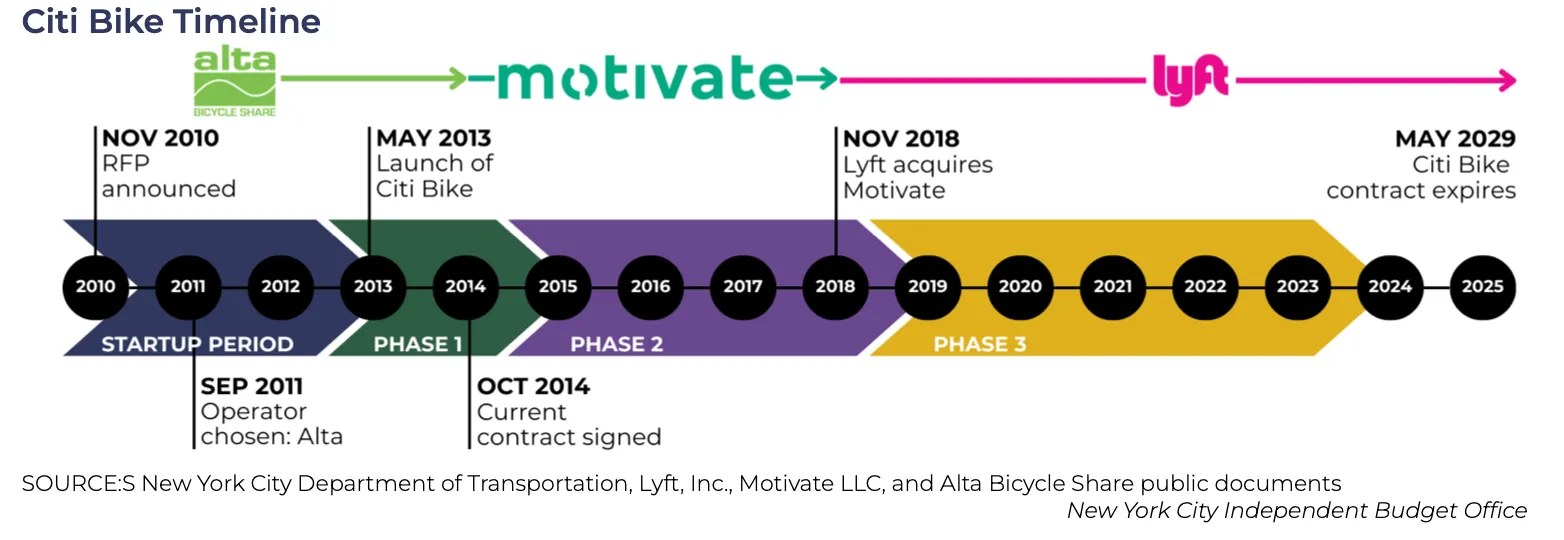
Citi Bike launched in 2013 with 330 stations and around 6k bicycles in lower Manhattan and downtown Brooklyn. The original operator was Alta Bicycle Share. By 2014, Alta's bike share operations had been acquired and rebranded as Motivate. In 2018, Lyft acquired Motivate's platform and became the program's effective operator, with Motivate continuing to handle day-to-day operations.
By 2024, the system had grown to approximately 37k bicycles and logged over 44m rides, more than double the ridership of 2019. It is the largest bike share system in the United States.
From the beginning, the program was structured as a public-private partnership. The City provides access to the public right-of-way for docking stations and handles contract oversight. Lyft owns the infrastructure, the bikes, docking hardware, and software, and covers all operating costs. In 2024, the City received $5.1m from Lyft under revenue-sharing provisions: $3.5m in ridership revenue share, $624k in sponsorship revenue share, and $1m compensating for parking spaces displaced by docking stations.
Pricing Structure
Citi Bike prices vary based on membership status, bike type, and ride duration.
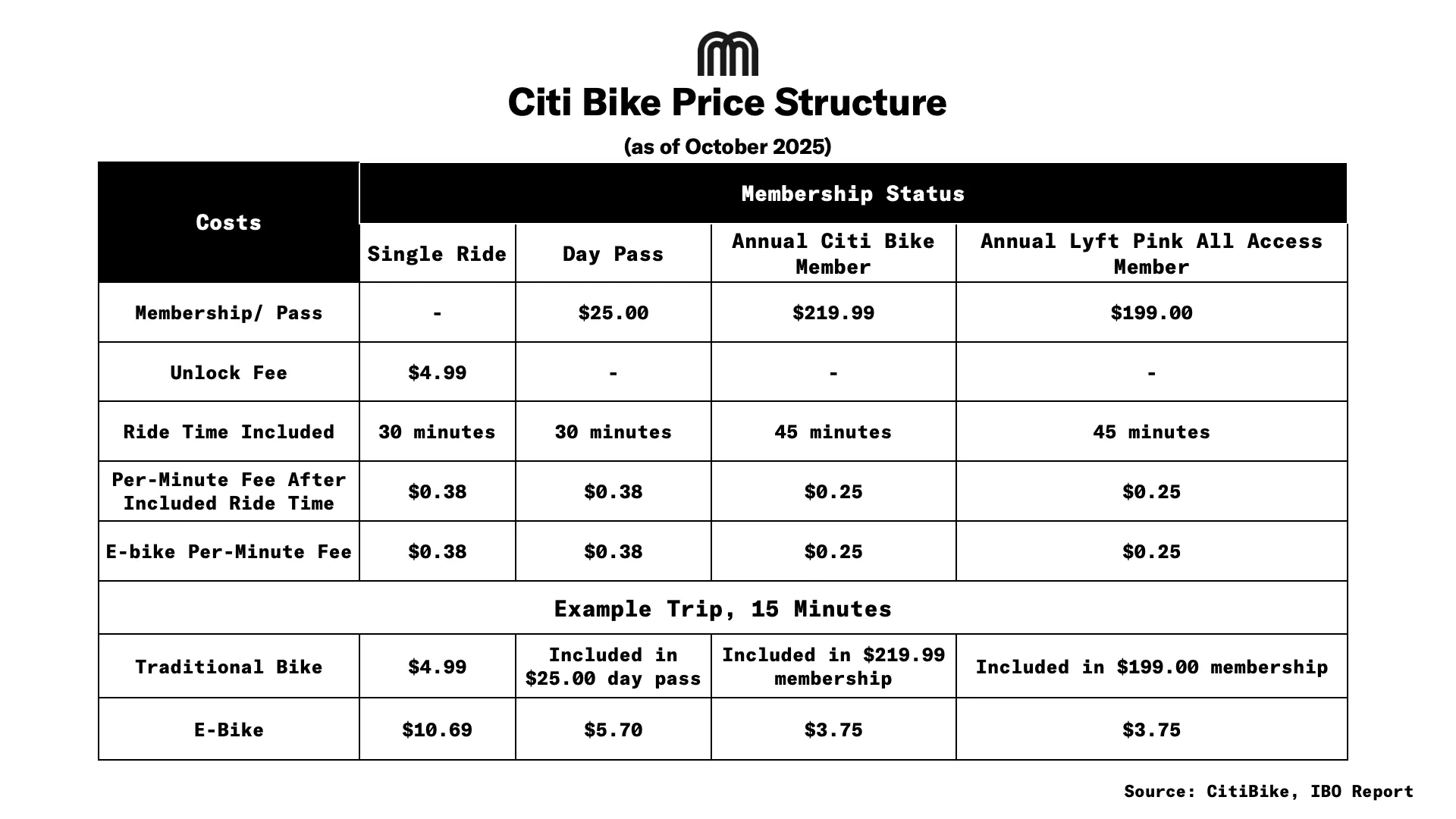
An annual membership currently costs $220 and includes 45 minutes of free ride time on a traditional bicycle per trip, plus a $0.25 per-minute fee on e-bikes. A single ride costs $4.99 to unlock, with 30 minutes of ride time included before overtime charges apply. E-bike single rides charge $0.38 per minute from the moment of unlock, a typical 15-minute trip costs $10.69 under this structure, roughly 3.7 times the current subway fare of $2.90.
A reduced-fare membership is available for $5 per month ($60 per year) to SNAP recipients, New York City Housing Authority residents, and members of three Community Development Credit Unions. Lyft Pink All Access, which bundles Citi Bike access with rideshare perks, is priced at $199 per year.
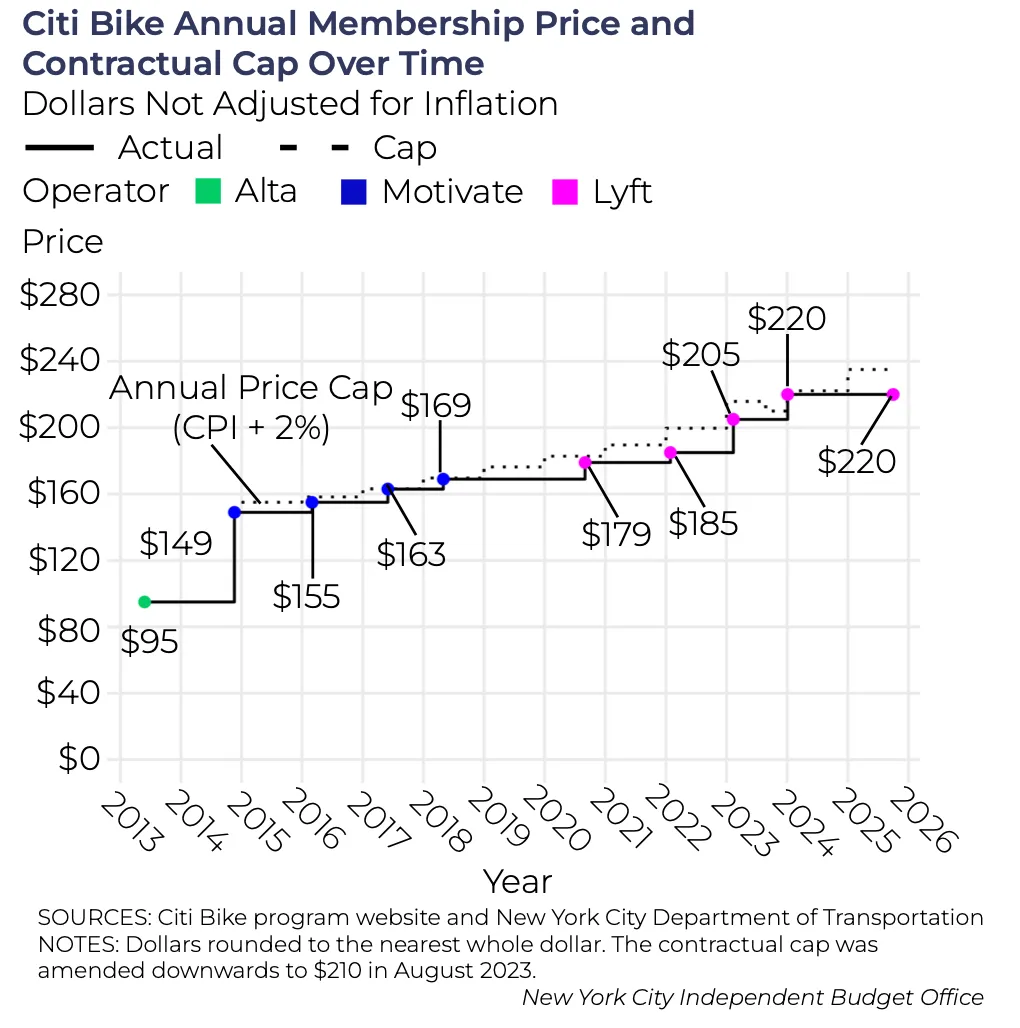
The contract between the City and Lyft sets annual price caps, allowing membership fees to rise by inflation plus two percentage points each year. Annual membership has climbed from $95 in 2013 to $220 today, a 77% real increase after inflation adjustment. Since Lyft took over in 2018, actual prices have consistently stayed below those contractual caps, including roughly $15 under the limit in both early 2022 and 2025. There is no contractual price cap for casual users on single rides or day passes. E-bike casual user pricing carries a contract-mandated floor instead: per-minute fees for non-members must be at least 50% higher than the rate for annual members.
The Revenue Picture
In 2024, Citi Bike generated $200m in revenue. The breakdown by source: approximately 68% from casual and per-minute ride charges, 21% from annual membership fees, and 11% from sponsorships, primarily Citigroup and other advertisers on docking station hardware.
E-bikes now account for 66% of all Citi Bike trips, despite making up only 40% of the fleet. Per-minute charges from e-bike rides alone represented 40% of overall revenue in 2024.
Lyft does not publicly disclose detailed cost information for the Citi Bike system. The IBO independently estimated major hard costs - bicycles, docking stations, labor, vehicles, facilities, at approximately $128m. The $72m difference between that estimate and reported revenue covers costs IBO could not estimate: executive compensation, insurance, marketing, and profit. In 2023, Lyft shared high-level financial data with the City suggesting revenues barely exceeded costs that year, when revenues totaled $122m.
How It Compares
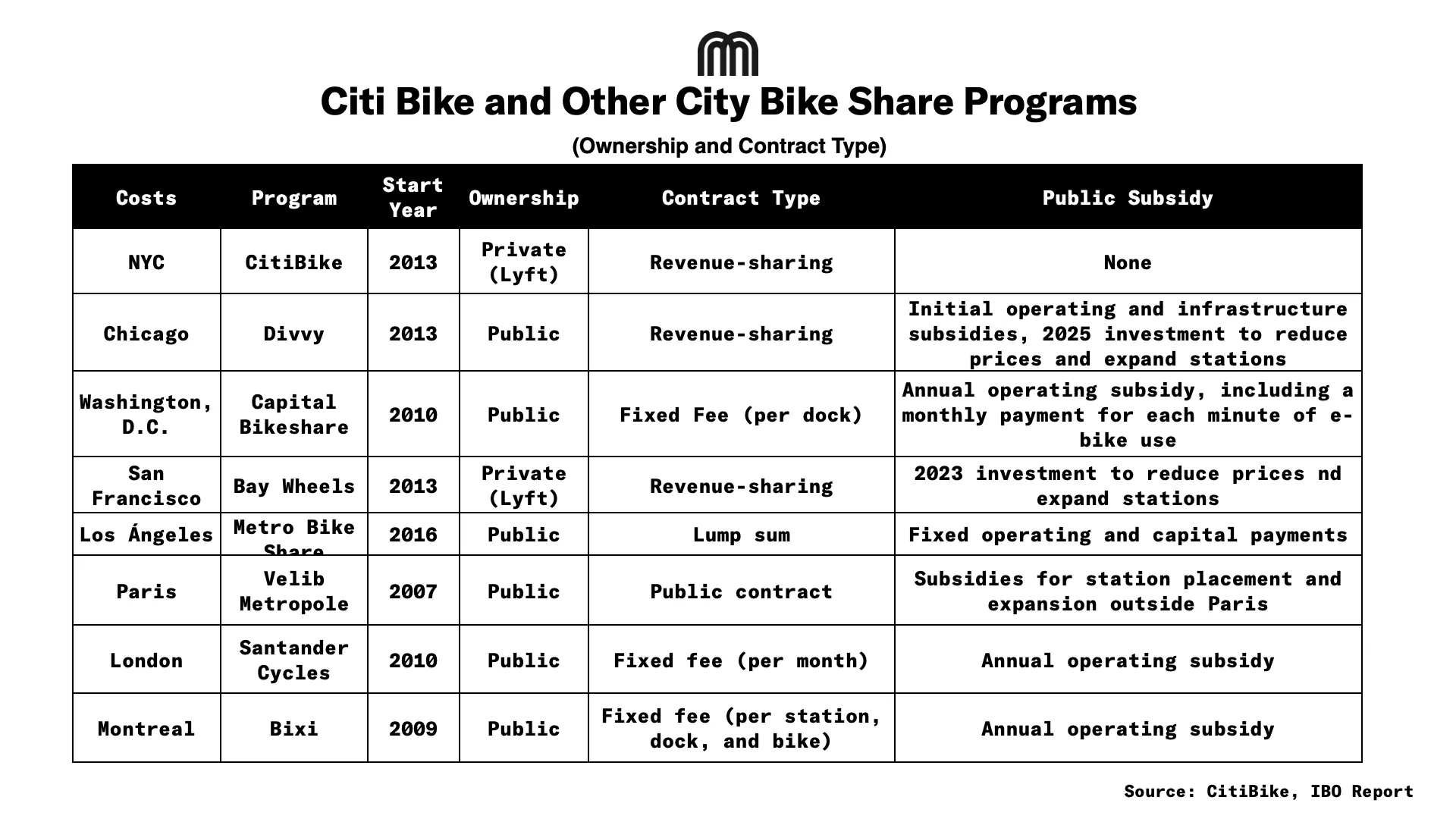
IBO compared Citi Bike against seven peer systems: Chicago's Divvy, Washington D.C.'s Capital Bikeshare, San Francisco's Bay Wheels, Los Angeles's Metro Bike Share, Paris's Vélib' Métropole, London's Santander Cycles, and Montreal's Bixi.
Annual membership: Citi Bike's $220 annual fee is the highest among the eight systems reviewed. Most charge around $140 per year, including Chicago's Divvy and San Francisco's Bay Wheels, both also operated by Lyft. Washington D.C.'s Capital Bikeshare charges $120.
Single rides: A 15-minute single ride on a traditional Citi Bike costs $4.99; the same trip on an e-bike costs $10.69. San Francisco's Bay Wheels, the next most expensive, prices a 15-minute traditional ride at $3.99 and an e-bike at $8.49. Los Angeles's Metro Bike Share is the least expensive at $1.75 for a traditional bike and $2.75 for an e-bike.
Discount memberships: Citi Bike's $60 reduced-fare membership ties with San Francisco's Bay Wheels as the highest-priced among U.S. systems in the comparison, though Bay Wheels charges $5 for the first year before rising to $60 annually thereafter. Chicago's Divvy and Washington D.C.'s Capital Bikeshare both offer discounted memberships for $5 per year, with broader eligibility criteria that include WIC recipients, Medicaid beneficiaries, disability assistance recipients, and students, groups not covered under Citi Bike's current program.
Utilization: Citi Bike logs 3.3 trips per bike per day, the highest among the U.S. systems reviewed. Paris's Vélib' Métropole leads the full group at 6.8 trips per bike per day, followed by Montreal's Bixi at 3.8.
The 2029 Question
With the current contract expiring in May 2029, the City faces a decision it hasn't had to make in over a decade: what comes next?
A switch in operators would not be simple. Lyft owns all of Citi Bike's physical infrastructure. A new operator would need to either buy Lyft's equipment at fair market value, lease it, or build an entirely new system from scratch. Paris navigated a similar transition in 2018 when it switched from operator JCDecaux to Smovengo, and the process took more than a year past the planned implementation date. A 2019 audit found that earlier preparation could have avoided much of the disruption.
DOT's median procurement timeline, from releasing a request for proposals to registering a contract, runs just over 700 days. That means the clock is already running.
The City's options range from renewing with Lyft under a renegotiated contract, to opening a competitive procurement, to introducing public subsidies, to considering alternative models like the nonprofit structure used by Montréal's Bixi. What isn't clear, based on available data, is which path leads to lower prices. London's Santander Cycles is publicly owned and subsidized, and still costs more per year than most U.S. systems. Los Angeles has the cheapest rides, but that reflects a deliberate price cap tied to the Metro fare, not a result of ownership structure.
What the evidence does show: the current model has produced the largest bike share system in the country, with no public subsidy, but at consistently higher prices than comparable cities. As the 2029 deadline approaches, the next procurement process will determine whether that balance changes.
Cover image credits: Citi Bike