.svg)
%2Bcopy.avif)

.svg)


.webp)

.webp)
.avif)
The default assumption in urban delivery for years was pretty basic. More demand means more vans. More vans mean more congestion, more emissions, more drivers hunting for parking on streets that were never designed for the volume.
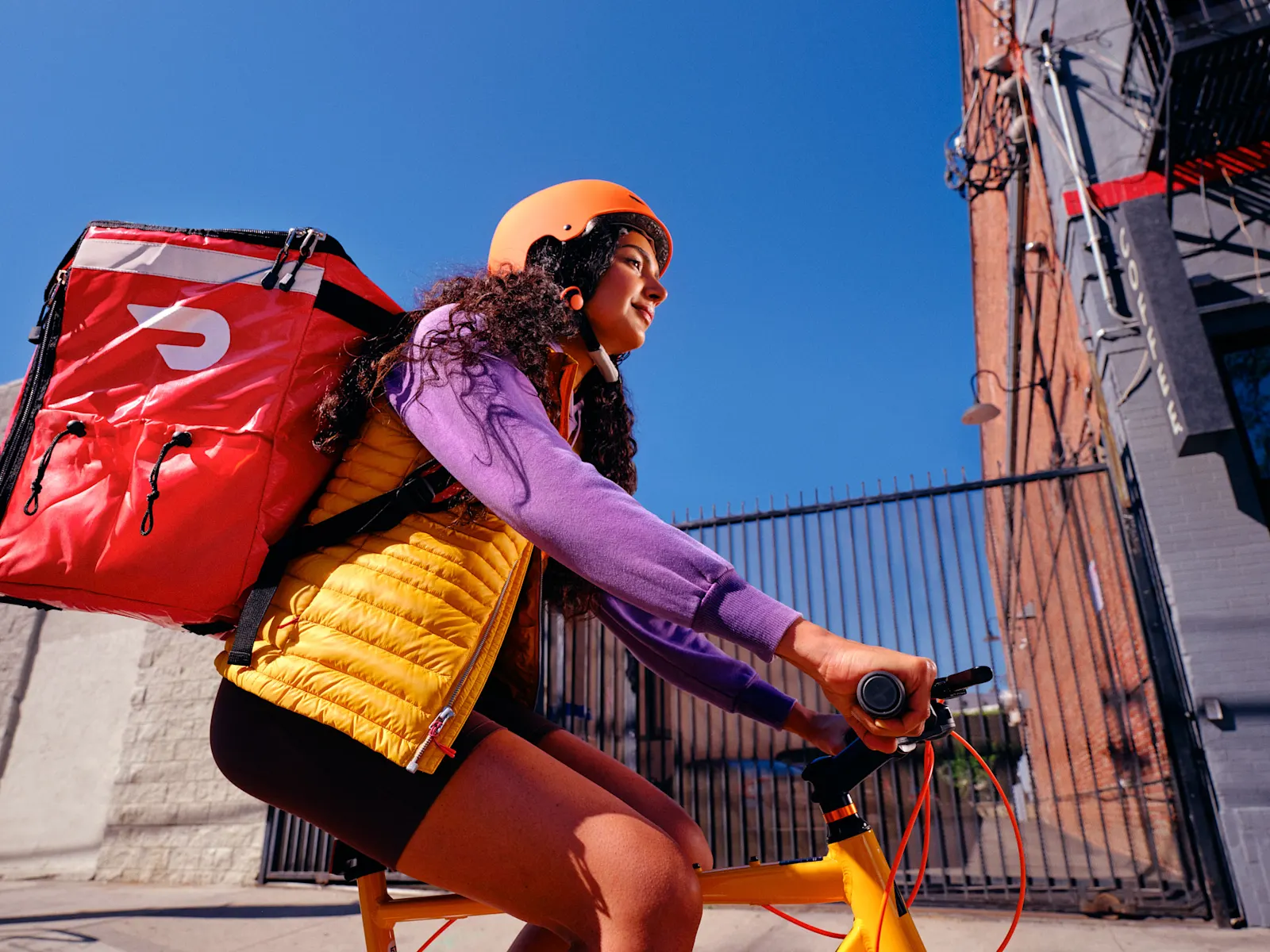
A new report from DoorDash suggests that in a growing number of American and Canadian cities, that assumption is quietly breaking down, and two wheels are stepping in to fill the gap.
DoorDash's 2026 Two-Wheeled Progress Report, released in March, draws on platform data from across the U.S. and Canada to show just how fast bike and e-bike deliveries are scaling, and what that shift means for the people delivering, the businesses being served, and the streets everyone shares.
The Numbers Are Moving Fast
Between 2024 and 2025, deliveries on two-wheeled devices grew nearly four times faster than car-based deliveries across DoorDash's U.S. and Canadian platform. To put that in context, two-wheeled dashing had already tripled between 2022 and 2025.
The Bay Area led the way, in Santa Clara and Sunnyvale, around 75% of all DoorDash deliveries were completed on two wheels in 2025, while San Francisco came in at 72%. Seattle sat at 66%, and even in cities not typically associated with cycling culture, the numbers were climbing. Los Angeles reached 49%, Philadelphia 43%, and Washington DC 54%.
Then there's Houston. A city built entirely around the car, with highway infrastructure stretching in every direction and minimal cycling lanes, and yet roughly one in twelve DoorDash deliveries there was completed on two wheels in 2025. That's not nothing. That's a signal that even in the least obvious markets, something is shifting.
Why It Works
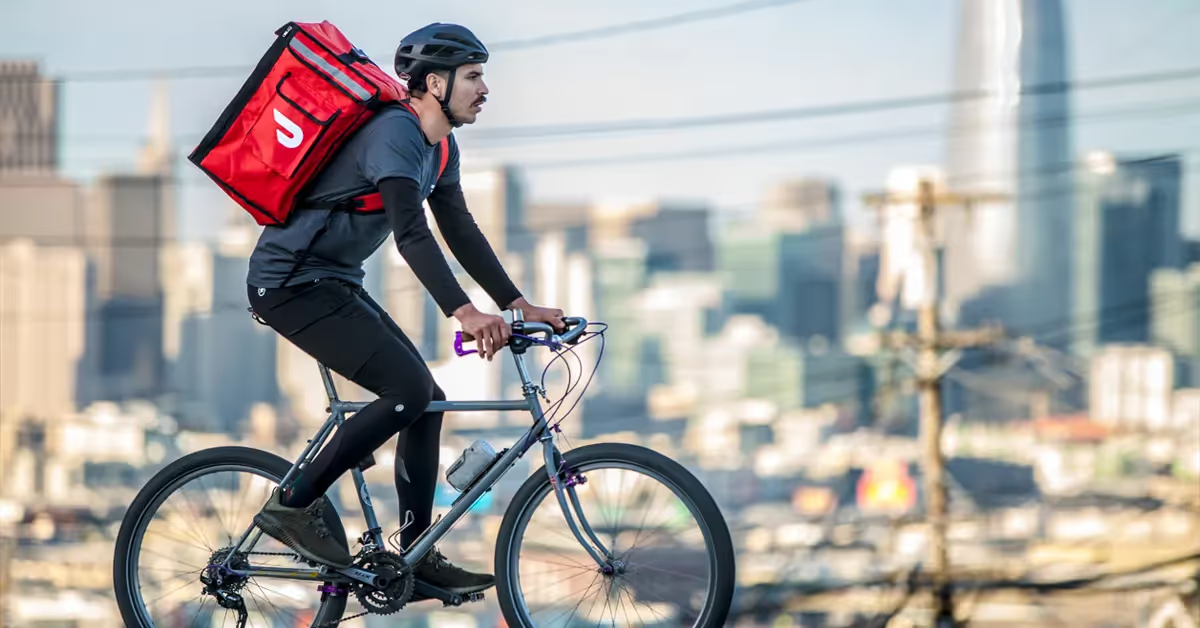
The efficiency argument for two-wheeled delivery is straightforward once you see the data. DoorDash found that riders on bikes and e-bikes spent around 15% less time traveling from order acceptance to store arrival for pickup compared to those in cars, largely because they skip the parking problem entirely. A Dasher on a bike rides up to the restaurant door, grabs the order, and leaves. A car-based Dasher parks, walks in, walks back, and navigates back into traffic, and during peak hours, that sequence can take up several minutes per delivery.
Those minutes compound across a shift. The result, according to DoorDash's data, is that two-wheel Dashers earned, on average, more than 10% more per hour spent on the app than those delivering by car in 2025. In dense city neighbourhoods, two-wheeled trips under 2 miles also moved at least 10% faster than cars, because bikes can take more direct routes, avoid congestion entirely, and park faster at every stop.
For local businesses, this translates directly into orders getting out more reliably and more quickly during the times it matters most, lunch rushes, dinner peaks, and high-traffic weekends.
Removing the Upfront Barrier
One detail in the report looks at a DoorDash partnership with Whizz, which launched in Chicago in March 2025 and has since expanded to Philadelphia, San Francisco, and Washington, D.C. Whizz offers flexible e-bike rentals and maintenance support for delivery workers, specifically targeting people for whom purchasing a bike outright isn't financially feasible and for whom uncertified or poorly maintained equipment poses a real safety risk.
Since the pilot launched in Chicago's downtown area, the share of deliveries completed on two wheels there increased by nearly 10% points, and more than 150 car-based Dashers switched to completing deliveries by bike. Fewer cars hunting for curb space, less double-parking, less congestion pressure in a neighborhood that already had plenty. The model doesn't require infrastructure changes or government funding, just a lower barrier to access for workers who want to ride but can't absorb the upfront cost.
Streets Are the Variable
The most instructive part of the DoorDash data is the correlation between a city's bike infrastructure and its share of two-wheeled deliveries.
DoorDash compared its delivery data against the PeopleForBikes City Ratings, a well-established annual assessment that scores cities on the quality and connectivity of their cycling networks, the safety of their streets for riders, and the strength of local policies supporting cycling. Cities that scored higher on this index consistently showed higher proportions of deliveries completed on two wheels. The relationship isn't a surprise, but seeing it mapped clearly across 20 major cities makes it concrete. Infrastructure isn't a nice-to-have, it's the variable that determines whether this mode of delivery can scale.
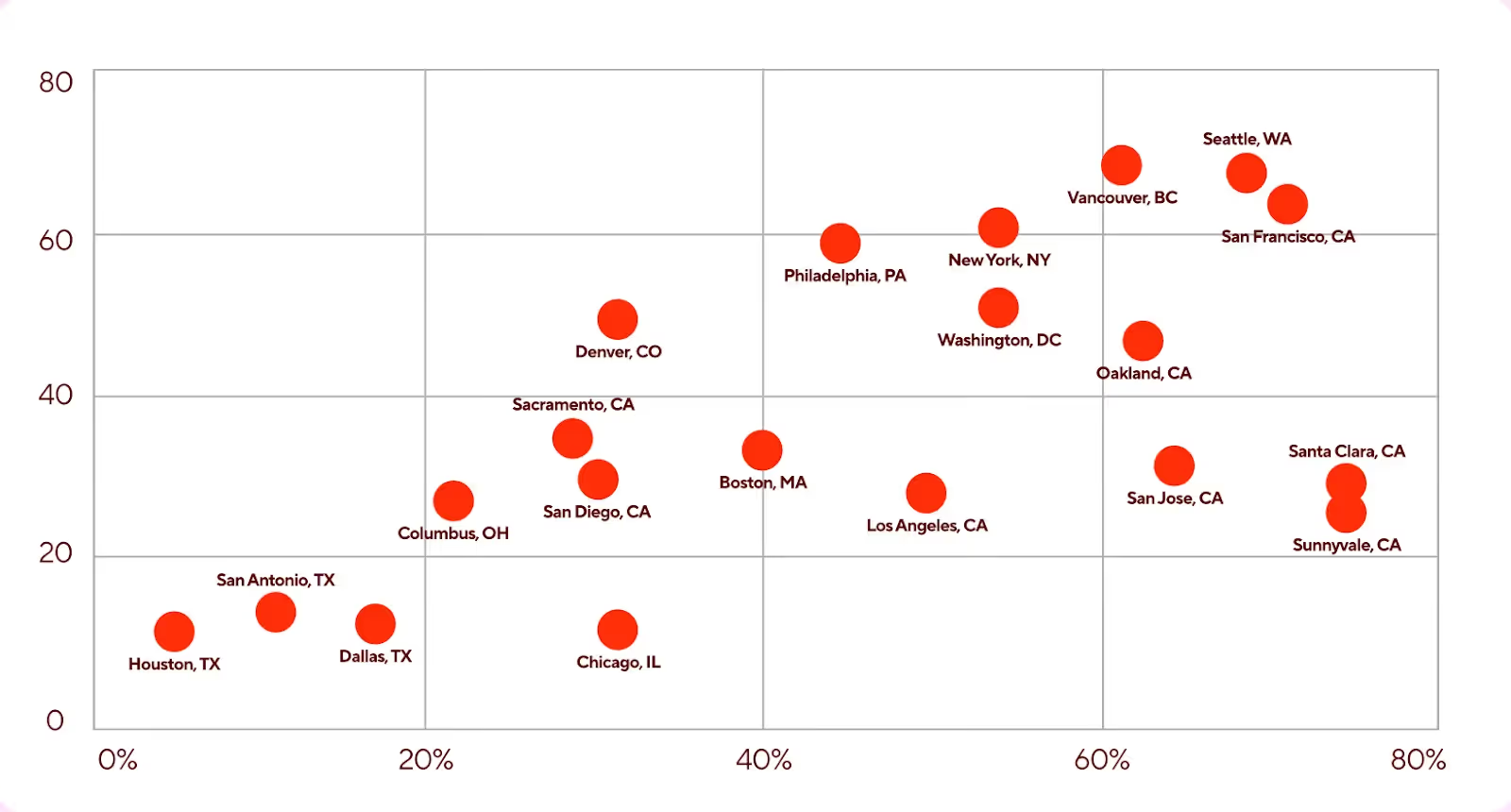
This chart from the DoorDash report shows more deliveries on two wheels in cities with higher bike scores.
This isn't a new case. In 2022, Uber and global engineering firm WSP published a joint report on last-mile delivery across 10 cities worldwide. That report noted that more than 46% of Uber Eats deliveries worldwide were already being completed on two wheels at the time, and that following improvements to cycling infrastructure in Toronto, Uber Eats saw a 40% increase in bike deliveries between 2019 and 2020. The infrastructure came first, and the behavior followed. DoorDash's 2026 data tells the same story, just from a North American vantage point 4 years later.
The Wider Benefits
Beyond the earnings and efficiency numbers, DoorDash points to two broader reasons why cities should care about this shift.
Streets get safer, not more dangerous. A common concern raised by city officials about the rise of delivery bikes is that more two-wheelers on the road means more accidents. The DoorDash data challenges this assumption. The report cross-referenced its delivery data against the Safe Streets Index, a road safety benchmarking report published by StreetLight Data in early 2026. One of the key measures in that index is how safe the roads are relative to the total volume of driving happening on them, essentially, how many crashes occur per mile driven across a city. What DoorDash found is that cities with higher shares of two-wheeled deliveries actually tended to score better on this road safety measure, not worse.
The reason isn't that bikes magically make streets safer. It's that the same kinds of city investments that make cycling viable in the first place - lower speed limits, protected bike lanes, more thoughtful street design, also tend to make roads safer for everyone, whether they're on a bike, in a car, or on foot. Two-wheeled delivery and safer streets correlate because they share the same enabling conditions. As DoorDash puts it, increased two-wheeled deliveries and street safety are not at odds with one another.
The carbon savings are real. Every delivery completed on two wheels is one fewer car trip. In 2025, DoorDash estimates that the vehicle miles traveled by two-wheelers instead of cars across the U.S. and Canada translated into approximately 200k tonnes of carbon dioxide avoided. At the scale of an entire platform operating across hundreds of cities, those numbers start to matter in the context of urban emissions targets.
What cities can do
DoorDash's report is fairly direct about what gets in the way in places where two-wheeled delivery could be doing more. Treating low-speed e-bikes like motorcycles and layering on licensing, registration, or insurance requirements that don't match the actual risk profile, pushes riders back toward cars, which helps nobody. The asks are straightforward: classify vehicles by actual speed rather than appearance, invest in protected and connected cycling infrastructure rather than fragmented lanes that disappear at intersections, and work with delivery platforms directly rather than just issuing blanket restrictions.
The cities generating the biggest numbers, San Jose logged 28.4m two-wheel delivery miles in 2025, New York 45.2m, Los Angeles 38.3m, are places where infrastructure, density, and access came together well enough to make two-wheeled delivery the rational choice for a large share of Dashers. That combination didn't arrive by accident in any of them, and it won't arrive by accident in the cities still sitting at the low end of the range either.
Cover image credits: DoorDash